
Abstract
The article examines A.D. 2044 or Sexmission, an Interactive Fiction and Polish text-based graphical adventure game developed by Roland Pantoła and released by LK Avalon in 1991. This game marks a significant milestone in the early history of Polish game development. The study aims to reconstruct the game’s operating mechanisms and explore how Pantoła navigated the limitations of the 8-bit Atari computer and personal environmental challenges, as a substitute for the technological crises that may come for humanity. It focuses on extending the rare Forth programming language and Pantoła’s proprietary engine. Using a media archaeology perspective, the research references the original floppy disks containing tools and source code. Furthermore, it interprets the game as a political satire reflecting on late-communist Poland’s realities. The work is organized into three main subjects: the tool (Chapter 1), the programmer (Chapter 2), and the creation itself (Chapters 3). This study contributes to the interdisciplinary understanding of computer games’ history and cultural context in Poland.
CCS Concepts: • Human-centered computing → Empirical studies in interaction design.
Keywords: Forth Programming Language, User Interface, Game Engine, Point and Click, Interactive Fiction, Graphical Adventure, Text Adventure, Computer Game, Homebrew Game, Program Development, Atari 8bit Platform, Gamedev in Poland, 80’s, 90’s, Political Satire, Communism and Postcommunism, Disasters or Crises, Media Archeology, Digital Preservation, Retrocomputing, PTODT, UBU Lab
1 THE TOOL - Forth for the End Times
In March 2025, an article titled "The Best Programming Language for the End of the World" was published in Wired 19. It was accompanied by the illustration that portrayed a desolate, likely post-apocalyptic landscape, where a human skeleton operates a vintage computer, programming in the Forth language. This image symbolizes an era of crisis, suggesting that even in our darkest times, we will still rely on computing capabilities, though we may lack the resources to sustain current electronic demands due to their vast energy requirements, complex infrastructures, and diminishing human or financial capital. The question arises whether large organizations, companies or governments, will be able to manage the staggering volumes of digital data and provide the immense computing power we see today? Could reducing humanity’s needs to a fundamental minimum be considered a solution to this problem? Should this consideration encompass both hardware requirements and the programming languages utilized in our interactions with machines? Are we returning to a scenario reminiscent of the early days of the computing revolution, where data is scattered and individual programmers possess the ability to write essential programs from the ground up? Or might we be heading toward a complete collapse of the digital age, that may lead to significant reductions in extravagant programming activities and focusing solely on utilitarian software that efficiently manages critical infrastructure such as solar panel controllers, water dispensers, and medical devices? Digital creators may imaginably come up with a solution to this problem reminiscent of a humorous remark by one of the Polish programmers: "Personally, I solved this problem by drastic means - I create nothing valuable, so I am not afraid of data loss." 12
In times of anticipated global crises, interest in Forth, the nearly forgotten programming language, has resurfaced. Outdated though it may seem, Forth is still used in niche applications due to its efficiency. Developed in an era of limited processing power and memory, yet Forth excels in controlling devices that require simple calculations. It offers low memory consumption and energy usage while being relatively easy to learn compared to assembly or machine code. Moreover, its minimal data storage requirements and straightforward structure make it ideal for situations with limited resources. In Wired, Forth is explicitly acknowledged as the language for the times of crisis. This statement is not merely the author’s speculation as it is based on the real actions of programming enthusiasts who are developing non-commercial operating systems such as Dusk OS and Collapse OS - names that are both suggestive and fitting - for potential periods of technological collapse: "Its primary purpose is to be maximally useful during the first stage of civilizational collapse, that is, when we cannot produce modern computers anymore, but there are still many modern computers around. It does so by aggressively prioritizing simplicity at the cost of unorthodox constraints, while also aiming to make operators happy. (...) It’s difficult to predict post-collapse conditions, but we can suppose that many operators will need to use their machines in novel and creative ways. The hackability of the operating system becomes paramount. Open-source modern operating systems can all be modified to fit their users’ needs, but their complexity limits the likelihood that the user is able to do so. A simpler OS increases this likelihood." 1
We are currently experiencing what is known as the age of polycrisis, characterized by things like pandemics, wars, inflation, energy shortages, and migration challenges. Drawing inspiration from the idea presented in Wired, we should prepare for these upheavals by practicing vintage platform programming or utilizing languages like assembly or Forth as it will help us preserve our understanding of low-level programming and will keep us connected closer to the machines, enabling us to maintain control over them even when managing complex operating systems or advanced software becomes increasingly difficult, as highlighted by Gołda: "Individuals who wanted to write games or utility applications for increasingly newer platforms began using tools more convenient than Forth back in the 1980s. There was a rapid evolution of both hardware and software. On newer generations of personal computers, few people create applications in machine code, assembly, or Forth. These are laborious and risky technologies for developing modern programs for a ‘mass’ audience. However, Forth has many advantages and learning at least its basics is worthwhile as it is said that this language shortens the distance between the hardware and the programmer and allows for exploring the architecture of the device. Whereas in contemporary programming languages, this area is often concealed under many layers of abstraction." 8 Forth’s advantages include its simplicity, allowing quick learning, and the compactness of its programs. Code distribution can occur instantly and offline, a benefit noticed by Forth Dimensions already in 1980 in a specific example: "The distribution of fig-Forth began on May 11, 1979, at the Fourth West Coast Computer Faire. The first installation to be brought up by a user occurred while the Faire was still running! Bob Steinhaus of Lawrence Livermore Lab got the 8080 listing on Saturday at the Faire. His wife read the hex code to him, and he typed it in. By Sunday morning, it was running!" 3
In the Forth language, learning just a small set of basic rules allows for quick program development. Its simple although logical structure differs significantly from popular programming languages, which may present a challenge for those who are used to contemporary programming practices. As the creator of the language, Charles Moore, states: "Forth is a trivial language - once you master it, you’ll gather a set of ‘words’ [to solve your problem] - perhaps a hundred or maybe a thousand. The learning curve is different from that of other languages that require learning syntax - in Forth, you have to learn semantics.” 18 The syntax of Forth is minimal, programmers build applications from the ground up like stacking blocks, using a few basic shapes to create complex structures.
Forth was notable for its ease of transfer between different platforms. However, the fact that programmers can build a custom language or "dictionary" tailored to specific problems can be both an advantage and a trap. The language’s simplicity also encourages the addition of features from other languages, thus creating a custom "kernel" that may break compatibility. Still, if programmers stick to established principles, Forth can remain relatively universal across various platforms and devices. While assembly language and machine code are more efficient, they often require familiarity with multiple systems, complicating their use and transportability. Forth is a very niche language, but it is still used in hobby electronics (projects like Mecrisp-Stellaris, Scamp, My4th, Forth Deck, and many others) 8 as well as in programming experiments, for example, as an inspiration for creating new operating systems and languages for resource-constrained platforms (e.g., the mentioned Wired article on Collapse OS, but also Dusk OS, UXN/Varvara, Konilo/RetroForth) 8. In space, there are presumably still probes and other devices operated by programs in Forth, precisely because of their low resource consumption, which is often a critical and decisive parameter in outer space. The Philae lander of the European Space Agency (ESA) systems were managed by software written in Forth-83, running on circuits RTX2010 8. This lander successfully entered orbit around the nucleus of comet 67P/Churyumov-Gerasimenko in 2014 and was deployed there by the Rosetta probe, marking the first successful landing on a comet in history. Generally, Forth is effective for managing devices with very limited resources, low energy consumption, and unconventional architecture, but as Gołda claims, “it can also be an extraordinary intellectual pastime, something entirely different from contemporary programming. 8-bit microcomputers - like Atari - can still be an interesting platform for such activities.” 8
The Forth programming language was invented in 1968 by Chuck H. Moore. Initially, Forth was used to operate The 36-Foot Telescope in Arizona. By the late 1970s, it was introduced to microcomputers as fig-Forth, a model with portable source code published by the Forth Interest Group, which promoted and taught the language 23. The bulletin of the organization was the magazine Forth Dimensions, published from 1978 to 1999. Among other things, it featured proposals for changes in the language, programming tools in the form of code to be entered (also in fig-Forth), correspondence with readers, and advertisements of companies that produced hardware and software. fig-Forth was published at the turn of the 1970s and 1980s in the public domain, as source code in assembly for several popular architectures 22. The author of many elements of this implementation is William Ragsdale. In the early 1980s, as home computers gained popularity, Forth emerged as a faster and more advanced alternative to the widely used BASIC language. In John Storey’s illustration for the article about Forth, featured in the British magazine Personal Computer World, a car metaphor is used: it depicts a man driving an outdated vehicle labeled "Basic" as he navigates winding mountain roads. Meanwhile, Forth is shown bypassing these obstacles effortlessly, moving well ahead 25. Despite being available on most 8-bit platforms, it never became a true competitor to BASIC. It was not created as a tool for learning programming; rather, it was designed to overcome the limitations of minicomputers, such as long compilation times and variations between different architectures. Forth is primarily a postfix notation (RPN) language using a stack data structure. It includes a “dictionary” for data storage and compiled code, offers basic data types (signed and unsigned numbers, limited-range strings, occasionally floating-point numbers), and can function in interpreter or compiler mode. Forth features concatenative programming, allowing for easy testing, prototyping, and experimentation with simple means. It is even possible to develop assemblers in Forth quickly and easily, as was done many times in the past.
Some versions of Forth, like fig-Forth, functioned as operating systems for creating and testing applications. The public domain “fig” model significantly influenced the language’s popularity in the late 1970s and 1980s, even though many other versions existed. fig-Forth is based on the Forth-78 standard and typically supports “blocks” and “screens” instead of a conventional file system: "The basic version of the language does not support files [to save sources], but ’screens.’ Almost all versions of Forth for 8-bit computers, including Atari, operate this way, providing commands to manage disk space. To a limited extent, this allows for a replacement of DOS, but requires specific handling when trying to transfer code between different computers. (...) ‘Screens’ can be imagined as strings of characters saved on a floppy disk, without line-ending characters, always in a fixed size, and with a specific number of such lines per ’screen’. We can envision this mechanism as digital ’grid sheets’ or as punched cards from the ’distant ages’ of computerization.” 8
The language modifiability is an advantage and a pitfall at the same time. While basic commands are written in the assembly language, the higher-level code is in Forth. The compiled application mainly consists of jump instructions to existing commands. The minimal syntax results in poorly readable code, necessitating adherence to rules and comments for understanding stack operations. Analyzing complex logic requires a non-intuitive approach, similar to how Forth processes programs, and lacks many familiar conveniences from other languages 6. The “block” and “screen” mechanisms from the early versions of Forth, mentioned above, enabled users to treat disk space as a "blank sheet" where they could compose code, write arbitrary texts (like a doomsday diary?), store binary data (interpreted by specific Forth "words"), or combine these functions based on their needs and creativity. This versatility provides features akin to hypertextuality.
2 THE ARTIST - Programmer in Times of Crisis
This article, based on the idea from Wired, discusses the environmental and technical crisis that inspired a single game creator to develop an interactive entertainment using a specific programming language. It highlights the programmer’s journey of learning to code in 1980s Poland, under the communist rule - a stark contrast to the prosperity of the West. This era, marked by martial law and repression, is satirically depicted in the author’s work. The article also reveals previously unpublished insights from members of PTODT[^1] and Ubu Lab[^2], addressing the lack of literature about influential figures in Polish gamedev like Pantoła.
Roland Pantoła who was born in 1958 in the town of Pilszcz in southern Poland, is the hero of this article and a real example of utilizing the potential of the Forth programming language under challenging conditions. It was in this language that the author, an electronics graduate and a craftsman specializing in producing pine furniture, a self-taught programmer, and at that time a father of four, would write one of the most crucial interactive games created in Polish, namely A.D. 2044 or Sexmission (released in 1991 by a small publisher Laboratorium Komputerowe Avalon), and later two more - that would also achieve market success and would be remembered as important for Polish culture. In a conversation years later, he would mention that the first game was developed in extreme conditions. The author worked on it for nine months, spending most of that time being employed as a warehouseman. In the morning, he would distribute tools and materials, in the evening, he would collect them, and during the day, when there was little activity, he programmed with a pen in a notebook, as he could not bring his monitor, computer, and tape recorder to work. Only after returning home from work, would he shortly test his ideas and algorithms on real hardware, specifically the Atari 800XL, which he purchased with his earnings in 1987 14. Why the 8-bit Atari? In the 1980s, Atari was the most popular computer platform in Poland, due to its sale in state-controlled stores, which provided buyers with a warranty and service, unlike purchases from other sources. It was on this 8-bit platform that Poles, falling behind by more than a decade compared to capitalist countries, began to create a local game development industry. The game by Pantoła would later become an important part of this process, one of the milestones of digital entertainment, on which an entire generation of Polish players grew up.
The author started programming with Atari BASIC, which was built into the computer he owned. Later, he used its enhanced version on Atari called Turbo BASIC XL 14. He managed to create several games, the complexity of which increased with experience. Master Mind, Jungle, Gabi, Kvadryk, Bongo are works from 1988-1990 that share a common denominator - these are games with a predominately logical component, these are puzzles for the player, which the author explains as follows: "Even in elementary school, I designed board games - so during such attempts, I developed my own methodologies - primarily the ability to create various logical relationships - this is something I learned back then that greatly helped me in creating computer games.” 14 Pantoła not only programmed them but also prepared the graphics, which were aesthetically pleasing. His education at an art high school and his experience in furniture making surely influenced this: "I also had higher education in electronics, as I mentioned earlier, studying at the Silesian University of Technology I became acquainted with programming and how computers generally worked, which was also very useful later on. On the other hand, since I finished an arts secondary school before going to university, I already had both technical and artistic skills at that time. I wondered what I could do by combining such skills, and it turned out that creating games would be the perfect direction. Having all those skills, I could create games independently. Some programmers needed to hire graphic designers; meanwhile, I was able to manage both programming and graphic creation on my own." 14
Pantoła was attempting to attract companies that produced games for Atari to his game creations. In Poland, there were only a few such companies, and the largest one employed only a small number of people. This was mainly due to the economy being newly market-oriented, which only recently allowed for the establishment of private companies. However, the first and largest at the time, mentioned before, LK Avalon, rejected the offer to distribute his games because they were “too slow” and challenging, and the most advanced and recent one, Bongo, had overly complicated rules 9. Spektra, another small company, agreed to publish games Gabi and Kvadryk, but it lacked the sales capabilities of LK Avalon, which resulted in limited profits for the author. There was no way to speed up these games, as he reached the limits of what Basic could do, even when compiled, and the games occupied all the available memory. Therefore, he abandoned this path and planned to move away from logic games, as more of them were appearing on the market, and he created an adventure game that did not require as much dynamism as action games. For this purpose, he was considering switching to a programming language other than Basic, which would not limit him as much in developing the game’s storyline and graphics: "However, when I came up with the idea of creating an adventure game, I already knew that this language would not be good, because it was too slow and took up too much space in the computer’s memory and external storage. So I was left with the choice of either assembler, which I didn’t know at the time, and I didn’t know they had Quick Assembler in LK Avalon, which was pretty good, I heard. So, I was looking for the right language for myself. One day, I read about the Forth language, which was memory efficient, the feature that was important for adventure games, especially with a lot of graphics. Everyone used text mode, but I wanted to create adventure games in graphics mode." 14
Pantoła found himself in a situation where he lacked not only the necessary technology and ready-made language solutions but also access to basic literature. While perusing the national computer magazine Bajtek, he discovered information about a bookstore in Katowice that was established by students. He found the Forth for Atari textbook there, the only one in Polish: "It was a grassroots movement; the state did not provide support, so people began to help one another. They started printing various computer books at that time, although some with poor-quality content. Nonetheless, these books existed and were accessible - (...) I decided to visit the bookstore to see if I could find some valuable resources. (..)I passed by that book titled ’Poznajemy Forth’ by Jan Ruszczyc several times, but ultimately, I decided to buy it and that turned out to be a good decision. I needed to obtain a compiler, and I think I was able to find one on the black market - people often didn’t realize the value of what they had there." 14 At that time, copyright laws for software were not a significant concern in Poland; they were largely ignored, and there were no distributors of foreign programs until around 1992. This gap was filled by venues such as black markets and "computer studios" where individuals could purchase pirated and unlicensed software from around the world. The software typically came as files without any accompanying documentation or seller support. The same situation applied to the Forth compiler acquired by Pantoła.
Despite limited resources, he taught himself to program in Forth using a low-quality book and a very limited time he had for programming. He relied on an Atari tape recorder for data storage, the one device which was affordable in socialist countries, costing around 48 dollars, about the average monthly salary in Poland. To achieve his artistic vision, he learned most things from scratch and created the necessary tools himself: "This language did not work well with the cassette system (...), so the first thing I did was to write the [proper] tape recorder’s operation in that very language." 14 Pantoła is still very proud of the expansion of Forth to support the Atari tape recorder, which allowed him to record sources on tape: "I got to know the first things in this language with a recorder; I learned, and I made various attempts.” 14 However, while his earlier productions in Turbo Basic XL could relatively easily be created using a tape recorder, working with fig-Forth was definitely not convenient with this particular device. Programs had to be saved on tape in compiled form, as a complete bootable Forth with new "words," without comments and without a readable code structure. Such code could be compiled, modified, and the entire Forth saved back to tape, but it was very slow and inefficient, practically unsuitable for writing larger programs, which the author mentioned: “The first things I did were also done with the tape recorder, but it was a nightmare – it froze on me so many times..." 14
The next step in the development of the author software was the purchase of a disk drive: "It was a leap; everything loaded quickly - in an instant! (...) Only when I had the disk drive did writing in Forth become easier. Actually, it made sense at that time.” 14 Christopher Carson, a member of the Seattle Puget Sound Atari Computer Enthusiasts (S.P.A.C.E.), indirectly helped to finance the purchase of a disk drive for Pantoła (the cost was twice the price of the computer). Pantoła discovered Atari clubs in the U.S. through the Polish magazine Bajtek, which published several contacts 4. These clubs promoted knowledge sharing, provided support, and published newsletters. Pantoła, who lived in a small town and was unaware of any similar clubs in Poland, wrote a letter to the U.S. and shared a demo of his games with Carson. Carson expressed interest in purchasing the software and distributing Pantoła’s games, after translation into English, as shareware. Carson believed that supporting Polish programmers was a way to combat communism 11: "November 1992, Trans World Exchange announces several new games for the Atari XL/XE from Poland. Thanks to the collapse of Communist domination, free enterprise flowers anew in Eastern Europe. 50% of the computers in use in Poland are Atari 8-bit! Yes, Europe is the place for software of Nintendo quality for your Atari! Be sure and get a copy of these games by Roland Pantola, from your Atari club disk library or on a BBS (...) These games are distributed as Shareware to benefit the poor programmers in Poland" 20. The revenue from game sales financed a disk drive, significantly impacting Pantoła’s career in game development.
The disk drive significantly accelerated the game’s development, although Pantoła once again adjusted Forth to his Atari 1050: "Of course, I also had to write support for my disk drive." 9, 14 Pantoła, who initially didn’t realize that Forth wasn’t popular in Poland or globally 26, notes today: "Only Americans used Forth, no one here." 21 The use of the Forth programming language in Atari games was quite limited, with only a few dozen examples available 8, indicating its low popularity. Even Atari, a major player in the computer gaming industry, employed Forth only occasionally and primarily for debugging arcade games 8. One of the most notable programs written in Forth was In-House Demonstration Program or Dealer Demo. This program showcased the Atari computer’s capabilities and was displayed on monitors connected to Atari systems in stores, running in a continuous loop. One of the authors, Mike Albaugh, argued that the complexity of the demonstration led to the choice of Forth 13. Forth facilitated a quick transition to a higher level of abstraction; once basic commands (also in assembly language) were established, the programmer could concentrate on the higher level of programming. This approach necessitated a precise definition of the task and its decomposition, allowing for easy development "from the bottom up" to create more advanced software 10.
Pantoła had access to the version of Forth that was a pirated copy of APX Extended fig-FORTH. A more widely used version for the Atari was valForth, known for its extensive range of paid modules that were useful for game development. In contrast, APX fig-FORTH lacked these add-ons, so Pantoła added the necessary elements himself: "Forth gained from the fact that a large number of small procedures were being created. The language was expanded with new instructions, and I was developing my own language." 21 Forth supported interactive testing of code and provided immediate error feedback. If a crash occurred, it quickly returned to the user’s toolkit, streamlining the process of editing, compiling, running, and testing code. This efficiency was particularly beneficial for creative programmers.
Using this version of Forth helped to avoid legal issues with game production. Other Forth versions often included disclaimers about legal requirements, such as removing options for retrieving the Forth core, that could let unauthorized users access core functionality. From a legal perspective, most software in Poland was generally developed using pirated development tools. Roland Pantoła faced an ethical dilemma, lacking good models to follow. The Forth book he owned provided no guidance, and the pirated software he used had no publisher or licensing details, only displayed a "fig-Forth 1.1" screen message. Later, by 1992, when he had become a well-known figure in Polish game development and began publishing a multi-part course on learning Forth in the Polish magazine Tajemnice Atari (Secrets of Atari), he advocated that Forth should be legally released in Poland 17. However, this was not realistic, as Atari had stopped selling the APX software series many years earlier, around 1984. Displaying respect for legal standards, he altered the commands in the released games, also as a security measure, making it impossible to recover the environment from those games. This practice aligned with the typical demands of language publishers, as well as the expectations of game publishers. What is interesting in that, he also felt no need to use any of the libraries or add-ons specific to APX Forth, mostly relying on two elements (“core” and “Ragsdale assembler”) which were nearly identical to the sources published in the public domain for the 6502 microprocessor.
Most advanced versions of fig-Forth for the 8-bit Atari included not only a basic line editor, allowing editing one line of text at a time, but also a full-screen editor. These editors often operated with unclear commands and featured different editing modes, which made it necessary for users to consult the documentation frequently 8. To simplify his work, Pantoła decided to create his full-screen editor: “I also had to write my own editor for this language because the original was not suitable for writing games – it was a line editor, the worst kind of junk. (...) Once, I even read in a foreign magazine that someone wrote about the Forth language, saying it was interesting, but there was no editor; however, he learned that Roland Pantoła from Poland wrote a full-screen editor for that language, which was good and fast – I thought, even in the West they appreciated me, that was nice. That person only mentioned that there was a lack of documentation for that editor, but who thought about documentation back then? I wrote that editor for myself, to be able to work comfortably and to create games." 14 Pantoła’s EDYTOR-FORTH utilized vertical scrolling to display the whole “screen” and featured efficient text buffer management for organizing multiple lines of code. It didn’t allow moving between “screens” or saving; users had to exit the editor to test and save changes 8.
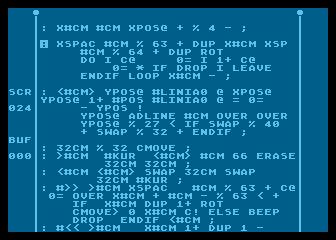
Forth programming environment and the adventure game engine, along with its scenario set in A.D. 2044, were developed by Pantoła over a period of nine months 10. The second game, Klątwa (The Curse), was created by Pantoła in about four to five months, while the third game, Władcy Ciemności (The Lords of Darkness), was completed even faster: "Everyone had to write their own engine, and it needed to have a very good understanding of the computer’s hardware architecture. I built such an engine while creating the game A.D. 2044, which is a creative adaptation of the Sexmission movie. As a result, by continuously developing this language, I was able to create these three games, which were released by Avalon. I spent a total of nine months developing the first game in Forth. After that, it took less time since I had the engine." 14 After A.D. 2044, the engine was modified for modular graphic construction, allowing the next two games to use pre-made elements for scenes. In A.D. 2044, room views were designed as a single image with additional frames for close-ups. Later, Pantoła successfully adapted his games for the Commodore 64 platform by using the same Forth source code 9. He received some assistance from a specialist in this computer, Janusz Dąbrowski, who implemented the sound procedures and graphic displays appropriate for the platform 24. This achievement showcased the universality and portability of Forth since a typical way of porting games between even similar platforms, like Atari and Commodore, was to rewrite most of the assembler code.
The game was designed to run from floppy disk, as this was a common requirement for complex games featuring extensive graphics that could not all fit into memory at once. The images were loaded in small segments from the disk, depending on the player’s location in the game. However, the publisher, LK Avalon, realistically evaluated the local market conditions. They noted that, in Poland, most consumers of games for 8-bit Atari computers had cassette recorders as their only storage devices. Therefore, releasing a version exclusively for floppy disks would not be economically acceptable 9, as Pantoła mentioned: "When creating A.D. 2044, I had the concept that it would only be a game on 5.25” diskettes, but when I presented the game at Avalon, they told me that the main market was tapes. I replied that it wouldn’t make sense, as it would take hours to load. They countered that it didn’t matter because the highest sales came from games released on tapes – disk drives were twice as expensive as Atari computers. So, I had to add support so that graphics could be loaded from the tape – I wrote a subsystem that supported this. At one point, the player would need to write down the counter on a piece of paper, and then they would receive instructions to fast forward or rewind, loading individual elements of the game, such as moving between different rooms.”14 The game was released on floppy disk, as initially designed, and in cassette format at the publisher’s request. The cassette version is less detailed, missing two locations, and is read in seven segments[21]. Despite the creator’s fears, the cassette version was well received: "As it turned out later, most of the people I talked to played A.D. 2044 from a tape recorder, to which I said, ’And you were willing to wait so many hours?’ They replied that yes, they waited because the game was excellent. However, people seemed to have more patience back then than they do now. They often mentioned that they had a great childhood because they met with friends at weekends to play the game and solve puzzles." 14 Thanks to the perseverance and talent, solitary visionary Pantoła managed to create his extension of Forth, developing an innovative engine for adventure games that was not just a one-time code but was also used in subsequent games on two different platforms, as well as a comprehensive environment that supports the game development process (such as music converters, graphics compressors).
3 THE CREATION - a comic vision of disaster from the year 2044
The game was released in December 1991 by a small Polish company, LK Avalon, that had been founded just two years earlier, following the fall of communism in Poland, which allowed for the establishment of private businesses. Initially, the game was intended to be a direct reference to the popular iconic film Sexmission, directed by Juliusz Machulski in 1983, and its title was inspired by the film’s name. Sexmission is a science-fiction comedy that also incorporates elements of political satire on communism. The film was a huge success in Poland and less so internationally, gaining popularity in East Germany and the Soviet Union. Notably, Mikhail Gorbachev enjoyed the film during a visit to a cinema in Poland, which helped facilitate its screening in the USSR, where it was censored and retitled ’The New Amazons’ 2. The game publisher, who was more aware of the potential legal issues with the identical title than its author, advocated for a change to A.D. 2044, so that the new title had no connection to the movie title and it referred to the year in which both the film and the game events are set. Consequently, only the first part of the name appears on the product cover and all printed materials, except the title screen in the game, include both names - A.D. 2044 and Sexmission. The author insisted on the publisher keeping the second part because he had put significant effort into designing the graphic for the title, which he felt looked great. Most players used the second name only because it was easier to pronounce and more closely associated with the game’s theme. Ultimately, there were no legal issues with the Atari version, primarily because, in the early 1990s in Poland, right after the fall of communism, the computer games industry was small and not taken seriously. At that time, there was no practice of suing for intellectual property infringements in this field. As the author recalls, “games were not seen as an art, but simple entertainment for the masses." 21 The enhanced remake of the game, released in 1996 for Windows on CD-ROM, attracted the favorable attention of the film’s director. As a result, LK Avalon entered into an agreement with him to pay a small royalty 21.
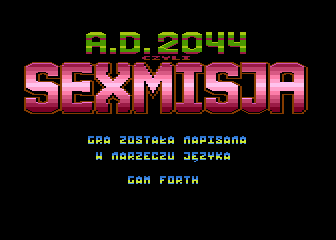
It is worth noting that although the game is not a faithful adaptation of the film, nor a precise rendering of its plot, the script does include references to the storyline, specific characters, locations, or scenes. It is therefore difficult for the viewer of the film or the player not to notice the obvious reference. As a reviewer of the game wrote in the Tajemnice Atari: "It was created under the influence of the author’s fascination with an excellent film. Of course, we are dealing with a very successful and skillful adaptation of the film’s themes, which have been tailored to provide wonderful entertainment for players of both younger and slightly older ages. (...) Familiarity with the film can significantly ease the gameplay; however, those who have not seen it will certainly also be able to complete the challenging mission(...)”.16 The story is set in a post-apocalyptic world, after the use of a biological weapon during the war that only women survived. The weapon meant to temporarily disable male genes malfunctioned and it wiped out all men. Blaming men for the devastation, women established a totalitarian society with a pervasive animosity toward men with features reminiscent of communist regimes, including newspeak and mandatory military drills. Historical contributions by men were minimized or distorted. Due to the Earth’s contamination, women lived underground and used a scientific method of parthenogenesis to give birth to girls, ensuring the survival of their society.
In the film, two men (in the game - a single player) accidentally enter the women’s world, being discovered by women in forgotten hibernation chambers. The chambers are a remnant of a hibernation experiment that began before the aforementioned war. The thawed men are proof of the experiment’s success, but there is no longer a world where men are needed. For women, they are merely subjects of a historical research, treated as curiosities, merely intriguing archaeological artifacts from the past. They pose a threat to the matriarchy if they wish to reproduce, which is why they must undergo a surgery - gender correction from male to female. The film’s protagonists refuse to submit to this, fleeing from women, which is accompanied by a series of plot-related gags. Ultimately, they discover that the surface of the Earth is not polluted, that the woman leading the community is a man hiding in fear, disguised as a woman, and the maintenance of the community underground and the rules that prevail there serve solely to exert total control over women. In the end, both men inject their own semen into samples in laboratories, causing the fertilization of many cells prepared for the process of parthenogenesis and thus recreating the male population shortly.
In the 1990s in Poland, the film and the game were both perceived as a political satire, primarily a critique of communism. The game, however, was not read as an attack on the matriarchy or as mocking or criticizing feminist ideas. Such voices have only been raised in Poland recently 15. However, after the game was released for Windows in 1996, when LK Avalon spoke with Electronic Arts about releasing it in the American market, the representatives from the USA stated that, despite its good humor, the plot was too "regional" and declined distribution.
The protagonist of the game on the 8-bit Atari platform is a man through whose eyes the player views the world - the various static locations in the game are observed from the first-person perspective (FPP). At the beginning, the player learns that the storyline is similar to that of the movie: “In the heyday of the communist system, a group of scientists conducted a notorious experiment. They sent a sample of society from the welfare state to future generations. The computer selected you. Upon awakening, you realized that as the only man, you had survived in hibernation until the year 2044, and this is when your real problem begins...”5 The goal of the game is to escape from the captive room and solve puzzles to access new areas, ultimately reaching the genetic lab to restore the male gender to the world.
A.D. 2044 falls within the broad genre of Interactive Fiction. It is a graphic point-and-click adventure game inspired by another Polish traditional text-based adventure game featuring graphic screens 7 - the Polish game Mózgprocesor[9, 14], which was first released on the ZX Spectrum platform in 1989 and later on the Atari in 1991. At the time of its release, Mózgprocesor was considered the best and the most sophisticated Polish text adventure game. Pantoła believed that creating a static game, which relies primarily on the storyline and puzzle solving, enhanced with graphics, would be easier than developing a game that requires a high level of dynamic elements, such as action or arcade games. However, he was not satisfied with the dated user interface for player-program communication. In traditional text-based games, players type commands, and the parser responds with changes on the screen. Pantoła sought to simplify this by allowing players to interact directly with elements on the screen, eliminating the need for syntax and command typing. He replaced keyboard input with joystick control to move the cursor on the screen, and used a program that responded when the cursor entered specific areas. When Pantoła released his game, it became the first of the kind for 8-bit platforms in Poland, marking a significant achievement in the industry. It should be noted that at the time this game was developed, the term "point-and-click" was not yet commonly used to describe this genre, both in Poland and globally. In fact, it was sometimes referred to as a "text game" due to its heavy reliance on text and illustrative graphics, similar to other games in that genre: "Attention to detail, a sense of humor, and reading skills are required here - A.D. 2044 is a text game. One of its undeniable merits is the extremely funny commentary on many of the actions performed by the player.” 16 The term "point-and-click" originally described the type of user interface in software in which users interacted with computers by using a mouse to control the cursor and perform actions by clicking. This terminology began to be used in discussions about games in the late 1980s and early 1990s as mouse-driven games gained popularity alongside graphical user interface (GUI) systems. Over time, the term "point-and-click" became specifically associated with adventure games, where clicking on screen elements was crucial to gameplay, and it eventually went out of use for general mouse interactions, as other input devices could also be used to control the cursor.
Such is the case with A.D. 2044, where the control of the cursor on the screen is done via a joystick, yet it operates smoothly. Paradoxically, this user-friendly and fast game interface owes its effectiveness to the limitations of the 8-bit platform, as the author innovatively utilized its limited resources. The 8-bit Atari did not typically come with a mouse which only appeared with the next generation of computers. First, the joystick points to a location on the screen, and by clicking the “fire” button, the program instantly shifts the cursor to the appropriate context, to the right place on the screen, for example with additional option selections or with possibility to move to the next part of the game. The player does not need to waste time to manually move the cursor from one point to another, especially when these points are located further apart on the screen. The huge reduction in the time the player spends on unproductive cursor movement, results in the increased enjoyment of the game. A different approach was used in younger sixteen-bit computers, where the basic equipment of platforms such as Atari ST, Amiga, Mac, and PC included a high-resolution screen, a fast processor allowing for a quick and smooth cursor movement across the screen, as well as sufficient memory to handle many events arising from user interaction with the game. The point-and-click game B.A.T., released on various sixteen-bit platforms between 1989 and 1991, has the most similar interface to A.D. 2044 where clicking triggers a jump to the pull-up menu containing only activities available to the player. For example, on the Atari ST platform, it occupies three floppy disks of 800 KB each, requires a computer with 512 KB of RAM, and a sixteen-bit Motorola processor running at 8 MHz. In contrast, Pantoła’s game must suffice with a computer dozens of times slower, featuring an 8-bit MOS 6502 processor at 1.77 MHz, with eight times less memory of 64 KB RAM, fitting on a floppy disk with a capacity of 260 KB.
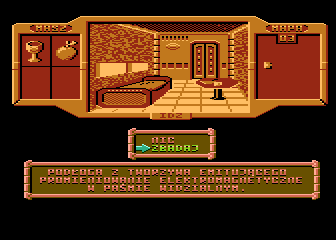
On the screen, there is a room where the player is located, along with an inventory on the left side and a map on the right. Using the joystick and the action button, a menu with interaction options for the selected object can be displayed. The game often shows close-ups of objects, such as drawers and cabinets, in a separate, small window. The button below the first-person view allows movement in any direction where an exit is present. At the same time, a player can carry a maximum of four items, which can only be placed in specific locations. The player must also regularly eat meals or he will die of starvation and the game will end.
The game often references jokes that may fully be understood only by the audience raised in Polish culture, particularly during the period of the communist regime from 1945 to 1988. Much like the film, the game serves as a satirical work portraying the Polish People’s Republic (PRL), which is evident through various linguistic references. They appear in the game in the form of regime slogans which may sound familiar to Poles (such as "recycled materials are the property of the entire society"), parodies of commonly used phrases ("long live the First Secretary"), or references to situations from popular Polish series ("dry bread for the horse" is a gag from the series Wojna Domowa (Domestic War) [1965]). Additionally, there are items in the game that are strongly associated by Poles with the communist era (Sport cigarettes, a work jacket, party membership card, insect repellent, a work apron resembling a uniform with ear-flap hat, Alberciki cookies), as well as such locations (MO - militia station, Wanda Wasilewska Genetic Center). This localization, new for Polish players accustomed to English-language games, has become a recipe for the market success of the game in Poland, but at the same time, it created a barrier to a success abroad. People outside the Iron Curtain would need explanations for almost every joke, its context, and meaning. This was later confirmed when Electronic Arts deemed the storyline of A.D. 2044 too localized for a Western release of the game on Windows. In the next two Atari games written in Forth, Pantoła continued to incorporate elements of localization, with references to Poland’s social and political situation still present. However, he significantly reduced the localized content, making the games broadly accessible to players outside of Poland, apart from a few exceptions in the script. His second game in Forth was released in English, but it failed to achieve significant success, as by 1992, the market for Atari 8-bit games in the West had practically disappeared.
This article presents findings from media archeological research conducted at the UBU Lab at Jagiellonian University and by the Polish Society for the Protection of Technical Heritage (PTODT ). It explores platform aspects of local digital culture, focusing on the canonical and unconventional works associated with platforms like the Atari 8-bit with the solitary work of Pantoła highlighted in this context. The PTODT also documents preservation techniques from the past, exemplified by the reissue of a key Polish book on Forth for Atari[8] and extensive research on Pantoła’s floppy disks 10.
The research conducted within these projects has an archaeological dimension in the media context and represents an attempt to understand platforms better. Studies of platforms involve a comprehensive understanding of both the hardware and software, as well as their cultural context. This is particularly significant in the context of Polish Atari, which during the years when global interactive entertainment was developing on newer platforms, and in an environment of tools such as Storyspace and Hypercard, saw the emergence of key works of interactive entertainment on 8-bit computers in Poland, such as previously mentioned Mózgprocesor on ZX Spectrum and the A.D. 2044 on Atari. These productions laid the foundation for the development of game creation in Poland, despite a significant delay compared to global trends. The work of Pantoła, created in a language that was then rare and difficult to master, is a valuable contribution to the history of Atari and Forth.
Roland Pantoła offered PTODT his collection of several dozen floppy disks that he had discovered in his home woodshop - floppies containing Forth tools, source code, and other materials from the Atari era. In December 2024, Jerzy Kut from PTODT received forty-nine disks, most of which were double-sided. Most of these disks contained original, previously unpublished content, including Pantoła’s Forth environment. Dr. Bartosz Trybus undertook a lengthy and challenging process to archive the content into a digital format. Fortunately, the most valuable materials were undamaged, as the disks had been carefully stored, and the archiving was conducted thoroughly and professionally. The author has agreed to publish his works. Bartosz Gołda from PTODT, who specializes in analysis, repair, and digital preservation, made the content publicly on GitHub[^3]. The code may be challenging to read, even for those experienced in assembly or C or those knowing general concepts of Forth, as Pantoła used very short names to minimize memory usage. Luckily, his code is documented in the most complex segments. Many elements are low-level, written in assembly. An example of a short code snippet from the game A.D. 2044 in fig-Forth looks as follows:
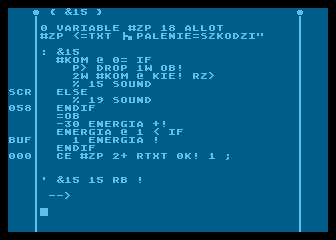
This is the algorithm’s logic that occurs at the start of the game, after a cigarette is lit, informing players about the dangers of addiction. Access to the next room is granted by deducting 30 energy points, but it won’t drop here below one point. The code also refreshes graphics and triggers sound effects.
The analysis of Roland Pantoła’s A.D. 2044 provides valuable insights into programming, culture, and history during Poland’s late-communist and post-communist periods. Created using the Forth programming language, the game functions as entertainment and a cultural artifact that reflects its socio-political context. Pantoła’s work showcases the resilience of creativity in the face of adversity, illustrating how programming can be a medium for personal and political expression. By examining these digital narratives, we can appreciate their artistic contributions and understand their relevance to contemporary society.
This research was funded by „National Science Centre, Poland” [Grant 2022/45/B/HS2/01605]. For the purpose of Open Access, the authors have applied a CC-BY public copyright licence to any Author Accepted Manuscript (AAM) version arising from this submission.
[^1]: https://ptodt.org.pl/
[^2]: https://ubulab.edu.pl/
[^3]: https://github.com/ptodt/gam-forth
References
Dusk OS [n. d.]. Dusk OS. Dusk OS. Retrieved May 1, 2025 from https://duskos.org/
ANTIC The Atari 8-bit Podcast [n. d.]. Seksmisja Ciekawostki. ANTIC The Atari 8-bit Podcast. Retrieved May 1, 2025 from https://www.filmweb.pl/film/Seksmisja-1983-1163/trivia
Stackosaurus.com [n. d.]. Stackosaurus Forth Interest Group Forth, "fig-FORTH". Stackosaurus.com. Retrieved May 1, 2025 from http://www.stackosaurus.com/figforth.html
1988. Kluby Atari w USA. Bajtek Tylko o Atari 2 (1988), 23 pages.
1992. A.D. 2044. game manual.
Leo Brody. 2004. Thinking Forth A Language and Philosophy for Solving Problems. Leo Brodie. https://www.forth.com/wp-content/uploads/2018/11/thinking-forth-color.pdf
Piotr Marecki et al. 2018. Gatunki cyfrowe. Instrukcja obsługi. Wydawnictwo Uniwersytetu Jagiellońskiego, Kraków. https://wuj.pl/ksiazka/gatunki-cyfrowe
Bartosz Gołda. 2024. Więcej o FORTH na Atari. In Poznajemy Forth. Retronics Publishing, Magdalenka, 169–232.
Bartosz Gołda. 2024. Wywiad z Rolandem Pantołą. In Poznajemy Forth. Retronics Publishing, Magdalenka, 234–240.
Bartosz Gołda. 2025. PTODT na tropach Fortha. (2025). Submitted to ‘Grel 4/2025’: accepted, awaiting publication.
Ed Hall. 1993. The Polish Connection: New Software for your Old Computer. Current Notes 13, 1 (1993), 46–47.
Paweł Kalinowski. 2025. Sprawy archiwizacji zasobów. AtariOnline.pl. Retrieved May 1, 2025 from https://atarionline.pl/forum/comments.php?DiscussionID=573
Randy Kindig, Kay Savetz, and Brad Arnold. 2013. ANTIC Episode 6 - The Atari 8-bit Podcast - Xmas & Mike Albaugh. ANTIC The Atari 8-bit Podcast. Retrieved May 1, 2025 from https://ataripodcast.libsyn.com/antic-the-atari-8-bit-podcast-episode-6-xmas-mike-albaugh
Łukasz Klejnberg. 2025. Rozmowa z Rolandem Pantołą. (2025). Submitted to ‘Grel 4/2025’: accepted, awaiting publication.
KME. 2023. Juliusz Machulski o zarzutach wobec "Seksmisji": "Burza w szklance wody". WP Film. Retrieved May 1, 2025 from https://film.wp.pl/juliusz-machulski-o-zarzutach-wobec-seksmisji-burza-w-szklance-wody-6898384727345920a
LK Avalon 1991. Recenzja: Saper i A.D. 2044. Tajemnice Atari 8 (1991), 29 pages.
LK Avalon 1992. Forth. Tajemnice Atari 1 (1992), 8–9 pages.
Charles Moore. 2025. Chat with Chuck 2024", Chuck Moore celebrates our 50th FORTH2020 ZOOM. YouTube. Retrieved May 1, 2025 from https://www.youtube.com/watch?v=2DROiNV9Obc
Tifanny Ng. 2025. The Best Programming Language for the End of the World. Wired.com. Retrieved May 1, 2025 from https://www.wired.com/story/forth-collapse-os-apocalypse-programming-language/
O.H.A.U.G. 1993. Ye olde Editor PRESS RELEASE. Old Hackers Atari User Group Newsletter 11, 02 (1993).
Roland Pantoła. 2022. ROLAND PANTOŁA - wywiad - LOST PARTY 2020. YouTube. Retrieved May 1, 2025 from https://www.youtube.com/watch?v=TUHGI-dDTcg
William F. Ragsdale. 1980. fig-FORTH 6502 Assembly Source Listing. Forth Interest Group. https://www.forth.org/fig-forth/fig-forth6502.pdf
William F. Ragsdale. 1980. fig-FORTH Installation Manual Glossary Model Editor. Forth Interest Group. https://web.archive.org/web/20221113014633if/http://archive.6502.org/books/forthinterestgroup/figforthinstallation.pdf
Łukasz Sanecki. 2002. Tworzenie gier na Commodore 64 - LK Avalon. Rozmowa z Januszem Dąbrowskim. C64Power.com. Retrieved May 1, 2025 from https://c64power.com/?strona=pub/lkavalon
Krzysztof A. Ziembik. 2023. FORTHyfikacja. (2023). Retrieved May 1, 2025 from https://www.researchgate.net/publication/390399031FORTHyfikacja Submitted to ‘Atari Fan 8’: accepted, awaiting publication.
Krzysztof A. Ziembik. 2024. Niepopularny, fascynujący Forth. In Poznajemy Forth. Retronics Publishing, Magdalenka, 5–10.
Do you like what you are reading? Subscribe to receive updates.
Unsubscribe anytime