
Synthetic Politics: Prevalence, Spreaders, and Emotional Reception of AI-Generated Political Images on X
Authors: Zhiyi Chen, Jinyi Ye, Beverlyn Tsai, Emilio Ferrara, Luca Luceri
Affiliations: University of Southern California, Los Angeles, CA, USA; University of Southern California, Los Angeles, CA, USA; University of Southern California, Los Angeles, CA, USA; University of Southern California, Los Angeles, USA; University of Southern California, Los Angeles, USA
Abstract
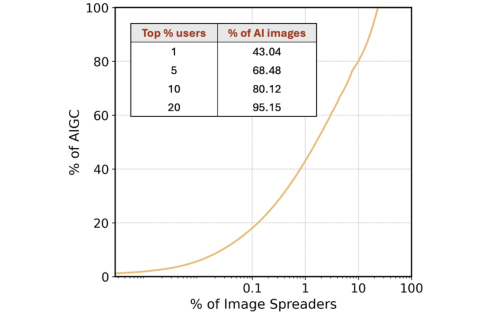
Despite widespread concerns about the risks of AI-generated content (AIGC) to the integrity of social media discourse, little is known about its scale and scope, the actors responsible for its dissemination online, and the user responses it elicits. In this work, we measure and characterize the prevalence, spreaders, and emotional reception of AI-generated political images. Analyzing a large-scale dataset from Twitter/X related to the 2024 U.S. Presidential Election, we find that approximately 12% of shared images are detected as AI-generated, and around 10% of users are responsible for sharing 80% of AI-generated images. AIGC superspreaders—defined as the users who not only share a high volume of AI-generated images but also receive substantial engagement through retweets—are more likely to be X Premium subscribers, have a right-leaning orientation, and exhibit automated behavior. Their profiles contain a higher proportion of AI-generated images than non-superspreaders, and some engage in extreme levels of AIGC sharing. Moreover, superspreaders’ AI image tweets elicit more positive and less toxic responses than their non-AI image tweets. This study serves as one of the first steps toward understanding the role generative AI plays in shaping online socio-political environments and offers implications for platform governance.
Introduction
Generative artificial intelligence (AI) technologies are increasingly mediating our online interactions on social media. From content moderation bots [27] and synthetic personas [20] to AI-generated news and tweets [28], AI is assisting, augmenting, or even replacing human contributions [46], creating a “synthetic reality” where human and AI actors coexist in our digital environment [21]. The advancements and proliferation of generative AI applications like ChatGPT, DALL·E, and Midjourney have amplified both the quantity and quality of AI-generated content (AIGC) online, while intensifying concerns about information credibility and authenticity [30], model bias [19, 34], social trust [18], and potential nefarious applications [38].
Generative AI democratizes visual production by enabling the automatic creation of realistic, complex images from user imagination [18]. However, in high-stakes contexts like democratic elections, these images can project biases or be manipulated. For example, deepfakes may portray political figures saying or doing things they never did [4, 9, 20], and AI-generated memes can be weaponized to stigmatize candidates [10, 38]. Misuse of AI-generated images raises two primary concerns: the spread of misinformation and their impact on audience responses [20]. First, research consistently shows that a small fraction of individuals—also known as superspreaders—are responsible for the majority of questionable information shared on social media [5, 15, 39]. These superspreaders are more likely to be automated accounts or bots [15, 44], and are often involved in the amplification of misinformation through botnets [13] or coordinated activities [12]. While AIGC clearly represents a new form of inauthentic content, it is still unknown whether superspreaders of AI-generated content display similar characteristics to misinformation superspreaders, yet, to the best of our knowledge, no prior work has examined this prolific group of users. Second, research also show that images convey information more effectively and evoke stronger emotional responses than texts [33], suggesting AI‐generated visuals may pose unique challenges. However, a systematic study of user responses to AI‐generated images on social media is still lacking.
To address this research gap, we leverage a comprehensive dataset collected from X/Twitter during the 2024 U.S. Presidential Election period to characterize the behavior of users who share AI-generated images<sup>1</sup> and to measure emotional reception of AIGC over the three months leading up to the election. We initiate our analysis by exploring fundamental questions about the prevalence of AIGC and the identification of users driving its dissemination. To this end, we leverage GPT-4o to detect AI-generated images and manually validate the outputs to ensure robust and reliable classification. Through this process, we identify a set of 128 superspreaders of AI-generated images, employing established metrics of online influence [15]. We then characterize the behavior of these superspreaders, focusing on factors such as political affiliation, premium account status, the proportion of AIGC shared, and their bot-like behavior. Finally, we examine user responses to AI-generated images across various dimensions, including emotional tone and levels of toxicity.
Contributions of this work
Guided by our motivation to examine the prevalence, spreaders, and emotional reception of AI-generated political images on X, we formulate the following research questions (RQs):
What is the prevalence and concentration of AI-generated images on X?
What are the characteristics and sharing behaviors of AIGC superspreaders?
How do users respond to AI-generated images on X?
This study serves as an initial step toward understanding how generative AI technologies shape social media dynamics in political discussions. As one of the first investigations using real-world data to assess the prevalence of AIGC on social media, we reveal that approximately 12% of images within the online discourse on X related to the 2024 U.S. Presidential Election are AI-generated. Notably, a small fraction of users dominate AIGC dissemination, with around 10% of image spreaders account for 80% of the shared AI-generated images. We identify and characterize the behaviors of AIGC superspreaders, noting that they are more likely to have a right-leaning political orientation, subscribe to X Premium, and exhibit stronger bot-like behaviors. Furthermore, users tend to adopt a more positive tone and exhibit lower levels of toxicity in response to AI-generated images. We hope our findings pave the way for further research on the role of AIGC in social media, offering valuable insights for platform governance, policy-making, and public awareness of generative AI’s growing impact on online sociopolitical landscapes.
Related Work
AI-Generated Images on Social Media
Generative AI has redefined the boundaries of visual content production. On one hand, it enables people to translate their imagination into highly customized and expressive visual content [2, 18]. On the other, AI-generated images may embed biases [45] originating from skewed training data [29] or maliciously crafted prompts. When disseminated on social media platforms, such biases can be reproduced or even amplified, potentially reinforcing harmful stereotypes, distorting public discourse, and exacerbating existing social inequalities. However, due to challenges in detecting AIGC and limited real-world datasets, only a few studies have explored its presence and impact on social media. Research has examined the prevalence and misuse of GAN-generated visuals for inauthentic activities [42, 50], the role of synthetic content like political memes in shaping discourse during elections [10, 38], the use of AI-generated images to gain profit on Facebook [16], and the broader influence of AIGC on platform dynamics, e.g., content creation and consumption patterns [49].
Despite these contributions, existing studies lack a comprehensive characterization of AI-generated images on social media. Many are constrained to a narrow set of generative models, such as GANs [42, 50], or depend on explicit hashtags to identify labeled AIGC [49], thereby excluding unlabeled content that may be misleading or harmful. Manual identification methods [10], while useful, are neither scalable nor consistently accurate. Together, these limitations impede a full understanding of the AIGC landscape on social media platforms.
Superspreaders of Online Information
Superspreaders, also referred to as supersharers, are users who disproportionately contribute to the spread of specific types of content on social media, such as low-credibility or fake news. They play a unique role in shaping online information ecosystems by generating content that garners substantial reach and engagement. Studies have consistently found that a small fraction of superspreaders accounts for the majority of misinformation shared online [15, 39]. For instance, during the 2016 U.S. Presidential Election, just 0.1% of Twitter users were responsible for nearly 80% of fake news shared, with similar patterns observed during the 2020 Election [5, 23, 25]. Superspreaders are typically identified using various metrics, such as k-core decomposition to assess centrality within the network, the sum of nearest neighbors’ degrees to evaluate local influence, and the h-index to measure the volume and reach of their shared content [15, 40]. Superspreaders are not limited to bots or automated accounts but frequently include politically active individuals and pundits with large followings [5, 24]. Recent work has also shown that X’s recommendation algorithm amplifies superspreaders like political commentators and partisan influencers [52].
While most studies have focused on superspreaders of misinformation, the rise of generative AI introduces new complexities and raises open questions. AIGC’s potential to mimic diverse styles and create realistic and complex content at scale raises concerns about its integration into existing misinformation networks [21]. Superspreaders of AIGC may exploit these affordances and automation capabilities to amplify their influence further. This study, therefore, builds on prior work by investigating AIGC superspreaders during the 2024 U.S. Presidential Election.
Emotional Reception of AIGC
Understanding emotional reception of AI-generated images is both urgent and important. Visual content evokes stronger emotions than text [33] and can more powerfully influence attitudes [47], so it is essential to investigate how users perceive and engage with AI-generated visuals. Most prior work has relied on controlled experiments across diverse contexts, yielding mixed findings. In artwork evaluation, for instance, individuals report lower emotional engagement when they believe a piece is AI-generated [1], and human-created art consistently elicits stronger emotions than AI-created art [14]. When looking into specific emotions, AI-generated images have been shown to provoke more negative reactions [37]. Nevertheless, in the context of architectural design, AI images effectively convey joy but poorly transmit negative emotions [53].
However, these experimental settings do not reflect the rapid, emotionally charged, and often polarized environment of social media. Few studies have explored how AI-generated images are received in real-world social feeds, where they are encountered, shared, and interpreted under naturalistic conditions. Addressing this gap is critical for understanding the public impact of AI-generated images.
Methodology
Pipeline of the detection and validation of AI-generated images.
Data Collection and Curation
We leverage an existing dataset of tweets related to the 2024 U.S. Election [3]. The dataset is generated by querying targeted keywords related to political figures, events, and emerging issues of the Presidential Election to retrieve data effectively. In this study, we analyze data spanning a three-month period leading up to the election, from July 1, 2024, to September 30, 2024. The resulting dataset includes 2.5M images shared by 414K spreaders. Given that our analysis centers on characterizing the behavior of users sharing AI-generated content during the observation period, we first identify and quantify these AIGC spreaders. Users who share at least one AI-generated image are denoted as AI image spreaders (details on the detection of AIGC can be found in Section 3.2). This yields approximately 88K AI image spreaders.
Next, to address RQ2, we apply a filtering process to identify a subset of target users. To ensure that each user has sufficient data points to analyze their sharing behavior and received engagement, two criteria are applied. The first criterion sets a minimum threshold for the total number of tweets a user has posted during the observed time period. AI image spreaders who have posted fewer than five tweets with at least one image in each are excluded from the analysis. Second, an AI image spreader must have shared at least one retweeted post containing AIGC, i.e., h-index > 0 (details on the h-index are provided in Section 3.4). These criteria collectively ensure a robust and meaningful dataset for evaluating user activity and influence. Finally, we retrieve a subset of target users consisting of 12,898 AI image spreaders. Subsequent analyses are based on this pool of target users.
AI-Generated Image Detection
With the proliferation of AI-generated content on platforms like X, accurately detecting such images has become increasingly challenging. Traditional deep learning models often struggle to distinguish AI-generated images [6]. In contrast, recent work demonstrates that large language models (LLMs) such as GPT-4o, when guided by carefully crafted prompts, offer robust multimodal detection capabilities [7, 10, 11]. Drawing on these advances, we employ GPT-4o to identify AI-generated images in this study. Figure 1 presents an overview of our detection and validation pipeline.
We leverage GPT-4o to classify images as AI-generated or non-AI-generated. To evaluate its performance, following Epstein et al. [17], we construct a validation set of 2,400 images, evenly split between 1,200 AI-generated and 1,200 non-AI-generated samples. The non-AI images are randomly sampled from the LAION-400M dataset [43], while the AI-generated set comprises 400 DiffusionDB samples [48], 400 DALL·E images collected from the subreddit r/dalle<sup>2</sup>, and 400 Midjourney images crawled from the Explore page<sup>3</sup>.
We extract image URLs from tweet metadata and send the following prompt to GPT-4o (temperature set to 0 to minimize variability):
Of the 2,400 images to be validated, the model returns responses for 2,367 and fails on 33 (often due to sensitive‐content filters), achieving an F1‐score of 0.96. To assess robustness, we employ two additional transformations to the same 2,400 images:
Rotation: We split the images into three equal groups, rotating them by 90°, 180°, or 270°. GPT-4o processes 2,380 images (20 failures) and reaches an F1‐score of 0.92.
Scaling: We resize half of the images to 200% and the other half to 50% of their original sizes. GPT-4o processes 2,366 images (34 failures) and achieves an F1‐score of 0.94.
These results demonstrate GPT-4o’s high accuracy and resilience to common image transformations. We then apply GPT-4o detection to our 2024 U.S. Election dataset using the OpenAI BatchAPI<sup>4</sup> to optimize time and cost. We categorize each response as: (i) valid (“yes” or “no”), (ii) download failure due to content moderation, or (iii) inability to respond (e.g., “Sorry, I cannot answer this.”). Categories (ii) and (iii) are treated as invalid answers. Of the 2,462,132 images processed, approximately 90.5% receive valid responses. Examples of detected AI-generated images are shown in Appendix. All subsequent analyses focus on these valid detections and their associated users. The images and detection results are available at: https://github.com/angelayejinyi/AIGC-Election-2024.
Validation of AIGC Detection
Although GPT-4o performs well on our constructed validation set, its accuracy on real-world social media images remains uncertain due to the variability and complexity of online content. To assess robustness in the wild, we adopt an annotation workflow inspired by Ricker et al. [42] that introduces annotation guidelines and heuristic-based training for annotators, followed by validation of samples from model-labeled datasets. Following a similar approach, we randomly sample 1,000 images labeled as AI-generated and 1,000 labeled as non-AI-generated by GPT-4o from our large-scale dataset. We then provide annotators with a detailed guideline to validate model’s performance in the wild.
To facilitate consistent annotation, we provide annotators with a set of heuristic strategies: (i) side-by-side comparison, where annotators compare the current image to ground-truth-labeled examples, focusing on their visual patterns and framing; (ii) zoom-in review of visual cues, which encourages annotators to identify common generation-related artifacts such as unnatural textures and object distortions; and (iii) contextual reasoning, which prompts annotators to apply basic logics to check the plausibility of the scene. These techniques, which have proven effective in previous work [42], are aimed at improving both accuracy and inter-coder reliability.
Beyond these heuristics, we integrate an additional technique inspired by Qian et al. [41]: Google reverse image search. Their study has shown that introducing reverse image search into a digital media literacy intervention significantly increases users’ intention and ability to verify images. The underlying rationale is that this tool allows users to verify the origins and context of an image by searching with the image itself rather than a keyword. When an exact or near-duplicate match is found online, the accompanying metadata, such as early publication dates or credited painters or photographers, can serve as strong evidence that the image is non-AI-generated. By incorporating this step, we not only provide annotators with external validation cues but also align our workflow with proven strategies to enhance media discernment and validation robustness.
Following the annotation guidelines, each image is independently labeled by two different annotators. We first assess inter-coder reliability, obtaining a Cohen’s κ of 0.87, which indicates a high level of agreement. We then evaluate the model’s performance by calculating its misclassification rates, yielding a false positive rate (FPR) of 6.5% and a false negative rate (FNR) of 1.6%. These results confirm the robustness of our detector when applied to the large-scale dataset in real-world scenarios. While the error rates are not zero, they are sufficiently low to support the validity of the subsequent analysis.
Identifying Superspreaders of AIGC
Superspreaders are typically identified using influence metrics, including k-core centrality, the sum of nearest neighbors’ degrees, and the engagement driven by their original content [15, 40]. Here, we adopt the h-index, originally designed to measure scholarly impact [26], and later adapted for identifying superspreaders of low-credibility content on X [15]. In our scenario, the h-index for a user i is defined as the maximum value of h such that user i posted at least h tweets containing AIGC, each retweeted at least h times. This metric captures both the volume of AI-generated content shared and the engagement received by each post. A superspreader must meet both criteria: a high number of tweets containing AI-generated content and a significant volume of received retweets. This ensures that superspreaders are identified based on both their activity and the broader impact of their AI-generated content on the platform.
Characterizing AIGC Superspreaders
We characterize superspreaders of AI-generated content based on two key metrics: The AI score quantifies the proportion of AI-generated content in a user’s posts. The bot score evaluates the probability of an account being automated based on its historical tweet activity.
AI Score.
To quantify the proportion of AI-generated content in a user’s tweets, we introduce a new metric called the AI score, defined as:
Do you like what you are reading? Subscribe to receive updates.
Unsubscribe anytime