
Abstract
This work discusses hyperlinked citations to two historical e-literature works articulated as hypercitations within the Game and Interactive Software Scholarship Toolkit (GISST). Hypercitations allow a user to link directly into a particular moment or performance of e.g. an historical program by retrieving a past computational state of that program or an input recording mapped over a series of states. In this case, we provide examples of two works preserved by the Electronic Literature Organization (Judy Malloy's Uncle Roger and Rob Swigart's Portal ) to illustrate the potential of hypercitation for the discussion, analysis, and sharing of historical hypertextual works. We also note the potential for new forms of hypertextual scholarship provided through the linking and embedding of meta-hypertextual citations.
CCS Concepts: • Information systems → Users and interactive retrieval; • Human-centered computing → Hypertext / hypermedia; • Applied computing → Digital libraries and archives.
Keywords: emulation, citation, electronic literature, GISST
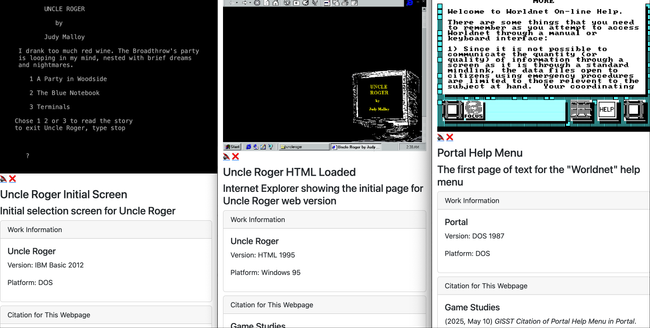
Figure 1: Three moments captured from hypertexts as interactive hypercitations.
Description: Three Web browser windows side by side. The leftmost shows the introductory screen of the DOS BASIC version of Judy Malloy’s Uncle Roger. To the right is the introductory screen of the HTML version, rendered in a Windows 95 emulator. Rightmost is the help screen of Rob Swigart’s Portal running in DOS. At the bottom of each window is some citation metadata.
1 Introduction
When we write about hypertexts, as when we write about any text, we are obligated to cite the work to sufficient precision that an interested reader could follow up and read the work for themselves to verify our argument (which itself may require hours of interaction with the text). This citation should also be durable: a reader ten or fifty or more years transposed in time from the publication date of the paper should be able to experience cited hypertext works for themselves. The alternatives to these two imposing requirements are that readers and authors have a shared memory or common knowledge of important texts to which readers can refer; or that readers simply take authors at their word on what a hypertext was like or how it functioned. Hypertexts, being creative works made either as or for software platforms, pose unique challenges to both citation access and permanence.
While some hypertexts of interest are sets of HTML files and admit links to specific points, many hypertexts are not representable in HTML. Sharing such works by reducing them to screenshots or online videos cannot always communicate the essential idea underlying the citation. These problems are compounded for historical hypertexts that don't run on modern computing systems.
In this paper, we propose to reuse whole-system emulation technologies of historical computing platforms to share live links directly into running hypertext systems (or to recorded, in vivo replays of performances of such systems) as the medium of citation. Because the citation database is itself built on Web technologies, this also allows for new opportunities for authoring hypertexts about hypertexts. We call this hypercitation.
2 Background
2.1 Hypercitations
Hypercitation refers to the ability to reference and retrieve internal states, or sequences of states, of a computational system, yielding hyperlinks across and into hypertexts. These deep links into application state bring the reader directly into the working system and give them access to previously curated configurations of storage and memory. Jumping into a hypertext via deep linking itself presents a sort of hypertextual reference traversal. This means that an interested scholar can also construct tours or series of examples from within a work that is presented through a meta-textual framing. In effect, this approach allows for a hypertextual exploration of a particular work or series of works, juxtaposing them in ways previously impossible within the systems themselves.
One of the most developed systems approaching hypercitation is Emulation-as-a-Service Infrastructure (EaaSI), which allows users to recall containerized emulated machines through a cloud-based interface 5. Audiovisual output from the emulator is sent to the user's browser with inputs streaming back to the emulated systems. Since EaaSI streams to conventional HTML elements, EaaSI configurations can be loaded into web pages, but not cued up into a particular computational state—the systems boot into the operating system, rather than directly into a specific work. It is up to each user to manipulate the emulated system to reach the desired state, which can be time-consuming or confusing for complex hypertexts or other interactive systems, or for novice users. EaaSI also provides no mechanism for capturing input recording of system interactions, but the project is exploring support for hypercitation of system memory snapshots 7.
Notions of hypercitation-like systems have been proposed in the e-lit community, notably in Nick Montfort's review of Espen Aarseth's Cybertext: Perspectives on Ergodic Literature , which featured embedded emulations of Infocom's Deadline interactive fiction 22. Further work in the e-lit and game studies communities has also highlighted the potential for preservation of hypertextual and gaming-related works through the organization of described and indexed emulated systems 23 , as well as performance capture formats built into specific game engines 16. The citation of emulated computational works also appears in platform studies 2 , and the digital preservation community routinely references preservation of past emulated systems 26.
In a similar vein to the containerization approach of EaaSI, other cultural organizations also offer pre-configured virtual machines (known as "capsules") loaded with various corpora and programs to aid in non-consumptive textual analysis applications 24. Users can run, save, and share particular analysis configurations, however there is not a direct need for hypercitation of analysis states.
Hypercitation has also been the basis for some experimental game designs. Farbs' ROMcheck Fail 6 , and Bennett Foddy's Multibowl 4 are games that manipulate a series of emulated states from past arcade games to create a set of progressive and curated challenges that play with the boundary of game and platform.
2.2 Challenges in Citing Hypertexts
As early as the 1990s, the ephemeral nature of web links and hypertexts was understood to be a problem for citation in scholarly works 9, 14. There is nothing archival about a Web link: The underlying resource may change over time, it may be removed, or the whole site may disappear. In other words, a link on its own does not serve the purpose of a citation, because a reader has no way of verifying that the content at the link they visit is the same as the content the author had in mind when making the citation.
Web archiving technologies and services exist to help remediate this issue of preservation, for example the Internet Archive's Wayback Machine 31 and WebRecorder 13. These are valuable and important resources that can capture a Web site as it was observed at a given point in time.
While the most popular referents of hypertext citations have historically been World Wide Web-based hypertexts, the problem of ongoing access is worse for non-Web-based works. Web-based works have the advantage of the ongoing development of and commercial interest in the Web platform, but hypertexts made for e.g. classic Mac OS, DOS, Amiga, or other platforms rely on a layer of system emulation which can be difficult for non-experts to set up and maintain, and especially to share with others. This added complexity discourages readers from following up on citations, and can lead authors to use static screenshots or recorded videos to present frozen, inert versions of hypertext works.
This highlights a second key issue when citing hypertexts: as ergodic literature 1 , hypertexts require effortful interaction along a specific path to reach certain states, scenes, or episodes. A quotation of the ending of a large work, rendered as a citation to the work as a whole, can put the burden of interaction on the reader who may not have the ability (or time) to reach the scene in question in order to verify the citation. Again, while hypertexts in the Web medium may allow easy linking to specific points in the work (if they do not depend too heavily on JavaScript computation or state), it has been difficult up to the present moment to provide links into emulated platforms.
2.3 A New Hypercitation Platform
A recently-available research system, the Game and Interactive Software Scholarship Toolkit (or GISST), is well-suited to resolving these issues of hypertext citation and reference 25 <sup>1</sup>. GISST has shown considerable promise in preservation use cases 12 , as it stores and reproduces complete computing environments in a similar fashion to EaaSI. Unlike EaaSI, GISST supports direct links to (citations of) snapshots of running computational systems (for example, an IBM PC running DOS, with a hypertext work executing in the terminal, cued up to a specific important moment).
GISST also allows for recordings of sequences of actions (like key presses or mouse movements) which can be replayed live and then interrupted or taken over by the viewer. Unlike a video recording, this amounts to watching a live performance of a work from which a reader could construct their own derivative performance. In essence, GISST combines the positive aspects of Web links (easy sharing and link following) with an archival commitment to immutable, durable reproductions of interactive works.
Previous prototypes of GISST have shown its utility as a platform for game studies, including a Web-based journal article with clickable links to jump the reader to specific moments in the influential PC first-person shooter DOOM 11. Games can be seen as a kind of hypertext 21 ; both are examples of ergodic literature, and the same features that make GISST suitable for sharing moments and performances of games also make it well-suited for citing hypertexts.
The GISST system currently provides access to emulated IBM compatible PCs and videogame consoles dating roughly from 1980-1996. The emulated software is run locally in the user's Web browser using specific tagged versions of open-source JavaScript-based system emulators, ensuring reproducibility. GISST stores software and hypertext works along with a database of saved moments and performances keyed to the specific virtual hardware configurations that produced them. These citations can be shared as links to a generic reference page or embedded directly into other Web pages to create new kinds of interactive documents.
<sup>1</sup> https://gisst.dev/
3 Case Studies
The chosen case study items, Judy Malloy's Uncle Roger and Rob Swigart's Portal , represent significant, early e-lit works that have been preserved by their authors and through the efforts of the Electronic Literature Organization (ELO). We select these works due to a presentation on GISST at the ELO's annual conference in 2024 that highlighted both works. Note that some references in this case study section resolve to hypercitations of these works within GISST, given as URLs with an archival durability commitment.
3.1 Uncle Roger
Uncle Roger is an early e-lit work whose release began in 1986 as a collection of UNIX shell scripts that manipulated a database file of hypertextual "lexias" (textual fragments), building off a discussion-forum based narrative on the WELL's ACEN 17. The work is composed of three narrative "files", each associated with different exploratory narrative structures tracking the experiences of the protagonist Jenny, the niece of the eponymous Uncle Roger, through her life in the San Francisco Bay area. The versions included in the case study set are a definitive HTML-version released in 1995 and a BASIC implementation circa 2012 meant to reproduce the 1988 IBM/PC version of the work (itself a port from the 1986 Applesoft BASIC version).
The different versions of the work highlight the progression of hypertextual technologies over the late 1980s (see Fig. 1 to see them side-by-side). The BASIC version executes by interpreting a.BAS program file through MicroSoft's GW-BASIC version 3.23 19. Readers communicate through the program with keyboard commands. The work's "File 1" entitled "A Party in Woodside" is traversed by typing in lexia from a compiled list that references discrete narrative segments. "The Blue Notebook" ("File 2") allows for the logical pairing of different lexia to produce reader-derived juxtapositions, and "Terminals" ("File 3"), chooses a randomly generated progression though lexias that changes each time the file is accessed.
The HTML version re-implements each of these files and modifies their traversal schemes 18. Instead of typing the names of lexia, readers click on hyperlinks, which in Files 2 and 3 are embedded within images. The generative progression of the third File is therefore replaced with a grid of identical squares that allow the reader to "randomly" traverse the lexia 20.
The BASIC version is running the program files as interpreted by a BASIC interpreter running on the FreeDOS operating system loaded within the v86 JavaScript emulator. For the HTML version, a Microsoft Windows 95 operating system image was loaded with a folder containing the original HTML files. Those files are read from the local file system through Microsoft Internet Explorer. As a result, some links within the HTML version do not resolve as they link to the historical hosting location for the work on the WELL.
3.2 Portal
Rob Swigart's Portal is an interactive novel released by Activision in 1986 and developed by the Nexa Corporation. It tells the story of an astronaut returning to Earth after a long sojourn to discovery a now abandoned planet. The astronaut reconstructs past events by interacting with the "HOMER" artificial intelligence through a derelict computer terminal. The story proceeds through the exploration of an interactive database, in which certain passages trigger the availability of new narrative locations. Portal 's interface is a bit abstruse, requiring the navigation of nested menus to access different locations within the text 30. It feels like navigating a vaguely alien system, and requires the reader to remember clues from previous passages to unlock further locations in the narrative. The novel includes a help menu to orient readers 28 and allows the reader to enter their character's name at the start of the experience 29.
4 Discussion
4.1 Hyper-hypertexts
As shown in the previous section, the citations to particular moments and configurations of the case items show the immediacy of such references. Readers of this paper can quickly jump into the above works at specific, highlighted locations and pick up traversal where we left off. With access to the GISST editor interface, the references could also support derivative explorations by a motivated reader. The juxtaposition of references allows for comparisons between different works, or in the case of Uncle Roger different versions of the same work. Previous uses of GISST also allowed for the linking of different citations to text-based hyperlinks, allowing readers to click on different passages and switch the loaded state of an in-browser emulation. Since GISST also provides for embedding a hypercitation within HTML elements (a <gisst> HTML element with a running system inside), one could imagine constructing more intricate hypertextual articles that themselves experiment with traversing different references to a collection of related hypertexts. The basic tools provided by GISST already present an opportunity to develop unique explorations of branching interactive works, and the ability to access past hypertexts quickly and easily.
4.2 Oral History and Serendipity
In providing easy, indexed access to past hypertext works, hypercitation also provides for new forms of collaborative analysis and discussion of the medium's past. The selection of these case items is directly related to their use in a demonstration of the GISST system at the ELO's Annual Conference in 2024 10. During that presentation, GISST's creators shared an interactive demo of the system including Uncle Roger , Portal , and an Adobe Flash-based work, Mez Breeze's Clo[h!]neing God N Ange-Ls 3. While showing a live comparison of the HTML version of Uncle Roger in a modern browser with its BASIC version in GISST the presenter noted that the progression through the narrative lexia differed between the two versions. Unbeknownst to them, Judy Malloy was present in the virtual audience and able to comment on the discrepancy. This interaction was unplanned, and showed the potential for hypercited access to past works as a way of locating and retrieving oral history. In this case, a serendipitous alignment of author, investigator, and text allowed for new knowledge about the work to come to light.
When presenting with GISST, the presenter can also share the linked citations with the audience. In virtual presentations, where everyone is already connected to browser, many viewers can explore the same program in the same state as the presenter. For in-person meetings, many GISST hypercitations also function in mobile browsers; in these cases QR codes can be used to align the audience on a specific hypercitation.
4.3 Archival Futures
Hypercitation also provides motivation for the preservation of software and software-based records. Preservation of hypertextual works is challenging as they are stored on deprecated media forms, and require interaction and participation to be better understood 8. This should lead to easier and more convenient access to software-mediated works into the future.
The use of the Web platform has benefits and drawbacks, since on the one hand it is ubiquitous and independent of device and operating system, and on the other it changes over time. GISST attempts to address these concerns by building on top of open source software and preserving as much information as possible about captured states and performances.
4.4 Challenges and Limitations
Hypercitations are an emerging technology without clear standards for descriptive metadata. How to cite both the creator of the citation and the author of the work (and possibly the authors of the system emulator) remains an open question. Luckily, the use of durable links as the medium of citation means that when such metadata standards are adopted they can "upgrade" existing citations with richer and more complete description.
Hypertexts designed for older computing platforms may embed certain assumptions about the platform into their design. It is a well known phenomenon that software written for DOS or older Windows PCs may run too fast on more recent computers; we see the same phenomenon with Portal. GISST currently does not support artificially slowing down emulation to account for this. Similar compatibility moves will probably be part of the ongoing development of the system, as it is for all emulated computers and game consoles.
GISST also currently delivers the hypertext work to end-users for emulation, which could pose a copyright concern. While our position is that this falls under fair use (and the works we presented in this case study are freely available), we hope that GISST eventually adopts authorization technologies similar to those used in online libraries and other settings where access to resources must be governed by licensing agreements.
Further, while GISST allows for access to the same data that reified past works, their reproduction through emulation and in-browser cannot be considered "authentic". The authenticity issues surrounding reproductions of interactive digital works are well addressed and theorized 15, 27. Still, a significant (and permanent) limitation of the hypercitations represented through GISST is their decontextualization both from the original physical infrastructure that supported them and from the socio-historical conditions of their use. Dropping a current reader into an antiquated system or into the middle of a narrative experience can be confusing and fail in some ways to represent the work without suitable description and preparation. Traversing and experience e-lit works are also about an individualized journey along a path, and hypercitation can cut against the ergodic intent of a work.
5 Conclusions
The next major steps in the development of hypercitations are to communicate their utility to scholars and encourage their use. We hope to propose workshops and journal special issues in a variety of fields (game studies, software studies, hypertext scholarship, and so on) to support the development and use of these novel citations, both in existing venues and in new Web-native scholarship that supports embedding interactive citations within the body of the text.
We have presented hypercitation as a technique for improving the citation standards around hypertexts, with brief case studies. While not perfect in all respects, they improve substantially on shallow links or degraded reproductions like screenshots. Hypercitations support easier access and more durable preservation of references to hypertexts, and also enable new kinds of writing and thinking about hypertexts.
Acknowledgments
The authors would like to acknowledge Pomona College undergraduate student researchers Max Linden, Rona Linarez, Stavros Zografos, and Uras Uyal.
References
Espen J. Aarseth. 1997. Cybertext: Perspectives on Ergodic Literature. JHU Press. https://www.press.jhu.edu/books/title/1398/cybertext
Nathan Altice. 2015. I Am Error: The Nintendo Family Computer/Entertainment System Platform. The MIT Press, Cambridge, Massachusetts. doi:10.7551/mitpress/9484.001.0001
Mez Breeze. 1999. Clo[h!]Neing God N Ange-Ls. https://the-next.eliterature.org/. Retrieved July 12th, 2025 from https://the-next.eliterature.org/works/269/0/4/
Seb Chan and Bennett Foddy. 2017. Bennett Foddy's Multibowl: A New Game of Old Games. Retrieved May 9th, 2025 from http://www.acmi.net.au/stories-and-ideas/bennett-foddys-multibowl-new-game-old-games/
Euan Cochrane, Klaus Rechert, Jurek Oberhauser, Seth Anderson, Claire Fox, and Ethan Gates. 2022. Useable Software Forever. The Emulation as a Service Infrastructure (EaaSI) Program of Work 20220913. In iPRES 2022 (Glasgow, UK). OSF, 40–52. doi:10.7207/ipres2022-proceedings
Farbs. 2008. ROMcheck Fail. Retrieved July 12th, 2025 from https://web.archive.org/web/20240629165437/https://farbs.org/rom-check-yourself
Rafael Gieschke, Klaus Rechert, and Euan Cochrane. 2023. Long-Term Preservation of a Software Execution State. In iPRES 2023 (Champaign, IL, USA). OSF. https://hdl.handle.net/2142/121093
Dene Grigar. 2018. Archiving Electronic Literature: Selection Criteria, Methodology, and Challenges. Journal of Archival Organization 15, 1-2 (April 2018), 20–33. doi:10.1080/15332748.2019.1609310
Corinne Jorgensen and Peter Jorgensen. 1991. Citations in Hypermedia: Maintaining Critical Links. College and Research Libraries 52, 6 (1991), 528–36. doi:10.5860/crl 52 06 528
Eric Kaltman and Joseph Osborn. 2024. Curating and Sharing Interactive Moments with the Game and Interactive Software Scholarship Toolkit (GISST). https://stars.library.ucf.edu/elo2024/hypertextsandfictions/schedule/14
Eric Kaltman, Joseph Osborn, and Noah Wardrip-Fruin. 2021. From the Presupposition of Doom to the Manifestation of Code: Using Emulated Citation in the Study of Games and Cultural Software. Digital Humanities Quarterly 015, 1 (March 2021). https://www.digitalhumanities.org/dhq/vol/15/1/000501/000501.html
Eric Kaltman and Joseph C. Osborn. 2024. The Potential of Cited Executable State for Software Object Access, Validation, and Research. Proceedings of the 20th International Conference on Digital Preservation (iPRES) (Sept. 2024). doi:10.21428/5676bf2d.b1b7d24e
Ilya Kreymer, Emma Dickson, and Lorena Ramírez-López. 2021. From Capture to Replay: Web Archiving With Webrecorder Tools. In Proceedings of the 17th International Conference on Digital Preservation (Beijing, China). OFS, Beijing, China. https://www.digipres.org/publications/ipres/ipres-2021/papers/from-capture-to-replay-web-archiving-with-webrecorder-tools/
Carrie Shively Leverenz. 1998. Citing Cybersources: A Challenge to Disciplinary Values. Computers and Composition 15, 2 (Jan. 1998), 185–200. doi:10.1016/S8755-4615(98)90053-6
Henry Lowood, Raiford Guins, and Matthew G. Kirschenbaum. 2023. Replayed: Essential Writings on Software Preservation and Game Histories (1st ed. ed.). Johns Hopkins University Press. https://www.press.jhu.edu/books/title/12805/replayed
Henry Lowood, Eric Kaltman, and Joseph C. Osborn. 2017. Screen Capture and Replay: Documenting Gameplay as Performance. In Histories of Performance Documentation. Routledge, 149–164.
Judy Malloy. 2014. Judy Malloy: Notes on Uncle Roger. Retrieved May 1st, 2025 from https://people.well.com/user/jmalloy/uncleroger/uncle readme.html
Judy Malloy. 2025. GISST Citation of Uncle Roger HTML Loaded in Uncle Roger. Cited by Eric Kaltman. Retrieved May 1, 2025 from https://gisst.pomona.edu/data/78f8eb30-1261-479e-8deb-6e76d7af2572?state=453dc91b-7813-43c4-a1f9-9d086b3bd4a8
Judy Malloy. 2025. GISST Citation of Uncle Roger Initial Screen in Uncle Roger. Cited by Eric Kaltman. Retrieved May 1, 2025 from https://gisst.pomona.edu/data/10ead012-ec08-4e9f-a775-07282b1e4e54?state=9741e995-b287-4dee-81be-57694b1e2f6d
Judy Malloy. 2025. GISST Citation of Uncle Roger "Terminals" Initial Screen in Uncle Roger. Cited by Eric Kaltman. Retrieved May 1, 2025 from https://gisst.pomona.edu/data/78f8eb30-1261-479e-8deb-6e76d7af2572?state=24c4f046-00fb-4a79-b62b-fd33b62295a8
David E. Millard. 2020. Games/Hypertext. Proceedings of the 31st ACM Conference on Hypertext and Social Media (July 2020), 123–126. doi:10.1145/3372923.3404775
Nick Montfort. 2000. Cybertext Killed the Hypertext Star | Electronic Book Review. Retrieved May 1st, 2025 from https://electronicbookreview.com/essay/cybertext-killed-the-hypertext-star/
Nick Montfort and Noah Wardrip-Fruin. 2004. Acid-Free Bits: Recommendations for Long-Lasting Electronic Literature. Retrieved May 1st, 2025 from https://eliterature.org/pad/afb.html
Jaimie Murdock, Jacob Jett, Tim Cole, Yu Ma, J. Stephen Downie, and Beth Plale. 2017. Towards Publishing Secure Capsule-Based Analysis. In 2017 ACM/IEEE Joint Conference on Digital Libraries (JCDL). ACM, 1–4. doi:10.1109/JCDL.2017.7991585
Joseph Osborn and Eric Kaltman. 2024. Toward A Game Citation and Reference Workbench. In Proceedings of the 19th International Conference on the Foundations of Digital Games (FDG '24). Association for Computing Machinery, New York, NY, USA, 1–4. doi:10.1145/3649921.3656983
Oya Y. Rieger, Tim Murray, Madeleine Casad, Desiree Alexander, Dianne Dietrich, Jason Kovari, Liz Muller, Michelle Paolillo, and Danielle K. Mericle. 2015. Preserving and Emulating Digital Art Objects. Technical Report. Cornell University. https://hdl.handle.net/1813/41368
Melanie Swalwell. 2017. Moving on from the Original Experience: Philosophies of Preservation and Dis/Play in Game History. In Fans and Videogames. Routledge.
Rob Swigart. 2025. GISST Citation of Portal Help Menu in Portal. Cited by Eric Kaltman. Retrieved May 1, 2025 from https://gisst.pomona.edu/data/5cbd9c93-206f-4fcc-a79e-d263879c7c73?state=d69b77ab-cb0c-4760-8ca4-53d35af4f23c
Rob Swigart. 2025. GISST Citation of Portal Name Entry Screen in Portal. Cited by Eric Kaltman. Retrieved May 1, 2025 from https://gisst.pomona.edu/data/5cbd9c93-206f-4fcc-a79e-d263879c7c73?state=21bbf309-8431-45b5-b8ae-891561be2f53
Rob Swigart. 2025. GISST Citation of Traversal of Initial Locations in Portal. Cited by Eric Kaltman. Retrieved May 1, 2025 from https://gisst.pomona.edu/data/5cbd9c93-206f-4fcc-a79e-d263879c7c73?replay=25beb068-e13c-44ef-867b-9c41730056b9
Internet Archive. [n. d.]. Wayback Machine. Internet Archive.
Do you like what you are reading? Subscribe to receive updates.
Unsubscribe anytime