
Reasoner Outperforms: Generative Stance Detection with Rationalization for Social Media
Authors: Jiaqing Yuan, Ruijie Xi, Munindar P Singh
Jiaqing Yuan — Amazon, New York, USA — jordanyuan111@gmail.com
Ruijie Xi — Meta, Bellevue, WA, USA — rxi@ncsu.edu
Munindar P Singh — Computer Science, North Carolina State University, Raleigh, NC, USA — mpsingh@ncsu.edu
Keywords: Social Media, Generative AI, Argumentation, Rationales
Pages: 28–32
Abstract
Stance detection is vital for promoting a trustworthy, human-centric Web by identifying biased or harmful narratives in user-generated content. Whereas recent LLM-based methods excel in accuracy, they often lack interpretability. We propose a generative stance detection approach that outputs explicit rationales and distills them into smaller language models (SLMs) via single-task and multitask learning. Our method enables Flan-T5 to outperform GPT-3.5 zero-shot by up to 9.57%. We further show that rationales enhance multitask performance and improve distillation fidelity, advancing the development of transparent, fair, and trustworthy NLP systems <sup>1</sup>.
Introduction
Stance detection plays a key role in fostering a human-centric Web by promoting fairness, inclusivity, and accountability in online discourse. It identifies biases, discriminatory language, and harmful narratives in user-generated content, which can erode trust and exacerbate division [6]. Prior work has addressed stance detection and argumentation broadly addresses a variety of domains [2, 11, 12, 13, 16, 29], typically modeling it as a classification task over author opinions—in favor, against, or neutral—toward given claims or topics [3, 10, 20, 22, 28].
Although accuracy remains a focus, interpretability is often lacking, limiting real-world utility in high-stakes settings. Reasoning-aware stance detection is crucial for interpreting nuanced opinions, combating misinformation, and promoting ethical AI systems [27, 31], such as decoding morality on social media [25, 26]. However, collecting human-labeled rationales is expensive and domain-dependent [4]. Recent progress in large language models (LLMs), especially with Chain-of-Thought (CoT) prompting [24], has demonstrated strong reasoning in complex tasks like multihop QA and math [17, 21, 23]. GPT-generated explanations have shown promise for stance interpretability [30], but their integration into downstream models remains underexplored.
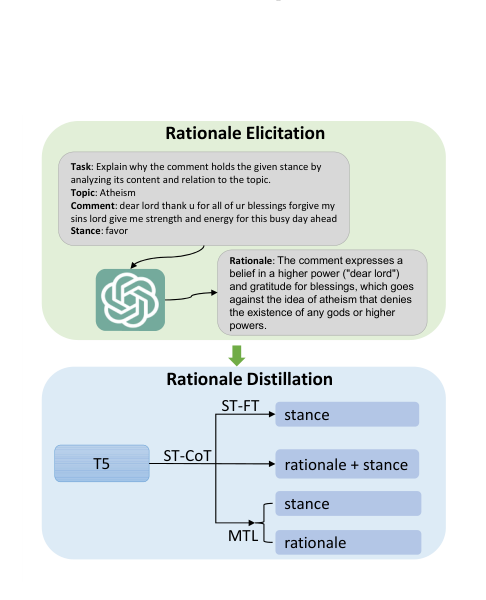
Figure 1: Framework for an explainable stance detection system. GPT-3.5 generates rationales conditioned on ground truth labels, and rationale distillation compares (a) ST-FT, (b) ST-CoT, and (c) MTL, where stance labels and rationales are generated concurrently.
We propose a generative framework that uses GPT-3.5 to produce both stance predictions and rationales, improving rationale faithfulness via conditioning on gold labels. We explore two rationale distillation strategies for small language models (SLMs): single-task CoT (ST-CoT) and multitask learning (MTL), and compare them to standard finetuning (ST-FT). ST-CoT generates rationales prior to predictions; MTL jointly learns both.
Our findings show that MTL outperforms ST-CoT and ST-FT, especially in low-resource settings, and better captures task structure. Moreover, rationale distillation boosts SLMs more than instruction tuning alone. Our contributions include (1) methods for eliciting faithful rationales from LLMs, (2) demonstrating MTL’s superiority for rationale distillation, and (3) identifying key factors driving rationale-based learning in stance detection.
Related Work
Early stance detection relied on machine learning models with handcrafted features [1, 9]. Subsequent research adopted deep learning approaches, including recurrent networks [14], attention mechanisms [32], and pretrained models like BERT [7], driving performance improvements. Chain-of-thought (CoT) prompting elicits reasoning in complex tasks, with Wei et al. [24] demonstrating step-by-step reasoning using few-shot learning and Kojima et al. [15] introducing zero-shot-CoT via the prompt “Let’s think step by step,” achieving state-of-the-art performance in tasks like arithmetic and logical reasoning.
Methodology
Figure 1 illustrates the framework for training a rationalized stance detection system. Human annotation for stance rationales is resource-intensive and prone to inconsistencies due to varying annotator expertise. To address this, we leverage the CoT capability of LLMs for consistent and faithful rationale generation. For integrating rationales into SLM training, we compare two approaches: single-task chain-of-thought (ST-CoT), which enforces rationale generation before prediction, and multitask learning (MTL), which separates the tasks. ST-CoT enforces rationale generation before prediction, intuitively appearing more effective than MTL, where prediction and rationale generation are separate. However, our experimental results contradict this expectation, showing MTL performs better.
Table 1: Statistics of SemEval-2016.
Topic | Favor | Against | Neutral |
|---|---|---|---|
Donald Trump | 148 | 299 | 260 |
Hillary Clinton | 163 | 565 | 356 |
Feminist Movement | 268 | 511 | 170 |
Legalization of Abortion | 167 | 544 | 222 |
Atheism | 124 | 464 | 145 |
Climate Change is Concern | 335 | 26 | 203 |
Prompt 1 Your task is to classify the stance of the comment on the topic as “favor”, “against”, or “neutral”. Conclude with the label.
Topic``: {Topic}
Comment``: {Comment}
Stance``:
Prompt 2 Explain the stance of the comment towards the topic by analyzing its content and relation to the topic.
Your answer should begin with: “The Comment``: {Comment} is classified as Stance``|: towards Topic``: {Topic} because ”
Prompt 3 Your task is to classify the stance of the comment on the topic as “favor”, “against”, or “neutral”.
Topic``: {Topic}
Comment``: {Comment}
Stance``:
Explain``:
Elicitation of Rationales from LLMs
Prompt 1 to Prompt 3 present the prompts used in this study, with colored text distinguishing input (input) and output (output). Our initial approach used GPT-3.5 to classify stances using Prompt 1. However, similar to previous work [30], its performance on SemEval-2016 is modest (average F1 = 70.15% across three random runs) given its scale, highlighting the challenges of directly applying GPT-3.5 to stance detection and the need for fine-tuning a custom model. To obtain accurate rationales, we reframe the predictive task as an explanatory one using Prompt 2 and GPT-3.5, which has been shown to generate robust explanations for stance detection [30]. Conditioning rationales on ground-truth labels encouraged GPT-3.5 to establish connections between the comment and topic. Whereas prior work on rationale extraction often relies on in-context learning with human-written exemplars [24], we adopt a zero-shot approach to eliminate human effort. Specifically, we prompt the model with The comment is classified as [Stance] towards [Topic] because, regulating the consistency between the rationale and the ground-truth label.
Rationale Distillation into SLM
We now present three finetuning paradigms designed to facilitate the adoption of a generative approach for the task of stance classification. Our chosen foundation model for finetuning is the unified text-to-text encoder-decoder model known as T5 [22]. We choose T5 for its unified text-to-text encoder-decoder architecture, well-suited for generating predictions and rationales, and its strong performance across diverse NLP tasks. We now introduce the details of our approaches.
Single-task regular finetuning (ST-FT):The conventional approach in leveraging generative models for classification tasks involves a verbalizer [19], a mechanism that associates each numerical label with a corresponding word or a set of words. Here, we employ the terms favor, against, neutral as the definitive labels representing the stance in our model’s ground truth. This methodology aligns with the established convention of transforming numerical outputs into interpretable linguistic expressions, facilitating a more intuitive comprehension of the generated classifications. ST-FT excludes the reasoning component during prediction.Single-task chain-of-thought finetuning (ST-CoT):An emerging capacity within LLMs is to articulate intermediate reasoning steps in the resolution of intricate problems prior to arriving at a conclusive solution. In contrast, SLMs exhibit a deficiency in respect of such proficiency. Therefore, an approach to equip SLMs with this capability involves leveraging rationale as additional finetuning supervision. The training process requires SLMs to generate rationales before making predictions, compelling the model to capture the relationship between rationales and predictions.Multitask learning (MTL):ST-CoT enforces rationale generation before predictions, but its rigidity can hinder performance with sparse training data, as poor rationale quality often leads to incorrect predictions. To address this, we propose a multitask learning (MTL) approach that treats reasoning as a flexible supervisory signal. MTL allows simultaneous generation of predictions and rationales, enhancing both robustness and interpretability. The MTL loss is defined as (mathcal {L} = alpha mathcal {L}{text{stance}} + (1-alpha)mathcal {L}{text{rationale}}) ), where α controls the weight of each task. For both predictions, we use the cross-entropy loss. Rationale prediction uses a token-level loss, treating generation as a causal language modeling task, with the model predicting tokens relative to the rationale sequences. Unlike classification models such as BERT [8], where separate classification heads are added for specific tasks, we adopt the multitask learning paradigm of T5 [22]. Specifically, we prepend task-specific prefixes to each input: Stance: for the stance prediction task and Explain: for the rationale generation task.
Experiments
Dataset. We evaluate our framework on the SemEval-2016 Task 6 Subtask [18], containing 4,163 English tweets annotated as favor, against, or neutral across five topics: Atheism (AT), Climate Change (CC), Feminist Movement (FM), Hillary Clinton (HC), and Legalization of Abortion (LA). Table 1 displays the statistics of SemEval-2016. Following prior work, we use the official train-test split but create a new validation set by randomly sampling 10% of the training data, ensuring all topics are represented.
Evaluation Metric. We use the macro-average F1-score for favor and against ((F{avg} = frac{F{favor} + F{against}}{2}) )) as the evaluation metric, with neutral included in training and testing.
Rationale Distillation. We finetune T5 [22] and its instruction-tuned counterpart Flan-T5 [5] at small (80M), base (250M), and large (780M) sizes. For ST-FT and ST-CoT, inputs are the target and comment separated by an end-of-sentence token. For MTL, inputs are prefixed with Stance: or Explanation: depending on the task. Flan-T5 uses a unified input format, shown in Prompt 3.
Experimental Details. We train models with a batch size of 128, learning rate 5e-5, 30 epochs, maximum input length 512, and maximum generation length 256, using NVIDIA GPUs (A100, A30, A10, A6000).
Table 2: F<sub>avg</sub> scores across models and sizes, with MTL performance reported at the optimal α. The subscripts are the standard deviation across three random runs. We establish the baseline by using GPT-3.5 to classify stances with Prompt 1, achieving an F1 score of 70.15% across three random runs.
Size | Task | T5 | Flan-T5 |
|---|---|---|---|
Small (80M) | ST-FT | 60.81<sub>5.91</sub> | 66.30<sub>0.19</sub> |
ST-CoT | 50.05<sub>0.32</sub> | 54.13<sub>0.28</sub> | |
MTL | 64.66<sub>4.16</sub> | 66.80<sub>0.18</sub> | |
Base (250M) | ST-FT | 65.54<sub>3.97</sub> | 73.56<sub>0.30</sub> |
ST-CoT | 58.46<sub>0.73</sub> | 60.89<sub>0.37</sub> | |
MTL | 67.40<sub>1.11</sub> | 74.53<sub>0.34</sub> | |
Large (780M) | ST-FT | 68.46<sub>0.45</sub> | 78.76<sub>0.29</sub> |
ST-CoT | 64.47<sub>0.28</sub> | 72.29<sub>0.36</sub> | |
MTL | 76.79<sub>0.71</sub> | 79.72<sub>0.23</sub> |
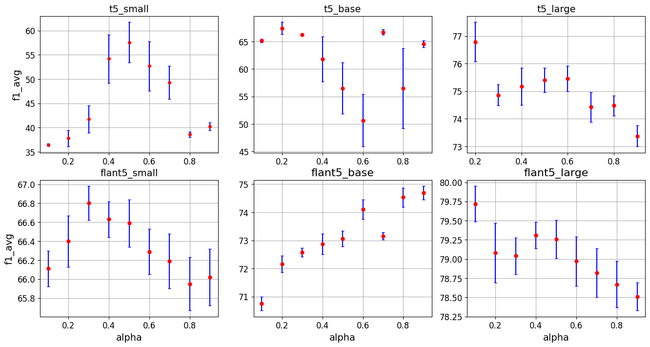
Figure 2: F<sub>avg</sub> scores on different α across models. Standard deviations are calculated from three random runs.
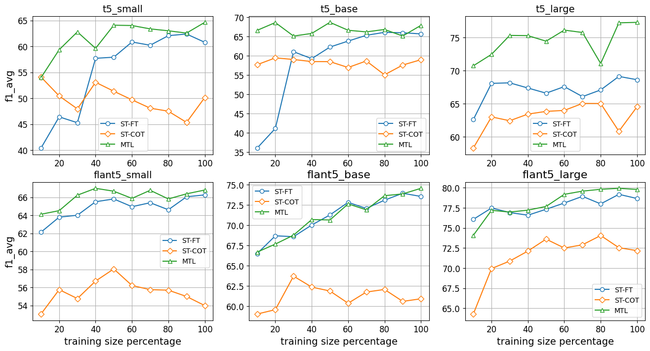
Figure 3: F<sub>avg</sub> for training with different sizes, ranging from 10% to 100%.
Results
Table 2 shows F<sub>avg</sub> across tasks and models. Compared to the zero-shot baseline performance of 70.15% using GPT-3.5 with Prompt 1 (as described in Section 3.1), our approaches achieve up to 79.72%, even with the relatively small size of T5 models. We summarize our findings below.
MTL enhances ST performance across all settings:MTL consistently outperforms ST-FT by independently generating rationales, avoiding interference with prediction tasks. This fosters deeper rationale-prediction connections. T5 models benefit more from MTL than Flan-T5, with average improvements of 4.71 and 0.81, respectively, indicating that instruction tuning equips Flan-T5 with inherent reasoning capabilities, reducing the marginal effects of further finetuning.SLMs struggle with CoT capabilities:ST-CoT underperforms compared to ST-FT across all settings, as generating intermediate steps is 3,000 examples). Deviations in rationale generation often lead to failed or incorrect predictions, making rationale as an auxiliary task a more effective approach.Instruction tuning improves performance:Flan-T5, despite its smaller size, rivals or outperforms larger T5 models. For instance, Flan-T5-Small achieves 66.30 in ST-FT, surpassing T5-Base’s 65.54, and Flan-T5-Base scores 74.53 in MTL, compared to T5-Large’s 76.79. Flan-T5’s finetuning on diverse datasets enhances its instruction-following proficiency, improving stance classification performance.Weighting rationale generation varies performance:We examine the impact of the prediction and rationale generation tasks in MTL by varying the parameter α from 0.1 to 0.9, as shown in Figure 2. Optimal α values are generally low: 0.5 for T5-Small, 0.2 for T5-Base and T5-Large, 0.3 for Flan-T5-Small, and 0.1 for Flan-T5-Large, with Flan-T5-Base as an exception at 0.9. These results suggest that rationale distillation enhances MTL performance, likely due to the stronger supervision signal provided by the more challenging rationale generation task.Training data size affect performance:We evaluate generative models under limited training data by varying dataset size from 10% to 100% (Figure 3). Flan-T5 and T5 models show consistent performance improvements with larger training sizes for ST-FT and MTL. However, ST-CoT exhibits greater variability, indicating potential instability during training. Notably, T5-Base and T5-Large achieve performance comparable to full-data training with only 10-20% of the dataset under MTL, outperforming ST-FT and ST-CoT.
Conclusions
Effective stance detection allows AI systems to align with societal values, promoting a Web where ethical considerations guide user interactions and supporting a human-centric approach to technology. In this paper, we present an explainable stance detection system that leverages generative models to produce both predictions and justifications, reframing the task with GPT-3.5 to prioritize rationale clarity, given its strong performance in generating explanations for stance detection [30]. By providing interpretable justifications, our method enhances the reliability of automated systems in detecting biases, misinformation, and polarizing narratives, thereby fostering a safer and more inclusive online environment. We propose two rationale distillation methods–ST-CoT and MTL–demonstrating that MTL outperforms, particularly in low-data settings. Moreover, small language models benefit more from justification distillation than instruction-tuned models, emphasizing the importance of both prediction and reasoning in MTL. This work contributes to advancing stance detection by promoting informed user engagement, supporting governance against harmful content, and helping bridge the digital divide through improved interpretability and accessibility of web technologies. Future research extending these methods to larger, cross-dataset applications [20] could enhance scalable solutions for fostering trust and inclusivity on the web.
Acknowledgments
We thank the anonymous reviewers for their helpful comments.
Notes
⁎ Jiaqing Yuan’s work was performed while he was at NC State University.
† Ruijie Xi’s work was performed while she was at NC State University.
Code and data can be found at https://github.com/jqJordan/stancebench.
References
[1]Abeer Aldayel and Walid Magdy. 2019. Your Stance is Exposed! Analysing Possible Factors for Stance Detection on Social Media. Proceedings of the ACM on Human-Computer Interaction 3 (2019), 1 – 20. https://api.semanticscholar.org/CorpusID:199501836
[2]Abeer AlDayel and Walid Magdy. 2021. Stance detection on social media: State of the art and trends. Information Processing & Management 58, 4 (2021), 102597.
[3]Emily Allaway, Malavika Srikanth, and Kathleen McKeown. 2021. Adversarial Learning for Zero-Shot Stance Detection on Social Media. In Proceedings of the 2021 Conference of the North American Chapter of the Association for Computational Linguistics: Human Language Technologies, Kristina Toutanova, Anna Rumshisky, Luke Zettlemoyer, Dilek Hakkani-Tur, Iz Beltagy, Steven Bethard, Ryan Cotterell, Tanmoy Chakraborty, and Yichao Zhou (Eds.). Association for Computational Linguistics, Online, 4756–4767. doi:10.18653/v1/2021.naacl-main.379
[4]Oana-Maria Camburu, Tim Rocktäschel, Thomas Lukasiewicz, and Phil Blunsom. 2018. E-SNLI: Natural Language Inference with Natural Language Explanations. In Proceedings of the 32nd International Conference on Neural Information Processing Systems (Montréal, Canada) (NIPS’18). Curran Associates Inc., Red Hook, NY, USA, 9560–9572.
[5]Hyung Won Chung, Le Hou, S. Longpre, Barret Zoph, Yi Tay, William Fedus, Eric Li, Xuezhi Wang, Mostafa Dehghani, Siddhartha Brahma, Albert Webson, Shixiang Shane Gu, Zhuyun Dai, Mirac Suzgun, Xinyun Chen, Aakanksha Chowdhery, Dasha Valter, Sharan Narang, Gaurav Mishra, Adams Wei Yu, Vincent Zhao, Yanping Huang, Andrew M. Dai, Hongkun Yu, Slav Petrov, Ed Huai hsin Chi, Jeff Dean, Jacob Devlin, Adam Roberts, Denny Zhou, Quoc V. Le, and Jason Wei. 2022. Scaling Instruction-Finetuned Language Models. ArXiv abs/2210.11416 (2022). https://api.semanticscholar.org/CorpusID:253018554
[6]Daniele De Vinco, Alessia Antelmi, Carmine Spagnuolo, and Luca Maria Aiello. 2024. Deciphering Conversational Networks: Stance Detection via Hypergraphs and LLMs. In Companion Publication of the ACM Web Science Conference (Stuttgart, Germany). Association for Computing Machinery, NY, USA, 3–4. doi:10.1145/3630744.3658418
[7]Jacob Devlin, Ming-Wei Chang, Kenton Lee, and Kristina Toutanova. 2019. BERT: Pre-training of Deep Bidirectional Transformers for Language Understanding. ArXiv abs/1810.04805 (2019).
[8]Jacob Devlin, Ming-Wei Chang, Kenton Lee, and Kristina Toutanova. 2019. BERT: Pre-training of Deep Bidirectional Transformers for Language Understanding. In Proceedings of the Conference of the North American Chapter of the Association for Computational Linguistics: Human Language Technologies, Volume 1 (Long and Short Papers). Association for Computational Linguistics, Minneapolis, Minnesota, 4171–4186. doi:10.18653/v1/N19-1423
[9]Kuntal Dey, Ritvik Shrivastava, and Saroj Kaushik. 2017. Twitter Stance Detection - A Subjectivity and Sentiment Polarity Inspired Two-Phase Approach. 2017 IEEE International Conference on Data Mining Workshops (ICDMW) (2017), 365–372. https://api.semanticscholar.org/CorpusID:5741922
[10]Eduardo Graells-Garrido and Ricardo Baeza-Yates. 2022. Bots don’’’t Vote, but They Surely Bother! A Study of Anomalous Accounts in a National Referendum. In Companion Publication of the ACM Web Science Conference (Barcelona, Spain). Association for Computing Machinery, NY, USA, 302–306. doi:10.1145/3501247.3531576
[11]Eduardo Graells-Garrido, Ricardo Baeza-Yates, and Mounia Lalmas. 2020. Every Colour You Are: Stance Prediction and Turnaround in Controversial Issues. In Proceedings of the ACM Conference on Web Science (Southampton, United Kingdom) (WebSci ’20). Association for Computing Machinery, NY, USA, 174–183. doi:10.1145/3394231.3397907
[12]Zhen Guo and Munindar P. Singh. 2023. Representing and Determining Argumentative Relevance in Online Discussions: A General Approach. In Proceedings of the 17th International AAAI Conference on Web and Social Media (ICWSM). AAAI Press, Limassol, Cyprus, 1–8. To appear.
[13]Zhen Guo, Zhe Zhang, and Munindar P. Singh. 2020. In Opinion Holders’ Shoes: Modeling Cumulative Influence for View Change in Online Argumentation. In Proceedings of the 29th Web Conference (WWW). ACM, Taipei, 2388–2399. doi:10.1145/3366423.3380302
[14]Elena Kochkina, Maria Liakata, and Isabelle Augenstein. 2017. Turing at SemEval-2017 Task 8: Sequential Approach to Rumour Stance Classification with Branch-LSTM. In Proceedings of the 11th International Workshop on Semantic Evaluation (SemEval-2017), Steven Bethard, Marine Carpuat, Marianna Apidianaki, Saif M. Mohammad, Daniel Cer, and David Jurgens (Eds.). Association for Computational Linguistics, Vancouver, Canada, 475–480. doi:10.18653/v1/S17-2083
[15]Takeshi Kojima, Shixiang Shane Gu, Machel Reid, Yutaka Matsuo, and Yusuke Iwasawa. 2022. Large Language Models are Zero-Shot Reasoners. ArXiv abs/2205.11916 (2022). https://api.semanticscholar.org/CorpusID:249017743
[16]Yingjie Li and Yue Zhang. 2024. Pro-Woman, Anti-Man? Identifying Gender Bias in Stance Detection. In Findings of the Association for Computational Linguistics, Lun-Wei Ku, Andre Martins, and Vivek Srikumar (Eds.). Association for Computational Linguistics, Bangkok, Thailand, 3229–3236. doi:10.18653/v1/2024.findings-acl.192
[17]Pan Lu, Swaroop Mishra, Tanglin Xia, Liang Qiu, Kai-Wei Chang, Song-Chun Zhu, Oyvind Tafjord, Peter Clark, and Ashwin Kalyan. 2022. Learn to Explain: Multimodal Reasoning via Thought Chains for Science Question Answering. In Advances in Neural Information Processing Systems , S. Koyejo, S. Mohamed, A. Agarwal, D. Belgrave, K. Cho, and A. Oh (Eds.), Vol. 35. Curran Associates, Inc., 2507–2521. https://proceedings.neurips.cc/paperfiles/paper/2022/file/11332b6b6cf4485b84afadb1352d3a9a-Paper-Conference.pdf
[18]Saif Mohammad, Svetlana Kiritchenko, Parinaz Sobhani, Xiaodan Zhu, and Colin Cherry. 2016. SemEval-2016 Task 6: Detecting Stance in Tweets. In Proceedings of the 10th International Workshop on Semantic Evaluation (SemEval-2016), Steven Bethard, Marine Carpuat, Daniel Cer, David Jurgens, Preslav Nakov, and Torsten Zesch (Eds.). Association for Computational Linguistics, San Diego, California, 31–41. doi:10.18653/v1/S16-1003
[19]Marius Mosbach, Tiago Pimentel, Shauli Ravfogel, Dietrich Klakow, and Yanai Elazar. 2023. Few-shot Fine-tuning vs. In-context Learning: A Fair Comparison and Evaluation. In Findings of the Association for Computational Linguistics: ACL 2023, Anna Rogers, Jordan Boyd-Graber, and Naoaki Okazaki (Eds.). Association for Computational Linguistics, Toronto, Canada, 12284–12314. doi:10.18653/v1/2023.findings-acl.779
[20]Lynnette Hui Xian Ng and Kathleen M Carley. 2022. Is my stance the same as your stance? A cross validation study of stance detection datasets. Information Processing & Management 59, 6 (2022), 103070.
[21]Baolin Peng, Chunyuan Li, Pengcheng He, Michel Galley, and Jianfeng Gao. 2023. Instruction Tuning with GPT-4. arXiv preprint arXiv:https://arXiv.org/abs/2304.03277 (2023).
[22]Colin Raffel, Noam Shazeer, Adam Roberts, Katherine Lee, Sharan Narang, Michael Matena, Yanqi Zhou, Wei Li, and Peter J. Liu. 2020. Exploring the Limits of Transfer Learning with a Unified Text-to-Text Transformer. J. Mach. Learn. Res. 21, 1, Article 140 (jan 2020), 67 pages.
[23]Yizhong Wang, Swaroop Mishra, and et al. Alipoormolabashi. 2022. Super-NaturalInstructions: Generalization via Declarative Instructions on 1600+ NLP Tasks. In Proceedings of the Conference on Empirical Methods in Natural Language Processing, Yoav Goldberg, Zornitsa Kozareva, and Yue Zhang (Eds.). Association for Computational Linguistics, Abu Dhabi, United Arab Emirates, 5085–5109. doi:10.18653/v1/2022.emnlp-main.340
[24]Jason Wei, Xuezhi Wang, Dale Schuurmans, Maarten Bosma, Ed Huai hsin Chi, F. Xia, Quoc Le, and Denny Zhou. 2022. Chain of Thought Prompting Elicits Reasoning in Large Language Models. ArXiv abs/2201.11903 (2022). https://api.semanticscholar.org/CorpusID:246411621
[25]Ruijie Xi and Munindar P. Singh. 2023. The Blame Game: Understanding Blame Assignment in Social Media. IEEE Transactions on Computational Social Systems 10 (2023), 1–10. doi:10.1109/TCSS.2023.3261242
[26]Ruijie Xi and Munindar P. Singh. 2024. Morality in the Mundane: Categorizing Moral Reasoning in Real-life Social Situations. In Proceedings of the 18th International AAAI Conference on Web and Social Media (ICWSM). AAAI Press, Buffalo, New York, 1648–1660. doi:10.1609/icwsm.v18i1.31415
[27]Ruijie Xi and Munindar P. Singh. 2025. Moral Sparks in Social Media Narratives. In Proceedings of the 36th ACM Conference on Hypertext and Social Media (HT). ACM, Chicago.
[28]Hanzi Xu, Slobodan Vucetic, and Wenpeng Yin. 2022. OpenStance: Real-world Zero-shot Stance Detection. In Proceedings of the 26th Conference on Computational Natural Language Learning (CoNLL), Antske Fokkens and Vivek Srikumar (Eds.). Association for Computational Linguistics, Abu Dhabi, United Arab Emirates (Hybrid), 314–324. doi:10.18653/v1/2022.conll-1.21
[29]Jiaqing Yuan, Ruijie Xi, and Munindar P. Singh. 2025. A Benchmark for Cross-Domain Argumentative Stance Classification on Social Media. In Proceedings of the 19th International AAAI Conference on Web and Social Media (ICWSM). AAAI Press, Copenhagen, 2182–2196. doi:10.1609/ICWSM.V19I1.35927
[30]Bowen Zhang, Daijun Ding, Liwen Jing, Genan Dai, and Nan Yin. 2022. How would stance detection techniques evolve after the launch of chatgpt? arXiv preprint arXiv:https://arXiv.org/abs/2212.14548 (2022).
[31]Hong Zhang, Haewoon Kwak, Wei Gao, and Jisun An. 2023. Wearing Masks Implies Refuting Trump?: Towards Target-specific User Stance Prediction across Events in COVID-19 and US Election 2020(WebSci ’23). Association for Computing Machinery, NY, USA, 23–32. doi:10.1145/3578503.3583606
[32]Lixing Zhu, Yulan He, and Deyu Zhou. 2020. Neural Opinion Dynamics Model for the Prediction of User-Level Stance Dynamics. Inf. Process. Manage. 57, 2 (mar 2020), 13 pages. doi:10.1016/j.ipm.2019.03.010
Do you like what you are reading? Subscribe to receive updates.
Unsubscribe anytime