

Defining Logical Domains in a Web Site
Authors: Wen-Syan Li; Okan Kolak; Quoc Vu; Hajime Takano
Publication: Proceedings of the Eleventh ACM Conference on Hypertext and Hypermedia (Hypertext 2000), ACM, 2000.
DOI: 10.1145/336296.336345
Source: ACM HyperText 2000 proceedings PDF (SHA-256: b65c670d4b60001ad2b8937411070bdbc4ac7bfc60a9aca6bee04cbf01c9ef7a).
Full text
Source page 1
Defining Logical Domains in a Web Site
Defining Logical Domains in a Web Site
Wen-Syan Li, Okan Kolak†, Quoc Vu
Abstract
Each URL identifies a unique Web page; thus, it is viewed as a natural choice to use for organizing Web query results. Web search results may be grouped by domain and presented to users as clusters for ease of visualization. However, it has a drawback: dealing with large Web sites, such as Geoci- ties, W3C, and www.cs.umd.edu. Large Web sites tend to yield many matches that leads to a few large, flat struc- tured, and unorganized clusters. As a matter of fact, these sites contain Web sites of other entities, such as projects and people. Many pages in these sites are actually “logical do- mains” by themselves. For example, Web sites for projects at a university or the XML section at W3C could be viewed as “logical domains”. In this paper, we propose the concept of logical domain with respect to physical domain which is identified simply by domain name. We have developed and implemented a set of rules based on link structure, path infor- mation, document metadata, and citation to identify logical domain entry pages and their corresponding boundaries. Ex- periments on real Web data have been conducted to validate the usefulness of this technique.
Keywords: Logical domain, domain boundary, WWW, link structures, site map
Permission to make digital or hard copies of all or part of this work fo
ersonal or classroom use is granted without fee provided that copies are not made or distributed for profit or commercial advantage and tha copies bear this notice and the full citation on the first page. To cop otherwise, or republish, to post on servers or to redistribute to lists, requires prior specific permission and/or a fee. Hypertext 2000, San Antonio, TX. Copyright 2000 ACM 1-58113-227-1/00/0005…$5.00
Permission to make digital or hard copies of all or part of this work for personal or classroom use is granted without fee provided that copies are not made or distributed for profit or commercial advantage and that copies bear this notice and the full citation on the first page. To copy otherwise, or republish, to post on servers or to redistribute to lists, requires prior specific permission and/or a fee. Hypertext 2000, San Antonio, TX. Copyright 2000 ACM 1-58113-227-1/00/0005…$5.00
1 123
Introduction
With the explosive growth of the WWW, most queries yield a large number of matched Web pages. Without aggregate structure and organization, it is difficult for users to forage for relevant pages. A URL identifies a unique page, ignoring dynamically generated pages. Thus, it is usually viewed as a natural choice to use for organizing Web query results.
For some Web search engines, query results are grouped by URL domain name and the users are presented with a set of clusters. This has an advantage of better visual- ization. The users first locate the most relevant site and browse through matched pages in that site. However, organizing query results by domain has two limitations, especially when dealing with large Web sites.
First, large sites tend to yield a lot of matches due to vast number of documents that they contain. This leads to a few unorganized clusters, which makes it hard for the users to distinguish relevant documents from oth- ers. As a matter of fact, many large Web sites, such as Geocities[1], AOL[2], and NEC BIGLOBE[3], are either ISP sites or Web site hosting providers. Many pages in these sites are actually “logical domains” by themselves. A logical domain is a group of pages that has a specific semantic relation and a syntactic struc- ture that relates them. For example, Web sites of “a user home page”, “a project group”, and “a tutorial on XML” can be viewed as logical domains.
yThis work was performed when the author visited NEC, CCRL. The author is currently a Ph.D. student at Department of Computer Science, University of Maryland.
y Quoc Vu C&C Research Laboratories, NEC USA, Inc. 110 Rio Robles, M/S SJ100, San Jose, CA 95134, USA Email: fwen,okan,qvug@ccrl.sj.nec.com
Wen-Syan Li Okan Kolak
C&C Research Laboratories, NEC USA, Inc. 110 Rio Robles, M/S SJ100, San Jose, CA 95134, USA email: {wen, okan, qvu}@ccrl.sj.nec.com
Hajime Takano Human Media Research Laboratories, NEC Corporation 4-1-1, Miyazaki, Miyamae-ku, Kawasaki, Kanagawa 216, Japan email: gen@hml.cl.nec.co.jp
Hajime Takano Human Media Research Laboratories, NEC Corporation 4-1-1, Miyazaki, Miyamae-ku, Kawasaki, Kanagawa 216, Japan Email:gen@hml.cl.nec.co.jp
Source page 2
Second, for a query with the keyword XML, many portal sites specialized in XML, such as www.xml.org and www.w3c.org, tend to have a large number of matches. Grouping results by domain does not provide a well organized way for users to locate the most rele- vant page in these Web sites. This motivates us to orga- nize the query results by logical domain. For example, we may identify the logical domains /standard/, /proposal/, and /official/in www.xml.org. It may be a better visualization to show users the en- try pages of these logical domains, rather than showing hundreds of pages within that domain.
In this paper we propose the concept of logical do- main. Logical domains are organized based on func- tionalities, such as project, seminar, and personal home page, with respect to physical domain, which is orga- nized based on domain names. We develop a technique for defining logical domains by utilizing Web page meta- data including titles, URL, anchors, and link structure as well as citation. The technique starts with identify- ing logical domain entry page candidates followed by defining boundary of each logical domain.
The rest of paper is organized as follows. In Section 2, we present the rules used to identify logical domain entry pages. In Section 3, we describe the methods for defining boundaries for logical domains. In Section 4, we present our experimental results on real Web data. In Section 5, we summarize related work in this area. Finally we give our concluding remarks.
Identifying Logical Domain Entry Pages
In this section, we describe a set of rules that we con- sider and use in identifying logical domain entry page candidates. We start with the definitions of physical do- mains and logical domains.
2.1 Definition and Criteria
A physical domain is defined as a set of pages with the same DNS domain name. For example, www.ccrl.com and www.ccrl.com/dl99ws/ are hosted by a Web server (or Web servers) of a unique DNS domain name and thus they are in the same physical domain. On the other hand, a logical domain is defined as a set of Web pages in a physical domain which as a whole provides a particular function or is self-contained as an atomic information unit. The root page of a logical or physi-
2 124
cal domain is called entry page, which is meant to be the first page to be visited by the users navigating that domain. We identify and summarize some functions of logical domains as follows.
Entry page for navigation : a page with the name in- dex.html is the default entry page of a directory for most Web servers (e.g. www.ccrl.com/index.html is the entry point for www.ccrl.com). It may have a site map or a number of links to assist users in navigat- ing the site.
Personal site : Usually personal web sites are locat- ed in a physical domain rather than being physical do- mains by themselves. www.ccrl.com/˜wen/, for example, is the entry page for a personal Web site. The personal Web sites by themselves are independent. We view them as logical domains and treat them as individ- ual entities.
Topic site : Usually web pages related to a particular topic are grouped together under a directory. Such log- ical domains could be used for class information, sem- inar announcement, faculty directory, or project Web sites. For example, www-db.stanford.edu/people/ and www.cs.umd.edu/projects/amanda/ can be viewed as logical domains by themselves.
Popular site : Sometimes a page in a domain may be more popular than the entry page of the domain. Such a popular page, indicated by a large number of ex- ternal incoming links (i.e. citation), may be viewed as an entry page of a logical domain. Some example pages of this kind include (1) publication pages of well-known researchers or professors; (2) “hobby” pages, such as www.cs.umd.edu/˜sibel/poetry/poetry.html; and (3) tutorial, reference, or direction pages, such as www.cs.umd.edu/˜pugh/intro-www-tutorial.
2.2 Rules for Identifying Logical Domain Entry Pages
We have developed a set of rules for identifying logical domain entry pages based on the available Web page metadata, such as title, URL string, anchor text, and link structures as well as popularity by citation. Each rule has an associated scoring function. We define an ini- tial scoring function for each rule and then make adjust- ments based on the experimental results on 3; 040 URL- s in www-db.stanford.edu and 18; 872 URLs in www.cs.umd.edu. Every page is assigned with a s- core. The higher is the score of a page, the more likely that a page is a logical domain entry page. After all
Source page 3
Rule#1 url : "/˜[ˆ/]/?$" : +60 Rule#2 url : "ˆ[ˆ˜]/(people|users?|class(es)?|projects?|seminars?)/$": +30 Rule#3 url : "ˆ[ˆ˜]/$" : +20 Rule#4 url : "/cgi-bin/" : -100 Rule#5 title : "bhomeb" : +10 title : "bwebb.bpageb" : +10 title : "bwelcomeb" : +5 Rule#6 incoming link anchor text : "ˆhome$" : +5 incoming link anchor text : "bgob.bhomeb" : +5 incoming link anchor text : "breturnb.bhomeb" : +5 Rule#7 outgoing link anchor text : "ˆhome$" : -10 outgoing link anchor text : "bgob.bhomeb" : -10 outgoing link anchor text : "breturnb.bhomeb" : -10 Rule#8 title of the linked page : "bhomeb" : -10 title of the linked page : "bwebb.bpageb" : -10 title of the linked page : "bwelcomeb" : -5 Rule#9 external incoming link count : >0 : +20 external incoming link count : : +20% Rule#10 outgoing link count : >20 : +5 Rule#11 internal incoming link count : == 0 : +20
pages are scored, a portion of top scored pages are used as logical domain entry page candidates for boundary definition. The rules in regular expression and their s- coring functions are summarized in Figure 1. Now we present the rules in detail.
Rule 1: If a URL ends with a user home directory in the form of ˜user name/, the score is increased by 60. It is because such a URL is most probably an entry page of a user home page and a personal Web site is viewed as a logical domain. Note that ˜us- er name/ and ˜user name/index.htmlare the same. Before applying the rules for identifying logi- cal domains, we remove index.html from all URL- s. Note that www.cs.umd.edu/users/candan/ does not match with this rule.
Rule 2: If path contains certain words given in the topic word list, such as people and seminar, and it is not under a user home page, then it is probably a logical domain. In our current implementation, a top- ic word list for the .edu domain contains people, users, faculty, students, class, seminar, and project. Other considered topic words include FAQ and Informationfor general purpose Web sites, such as NEC and W3C. If we identify a URL ending with a word in the topic word list, we increase the score. For example, www-db.stanford.edu/people/ and www.cs.umd.edu/users/match with this rule while www.cs.umd.edu/projects/omega/ does not.
3 125
Rule 3: If a URL ends with a “/”, such as the URL www.ccrl.com/dl99ws/, there exists an in- dex page (i.e. index.html) in that directory. Thus, this URL is designed to be an entry page for navigating that directory; we increase the score of the page. URL- s such as www.cs.umd.edu/projects/omega/ and www-db.stanford.edu/lore/match with this rule. Note that /˜crespo/publications/meteor/ does not match with this rule. The reason is that we would like to identify /˜crespo/ as a entry page in- stead of having both URLs as entry pages; which may consequently result in several smaller logical domains. However, we do not eliminate the fact that there can be more than one logical domain within a single user Web site. For example, in www.cs.umd.edu we identify /users/sibel/poetry/ as a possible logical do- main entry page in addition to /users/sibel/ be- cause that Turkish poetry portal site is very popular; in- dicated by a large number of external incoming links.
Rule 4: We do not consider dynamically created pages, such as www.cs.umd.edu/cgi-bin/finger/, as an entry page. Thus, we reduce the scores.
Rule 5: If the title of a page contains the phrase “home”, “welcome”, or “homepage” which indicate that page is a logical domain entry page, we increase its score. One frequently seen title matching this rule is “Welcome to my homepage”.
Figure 1: Rules and Scoring Functions for Identifying Logical Domain Entry Pages
Source page 4
Rule 6: If there is a link pointing to a page with the phrase “home”, “go home”, or “return home” in the anchor, there is a high possibility that the page being pointed to is a logical domain entry page.
Rule 7: This is the counterpart of rule 6. If a page A under B points to the page B with “home”, “go home”, “return home” in the anchor, then it is more likely that B is an entry page (based on rule 6). On the other hand, A which is under an entry page B is less likely to be an entry page too. Based on this observation, we reduce the score of A.
1 This is the counterpart of rule 5. If a page A under B links to B whose title contains home, Web page, welcome, etc., then B is likely to be an entry page based on (rule 5). On the other hand, A is less likely to be an entry page too. Based on this observa- tion, we reduce the score of A.
Rule 8:
Rule 9: If a page has external incoming links from other physicial domains, then this page is likely to be an entry page. The reason is that people tend to link the entry page of a domain rather than pointing to a spe- cific page. We increase the score of a page if it has an external incoming link. The higher the number of ex- ternal incoming links, the higher the probabilty of the page being a logical domain entry page, so we add 20% of the number of external incoming links to the score of the page. The external incoming link information is extracted using AltaVista Connectivity Server[4, 5].
Rule 10: If the page has more than 20 outgoing links, it might be an entry page, pointing to several other pages within the logical domain. This is similar to the concept of “fan” proposed by R. Kumar et. al[6]. In [6], only those Web pages with more than 6 outgoing links are considered for topic distillation by assuming that in general a good page should not have less than 6 pages. Similarly, we observe that a page with very few outgoing links is probably not an entry page.
Rule 11: If there is no link from any other page in the same domain to this page, that means the page is designed to be accessed directly, and therefore probably an entry page to a logical domain.
The algorithm that scores the pages initially pro- cesses all the pages linearly, and assigns them a score. So any page, whether linked by some other page in the domain or not, are included in the scoring process. It
1This rule is not used in the experiments presented in Section 4.
4 126
is boundary detection that follows the links to find the pages in a candidate logical domain. Depending on the crawling method used, it is possible to crawl pages in a domain that are not linked by any other page in that domain. If they are crawled, scoring phase will process these pages too.
These rules and scoring functions perform well in the two Web sites we tested. Obviously, more sophis- ticated schemes and additional tuning can further im- prove the results. For example, we may develop tech- niques for identifying mirror sites and identical docu- ments with symbolic links. If we can identify two URL- s are actually identical, we should merge them for e- valuation. We did perform pre-process tasks to merge URLs that can be identified identical. For example, the pages ˜candan/ and ˜candan/index.html in www.cs.umd.edu are merged. Some more so- phisticated techniques, such as [14], can be useful for further improvements of the experimental results.
Currently we are applying machine learning tech- niques to automatically derive scoring functions as list- ed in Figure 1 as well as evaluating our algorithms on large portal sites, such as NEC BigLobe[2], which is providing directory services.
3 Defining Boundary of a Logical Domain
After all pages are scored, a certain percentage or num- ber of pages with higher scores are chosen as entry page candidates to form logical domains. The boundaries of logical domains are identified using path information and link structure. Our boundary definition tasks start with using path information to assign all pages under certain entry pages. Then, we make adjustments in- cluding checking accessibility through links, removal of small size logical domains, and reassignment of re- moved logical domain pages. In this section we present logical domain boundary definition methods.
3.1 Path-based Boundary Definition Approach
The main purpose of this approach is to assign all pages to a logical domain. The boundary of a logical domain is first defined as the pages under the entry page of that logical domain based on paths. Our intuition is that the pages in a logical domain would be in a directo- ry, where the entry page is at the top level. After all the pages in all domains are determined, one more pass is
Source page 5
(a) (b) (c)
P1
p3
20
p2
p4 p2
D1
9
11
4 11
D3
D2
D2
D4
performed to eliminate the ones with very few pages; which would not be suitable to be a logical domain by themselves. The pages in these removed logical do- mains are reassigned to other logical domains imme- diately above. Both passes performed on every logical domain in a bottom up fashion.
The detailed algorithm of this approach is described below. The algorithm takes the results from Section 2 (i.e. all n pages and their scores) and two parameter- s, the initial number of entry page candidates, k, and the minimum number of pages required in a domain,
min domain siz e.
Step 1: Select k pages, P
k with the highest score as entry page candidates.
: : : P
1
Step 2: Build P ar ent chil dr en List for P
k based on the path. P
: : : P
1
i is the parent of P
j if P
:hostdir is a longest prefix of P
i
:hostdir = URL of P
:hostdir. P
j
i
i without the last file name.
Step 3: Assign P
n to be under one of the entry pages P
: : : P
k +1
k to form logical domains D
k.
: : : P
: : : D
1
1
j is assigned to be under P
i if only if P
P
:hostdir is the longest prefix of P
i
j is the en- try page of the logical domain D
:hostdir. P
j
j.
Step 4: Merge D
i recursively from the bottom to the top if the size of D
j and P
j with D
j is less than
min domain siz e, where P
i is the immediate parent of P
j
Step 5: Output all logical domain entry pages, P
i and their corresponding domains, D
i.
We first use path information for logical domain definition. That is, only pages that are under the same directory root can be in the same logical domain. A page must be under the same directory as the entry page or in a subdirectory under the entry page because this is
5 127
P1
P1
p3
p2 20
33
D1 D1 13
11
D3
D2
how people organize HTML files in the directories. Say, if www.cs.umd.edu/users/is identified as a logi- cal domain, www.cs.umd.edu/projects/hcil/ cannot be in the logical domain /users/ even there exists a link between these two pages. This is because /projects/hcil/ is under a different directory.
Another design consideration is that we must per- form the entry page definition task in a bottom up fash- ion in step 4. Let’s use Figure 2(a) as an example for il- lustration. P
4 are the entry pages for the logical domains D
1, P
2, P
3, and P
4 respectively. The numbers indicate the number of pages in each initial logical domain. We identify the P ar ent chil dr en List as (P
1, D
2, D
3, and D
). In step 4, we per- form adjustments by removing those domains with very few pages. For example, we would like to consider on- ly the domains with more than 10 pages. One way is to just remove all entry pages whose domains have less than 10 pages and reassign their pages to other domain- s. However, one drawback is that we will remove both
), (P
), and (P
; P
; P
; P
1
2
1
3
3
4
4 as shown in Figure 2(b). This scheme tends to generate domains as an hirarchy of many levels; that is, the domains closer to the root page will gather a lot of released pages from the bottom domains.
3 and D
D
One better way (as in our implementation in step 4) is to reassign the pages dynamically in the bottom up fashion. As shown in Figure 2(c), we first remove D
4 and reassign the pages in D
Now D
4 and P
4 to its parent D
3 itself forms a logical domain and all domains have more than 10 pages.
3 has 14 pages so that D
3.2 Path+Link Boundary Definition Approach
One of the characteristics of the path-based approach is that all pages are assigned one logical domain. Howev- er, we observe that some logical domains may have iso- lated sub-domains. That is, we may not be able to nav- igate from a logical domain entry page to all the pages
Figure 2: Path-based Approach (a) Initial Assignment; (b) Adjustment by Checking Min. Page Count and Removing Small Domains; and (c) Adjustment by Checking Min. Page Count with Dynamic Page Reassignment
Source page 6
(b) (c) (d)
P1
P1 (a)
20
20
p3
p2 D1
D1
pages which are not assigned
p2
to any logical domain
18 p4
14
15
15 D3
D2
D4
D2
P1 (a)
P1
(b)
20
20
p3
p3
D1
D1
p4 p2
p4 p2
9
13 D3
11
11
D3 4 D4
D2
D2
Figure 3: The Issue of Logical Domains with Isolated Sub-domains
in the same logical domain. In Figure 3(a), four logical domains are created. The pages in D
4 are crawled by following the links from a page in D
1 and there is no link from any page in D
Using the path-based approach, the pages in D
3 to D
4 would be released and reas- signed to D
3 to all the pages in its logical domain. The path+link approach is developed for dealing with this drawback. Note that if P
But users can not navigate from P
1 and that page has a link pointing to a page in D
3 has a link pointing to a page in D
4, such a path is not considered because otherwise D
3 is not a tree by itself.
The path+link based approach is similar to the path- based approach except step 3 and step 4 need to be mod- ified to consider page accessibility from logical domain entry pages. A new parameter r adius is introduced for specifying how many links to follow for verifying ac- cessibility. The detailed algorithm is as follows (the ad- ditions to the path-based approach algorithm are under- lined).
Step 1: Select k pages, P
k with the highest score as entry page candidates.
: : : P
1
Step 2: Build P ar ent chil dr en List for P
k based on the path. P
: : : P
1
i is the parent of P
j if P
:hostdir is the longest prefix of P
i
:hostdir = URL of P
:hostdir. P
j
i
i without the last file name.
Step 3: Assign P
n to be under one of the entry pages P
: : : P
k +1
k to form logical domains D
k.
: : : P
: : : D
1
1
j is assigned to be under P
i if only if P
P
:hostdir
i
6 128
P1
P1
14 12
p3
p3
p3
p2 D1
p2 D1
D3 11
11 10 D2
13
D3
D3
is the longest prefix of P
j can be reached from P
:hostdir and P
j
i by following r adius hyperlinks within the union of D
j is the en- try page of the logical domain D
i, P
j, and D
j. P
j.
Step 4: Merge the pages in D
j which can be reached from P
j and P
i by following r adius hyperlinks within D
i recursively from the bottom to the top if the size of D
i. with D
j is less than the value of min domain siz e, where P
i is the immediate parent of P
j
Step 5: Output all logical domain entry pages ,P
i, and their corresponding domains, D
i.
In Figure 4, we compare these two discussed ap- proaches. Figure 4(a) shows an initial result based on only path information, in which some small domains may exist. We can add a constraint of minimum do- main size and dynamically reassign pages. As shown in Figure 4(b), the size of each domain is now more desirable. Figures 4(c) and 4(d) illustrate the result by checking accessibility by link with different radius val- ues. Note that in this two cases some pages may not be assigned to any domain. The larger is the radius, the more pages are contained in a logical domain. In the next section, we present the experimental results.
Experimental Results
We have implemented the rules and algorithms described in Sections 2 and 3. We have conducted experiments on www-db.stanford.edu , www.cs.umd.edu, and www.w3c.org. The pages collected from these domains were crawled from the root pages by follow- ing the links within the same domains. 3040, 18872, and 13356 pages were collected from these three sites respectively. The purposes of the experiments are ob- serving (1) the performance of the rules presented in
4 D2
Figure 4: comparison of Approaches to Boundary Definition: (a) Original Assignment; (b) Path-based Approach; (c) Path+Link Approach with r adius=3; and (4) Path+Link Approach with r adius=2
Source page 7
Score Document ===== ================================== 488.8 www-db.stanford.edu/ 150 ˜crespo/publications/awareness/ 124.2 ˜ullman/ 115.4 people/ 108.2 ˜cho/ 105.6 ˜vin/ 105.4 ˜widom/photos.html 105.2 ˜vassalos/cs34598/ 100.8 ˜wiener/ 100.8 ˜breunig/ 100.4 ˜crespo/publications/webwriter/ 100.4 ˜crespo/publications/meteor/ 100.2 ˜catherin/ 100.2 ˜ullman/pub/kdt.html 100.2 ˜testbed/python/manual.1.3/lib/ 97 ˜ullman/fcdb.html 94 ˜widom/ 91.8 ˜junyang/seven/ 90 ˜sergey/ 90 ˜ullman/ullman-books.html 89.2 ˜echang/ 88.6 ˜zhuge/ 87.2 ˜zhuge/zhuge.html 87 ˜ullman/ullman-papers.html 86.6 ˜widom/widom.html 86.4 ˜vassalos/ 86.2 ˜ullman/fcsc-notes.html 86.2 ˜danliu/ 85.8 ˜tlahiri/ 85.8 ˜chaw/ ========================================
Figure 5: Logical Domain Entry Page Identification Re- sults for www-db.stanford.edu (top 30)
Section 2; (2) the behavior of algorithms and parame- ters; and (3) the performance of logical domain defini- tion algorithms. We now present experimental results in detail.
4.1. Performance of Entry Page Identification
The first experiment is to test the performance of rules. We believe that the results are satisfactory, given that we do not perform intensive tuning to make them “ex- cellent”. The effectiveness of the rules, especially rule 2, are really application domain dependent. The scores of the top 50 pages in www-db.stanford.edu are given in Figure 5.
In the experimental results on www.cs.umd.edu and www-db.stanford.edu,the logical domains i- dentified are mostly Web sites for people, projects, and classes. The results indicate that most pages in these
7 129
two Web sites are organized in such ways for users to navigate.
On the other hand, www.w3.org behaves more like a single entity. We observe that the logical domains in www.w3.org are defined based on “subjects” rather than “entities”. Some representative logical domains i- dentified are as follows:
www.w3.org/MarkUp/ www.w3.org/Protocols/ www.w3.org/XML/ www.w3.org/People/ www.w3.org/TR/ www.w3.org/Provider/ www.w3.org/Tools/ www.w3.org/RDF/
Our technique aims at considering both link struc- ture and contents. Although we do not examine the doc- ument contents directly, our rules examine the number of external incoming links and use that information as an indicator to judge the importance of each page. This concept is similar to “topic distillation” for organizing Web query results proposed by J. Kleinberg. [7]. In the experiment results, many popular pages on particular topics outscore most of personal and project Web sites. Some of logical domains identified mainly by their pop- ularity. Examples could be a manual site, an interesting portal site, or publications.
4.2. Behavior of the Algorithms
The second set of experiments are designed to observe the behavior of the algorithms by varying three param- eters: (1) initial number of entry pages; (2) minimum domain size; and (3) radius for checking accessibility by link. Table 1 summarizes the experimental result- s on www-db.stanford.edu with different combi- nations of parameter values. Note that in the experi- ments, we do not consider the entry page candidates without any page under them. In experiment 1, we found 73 entry page candidates have no page under them. We reassign these pages to other logical domains. Thus, 27 logical domains are defined.
We observe that the selection of initial number of entry pages makes little difference as long as it is large enough to include all logical domains. One reason is that there are many small domains in the Stanford Web site and they are usually later removed. Another reason is that the logical domains have high scores and con- tain a large number of pages tend to be ranked at the top. Thus, they are selected as initial entry page candi- dates regardless whether 50 or 100 is used for the initial number of entry page candidates.
Source page 8
Experiment Initial Number Min. Domain Link Logical Domains Avg Logical Total Number of Pages # of Entry Pages Size Radius Identified Domain Size Included in Logical Domains 1 100 NA NA 27 112.5 3040 2 100 5 NA 17 178.8 3040 3 100 10 NA 13 233.8 3040 4 100 NA 2 24 16.1 388 5 100 5 2 14 26.8 376 6 100 10 2 8 43.0 345 7 100 NA 3 24 24.2 582 8 100 5 3 14 38.2 574 9 100 10 3 8 68.1 545 10 50 NA NA 24 126.6 3040 11 50 5 NA 16 189.93 3040 12 50 10 NA 13 233.8 3040 13 50 NA 2 20 16.3 326 14 50 5 2 12 26.2 315 15 50 10 2 7 40.4 284
The second observation is that the minimum do- main size does have a great impact on the total num- ber of logical domains defined in all experimental set- up. The larger is the minimum required domain size, the fewer are the logical domains defined.
The third observation is that the increase of the ra- dius for checking accessibility by link results in the in- crease of average domain size. We notice that in two university sites tested in this paper, the link structure is quite shallow. For example, in www-db.stanford.edu
76% of the Web pages can be reached from the root page within 3 links. Thus, we believe that checking ac- cessibility within a small number of links is sufficient.
4.3. Performance of Boundary Definition
In Section 4, we present two approaches to boundary definition. Note that the boundary definition is tunable in our algorithms. In Table 1, we show how the number of domains identified can be adjusted using the param- eters of minimum domain size and radius for checking accessibility by link. Thus, the average size of each do- main can be tuned as well. For the bound definition results, on the left hand side of Figure 6, we show the partial boundary definition for www.w3c.org in the format of Web site maps.
Related work
Most related work are in the area of Web query result organization. The motivation is that since WWW en-
8 130
courages hypertext and hypermedia document author- ing (e.g. HTML or XML), authors might prefer to cre- ate Web documents that are composed of multiple pages connected with hyperlinks. Therefore, indexes used by search engine based on individual pages are not suffi- cient. Many schemes have been investigated to organize either query results for better presentation or to cluster pages for better indexing.
Keishi et al.[8] proposed a query framework in which hypertext is divided into connected sub-graphs corre- sponding to individual topics. These sub-graphs are used as the data units for queries. Both contents and link topology are used for finding connected sub-graphs of documents associated with a topic. This approach is also used as base for visualization, as in[9]. Li and Wu[10] introduced the concept of information unit, which can be viewed as a logical Web document consisting of multiple physical pages as one atomic retrieval unit. A framework of query relaxation by structure is pro- posed. In this framework, a set of connected physical pages that, as a whole, contains all query terms can be retrieved. This framework supports desirable progres- sive processing for Web queries, i.e. it generates the best k results in the order of ranking. This method aims at dynamically organizing query results. The work p- resented in this paper can be combined with the query relaxation by structure scheme by Li and Wu[10] in the way that the structure relaxation is limited to logical domains rather than physical domains as used in [10]. The work by Tajima et al.[11] extends the concept of information units by considering keyword occurrence
Table 1: Comparisons of Results on www-db.stanford.edu Using Different Parameter Values
Source page 9
frequency and distribution. This work focuses on for a given set of documents as query results, how to rank them based on contents and link structures.
WWW Dynamic Bookmark (WDB)[12] is a man- agement tool for supporting revisiting WWW pages. WDB watches and archives a user’s navigation behav- ior, analyses the archive, and shows analyzed results as clues for revisiting URLs. It integrates link analysis and user behavior analysis to evaluate WWW page impor- tance. WDB presents a list of sites that a user has vis- ited, in the order of importance, via a landmark list in each site, and showing relationships among sites. In this work, only a few simple rules are applied.
The contents of Web pages are often not self-contained given they are in hypertext. A page author often as- sumes all the readers of the page come through the same path (i.e. from root page). However, search engines on- ly return the hit pages rather than giving all pages on the navigation path. Mizuuchi and Tajima[13] propose a method of these paths within a physical domain. Our methods for finding logical domains and their bound- aries can be used to enhance the work by Mizuuchi and Tajima[13] in the way that we only need to return the
9 131
pages in the path from the hit documents to the logical domain entry page, instead of the root page.
Compared with the mentioned existing work, the work presented in this paper is novel in defining logical domains in a Web site. Another novelty of our work is that in addition to page metadata and link structures, we also utilize external incoming links for ranking quality of logical domains so that more important and higher quality entry pages are selected as representatives.
Concluding remarks
In this paper, we present the concept of logical domain with respect to physical domain identified by domain name. We develop a set of rules for identifying logi- cal domain entry pages and methods for defining logi- cal domain boundaries. These methods have been ex- perimentally evaluated on three large, real Web sites, including two university sites and one organization site. The preliminary experimental results show our approach is promising in producing good results.
The idea was to develop a general system that may identify the logical domain in any web site. In case
Figure 6: Web Site Map for Navigating www.w3c.org
Source page 10
of W3, the site is well organized using directories for logical domains, so overlap is normal. Although it is true that for that site one could simply use the directory structure to organize the site into logical domains, one would first need to know the fact that directory structure is in parallel to logical domain structure for that site. So we can say the system was still useful in that it helped finding that fact.
Finally, we would like to note the fact that these al- gorithms are designed to work off-line. This is more obvious for creating a sitemap, but may be subtle when we talk about organizing query results. We can sum- marize the procedure as follows: (1) All the pages in the domain(s) that is indexed are crawled, (2) Logical domains are extracted off-line using crawled pages, (3) The results of off-line logical domain extraction can be used to do on-line query result organization and sitemap creation.
Acknowledgement
The authors would like to express their appreciations to the Web sites www.w3c.org, www.cs.umd.edu, and www-db.stanford.edu for their data used in the experiments described in this paper. Selecting the Web sites is based on the considerations (1) the authors need to be familiar with the contents so that the authors can evaluate the results; and (2) the pages in the We- b sites must not be dynamically generated pages. The second consideration restricts the authors from using most of corporation sites. The experimental results p- resented in this paper are for the purposes of scientific research only.
References
[1] Yahoo Inc. Information available at http://www.geocities.com/.
[2] America Online, Inc. Information available at http://www.aol.com/.
[3] NEC Corporation. Information available at http://www.biglobe.ne.jp/.
[4] AltaVista Technology, Inc. of California. Infor-
mation available at http://www.altavista.com/.
[5] Krishna Bharat, Andrei Broder, Monika Hen-
zinger, Puneet Kumar, and Suresh VenKatasubra- manian. The connectivity server: fast access to
10 132
linkage information on the web. Computer Net- works and ISDN Systems, (30):469–477, 1998.
[6] Ravi Kumar, Prabhakar Raghavan, Sridhar Ra-
jagopalan, and Andrew Tomkins. Trawling the Web for Emerging Cyber-Communities. In Pro- ceedings of the 8th World-Wide Web Conference, Toronto, Canada, May 1999.
[7] Jon M. Kleinberg. Authoritative sources in a hy-
perlinked environment. In Proceedings of the ACM-SIAM Symposium on Discrete Algorithms, pages 668–677, January 1998.
[8] Keishi Tajima, Yoshiaki Mizuuchi, Masatsugu K-
itagawa, and Katsumi Tanaka. Cut as a Query- ing Unit for WWW, Netnews, e-mail. In Pro- ceedings of the 1998 ACM Hypertext Conference, pages 235–244, Pittsburgh, PA, USA, June 1998.
[9] Kenji Hatano, Ryouichi Sano, Yiwei Duan, and
Katsumi Tanaka. An Interactive Classification of Web Documents by Self-Organizing Maps and Search Engines. In Proceedings of the Sixth In- ternational Conference on Database Systems for Advanced Applications (DASFAA),, pages 35–42, Hsinchu, Taiwan, April 1999.
[10] Wen-Syan Li and Yi-Leh Wu. Query Relaxation
By Structure for Document Retrieval on the Web. In Proceedings of 1998 Advanced Database Sym- posium, Shinjuku, Japan, December 1999.
[11] Keishi Tajima, Kenji Hatano, Takeshi Matsuku-
ra, Ryoichi Sano, and Katsumi Tanaka. Discov- ery and Retrieval of Logical Information Units in Web. In Proceedings of the 1999 ACM Digi- tal Libraries Workshop on Organizing Web Space, Berkeley, CA, USA, August 1999.
[12] Hajime Takano and Terry Winograd. Dynamic Bookmarks for the WWW. In Proceedings of the 1998 ACM Hypertext Conference, pages 297–298, Pittsburgh, PA, USA, June 1998.
[13] Yoshiaki Mizuuchi and Keishi Tajima. Finding Context Paths in Web. In Proceedings of the 1999 ACM Hypertext Conference, Darmstadt, Germany, February 1999.
[14] Krishna Bharat and Andrei Z. Broder. Mirror, Mirror, on the Web: A Study of Host Pairs with Replicated Content. In Proceedings of the 8th World-Wide Web Conference, Toronto, Canada, May 1999.
Figures
Figure 1
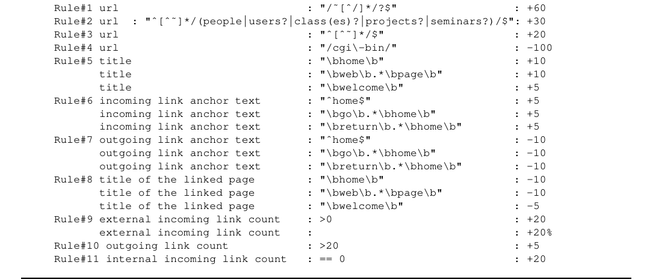
Figure 1: Rules and Scoring Functions for Identifying Logical Domain Entry Pages
Figure 2

Figure 2: Path-based Approach (a) Initial Assignment; (b) Adjustment by Checking Min. Page Count and Removing Small Domains; and (c) Adjustment by Checking Min. Page Count with Dynamic Page Reassignment
Figure 4

Figure 4: comparison of Approaches to Boundary Definition: (a) Original Assignment; (b) Path-based Approach; (c) Path+Link Approach with r adius=3; and (4) Path+Link Approach with r adius=2
Figure 3
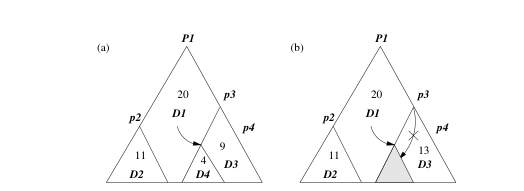
Figure 3: The Issue of Logical Domains with Isolated Sub-domains
Figure 5
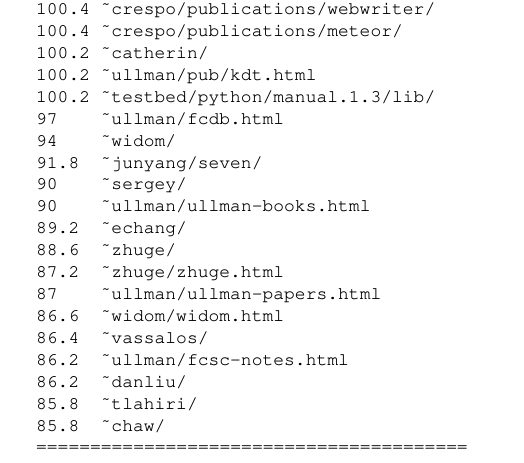
Figure 5: Logical Domain Entry Page Identification Re- sults for www-db.stanford.edu (top 30)
Figure 6
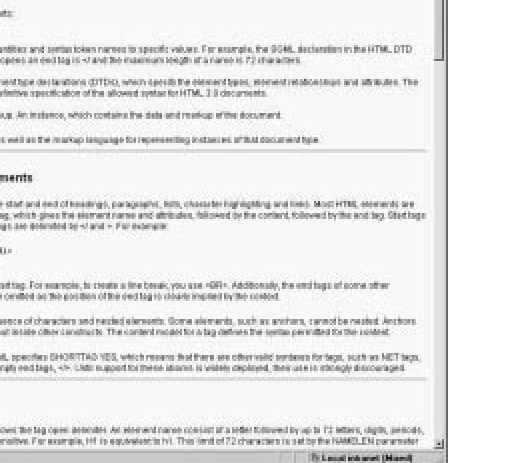
Figure 6: Web Site Map for Navigating www.w3c.org
Do you like what you are reading? Subscribe to receive updates.
Unsubscribe anytime