
Defeat the Feed: Evaluating Interface Designs to Support Users in Managing their Social Media Use
Authors: Eelco Herder, Paulina Moerland Published in: HT '24: 35th ACM Conference on Hypertext and Social Media, Poznan, Poland, September 10-13, 2024 DOI: 10.1145/3648188.3675148 License: © Copyright held by the owner/author(s). Publication rights licensed to ACM.
Defeat the Feed: Evaluating Interface Designs to Support Users in Managing their Social Media Use
Eelco Herder Paulina Moerland e.herder@uu.nl p.moerland@students.uu.nl Utrecht University Utrecht, The Netherlands
Abstract
Due to the increasing ubiquity of social media, compulsive social media use is an increasingly persistent issue that compels users toward excessive social media usage, which can lead to negative consequences. Though reasons for this behaviour are difficult to research, it is theorized that addictive social media design may contribute to compulsive social media use. In this study, we design and evaluate alternatives for the so-called infinite scroll, offering natural moments to leave the feed, and for notifications, providing users with various types of support to decide to respond to them, or to ignore or postpone them. The designs are inspired and informed by the literature and the results of a survey study. The results of this study contribute to understanding addictive design better and can contribute to the improvement of social media to make them less addictive.
CCS Concepts
• Information systems →Social networks; • Human-centered computing →Empirical studies in collaborative and social computing; Empirical studies in interaction design.
Keywords
social media, social media addiction, compulsive behavior, infinite scroll, notifications
1 INTRODUCTION
In the past few decades, reliance on digital platforms has increased and social media use has intensified significantly. Sharing, liking and commenting on social media has become a part of many people’s daily routines, encompassing a large portion of people’s social
interactions and sources of information and entertainment [20]. Due to the rising use and ubiquity of social media platforms, the risk of excessive and problematic use has also risen accordingly. Average daily social media use is estimated to have increased by 13% to 43% in the past 10 years and is still rising [12, 13]. Compulsive social media use has been linked to negative consequences such as a decrease in productivity, lower quality of mental and physical health, worsening of relationships and overall, a decrease in control of one’s screen time [1, 17]. Despite the previous concerning statistics, compulsive social media use is not a well-understood or extensively researched phenomenon, even though a significant portion of social media users feel like they are addicted and suffer negative consequences because of it [7, 13]. According to different studies, personal reasons for using, and overusing, social media differ and reasons are generally not easily identified [18]. Research has been conducted on the topic of social media addiction, but rarely on the effects of addictive designs. Different solutions to social media addiction exist and have been proposed, such as nudges and screen time trackers that aid in directing user behaviour. These often do not take into account the highly persuasive nature of addictive social media designs. Thus, many solutions are disliked or ineffective in the long run. In this paper, we aim to investigate the nature of addictive social media design and develop non-invasive design transformations for social media user interfaces and their effects on social media usage. In Section 2, we discuss relevant related work, followed by our methodology in Section 3. Section 4 covers the largest part of this paper and is divided in two parts: first, we present survey results on social media use, while the second part introduces design transformations for the infinite scroll and notifications and their evaluation. We conclude with a discussion in Section 5 and conclusions in Section 6.
2 RELATED WORK
Compulsive social media use is a condition that compels individuals towards irrational and excessive social media usage [6, 7]. It is characterized by the compulsive need to use social media frequently and unceasingly, possibly at the cost of health, responsibilities and relationships [2, 10]. Compulsive social media use culminates in a few characteristic types of behaviours. One of the most significant aspects of compulsive social media use is the state of flow it can induce for a user. Flow, a term coined by Csikszentmihalyi in 1990 [5], is a mental
state of concentration that is so focused that people find themselves deeply absorbed in that activity. Addictive social media design can be defined as user experience features that aim to persuade the user towards engaging with social media as often and as long as possible [11]. It is theorized that many social media platforms are purposefully designed to provide users with a constant stream of positive feedback, through likes, comments, and notifications. This creates a dopamine-driven feedback loop, where users, for example, feel a sense of reward and validation each time they receive a notification [9]. The first problematic design element is the infinite scroll feature, which is the most well-researched feature in relation to social media addiction. It is encountered inside social media feeds. The infinite scroll is a navigational feature where social media content is automatically loaded at the bottom of the feed on a single page, rather than letting users generate new pages of content themselves by clicking a button, as was common in earlier web designs [8]. Another possibly problematic design feature is the notification. They serve to alert users to new activities that occur in their social media accounts [19]. For example, notifications may be used to alert users about new chat messages, that someone has liked their post or that they should view a recommended post. Notifications are different from other addictive design features by being present both inside and outside an app, serving as a significant cue to open up social media [3]. What may make notifications especially addictive is how the content and the reason for a notification are presented. An ideal notification will alert the user of the reason, so the user can decide whether it is worth it to open their social media or not [19]. However, when hiding the intent by providing an ambiguous notification, the user cannot decide whether they should open their social media and is more likely to do so, in the case it is important and worth their immediate attention [16]. Behavioural interventions are typically an effective tool to improve social media use for users who engage in compulsive social media use to a debilitating degree. For instance, screen time trackers aim to quantify a user’s total screen time on a device, such as a smartphone. Android smartphones, for example, have Digital Wellbeing1 as an opt-in feature for users. A study by Zimmerman et al. [21] about screen tracking similarly showed that users can have mixed feeling about tracking screen time. Users may also feel angry or guilty about seeing their personal screen time data, such as anger and guilt toward their personal usage, which may worsen compulsive social media use [4]. Since social media addiction has been a recognised issue, many researchers have aimed to design interventions against the addictive effects of social media inside the social media platforms themselves, with mixed results. A study by Purohit and Holzer [15] found that nudges in social media raise concerns about ethics and privacy, feeling "being told what to do". A later study [14] aimed to co-design nudges against Instagram overuse, which led to more positive results for users and their social media behaviour. Further, research indicates that users may become immune to nudges over time [21]. In summary, earlier work indicates that user behaviour should be influenced subtly and not invoke feelings of loss of privacy. Design
1https://www.android.com/intl/nlnl/digital-wellbeing/
interventions should be non-invasive and pleasant to use, while making sure users do not feel the need to keep compulsively using social media. Therefore, this study aims to provide insights what this ideal solution against addictive social media could look like.
3 METHODOLOGY
As explained in the previous sections, this study aims to research the nature of compulsive social media use due to addictive social media design, as well as its mediation by studying existing solutions and designing new, integrated non-invasive solutions. The multidimensionality of this study has led to the design of two different phases, each using different research methods. The first study aims to answer how compulsive social media use is experienced and mediated, and what are the addictive features of social media design. In a survey, the participants were asked about their general social media use, such as which platforms they use and how, and they will be asked about how feel about and interact with social media. Participants were also asked about how they perceive their social media use and how they control it. Based on the results of the survey, a set of design alternatives have been created. These proposals have been applied to mock prototype screens of popular social media platforms, to be familiar to participants during the evaluation. Subsequently, the proposed designs are evaluated on quality and user acceptance. The choice was made to conduct interviews with participants who are interested in altering their social media use. Then, in-depth discussions can be conducted on what potential users think of the features, and how the solutions compare against each other. Participants were encouraged to provide their own ideas as well, as there may be more ways to alter addictive social media features. Before each study, participants have been informed about what the study will entail, what will be done with their information and what their rights are. All participants were given the opportunity to ask further questions before the start of each study and were able to give informed consent. All participant data has been anonymized.
4 RESULTS 4.1 Survey results on social media use
The survey received an initial 84 responses, all from Dutch-speaking participants. A total of 10 responses have been omitted from the data analysis due to incomplete or invalid results. All omitted responses have been permanently deleted. This leaves a total of 74 responses that have been analysed. 50 women and 24 men and no non-binary persons participated in the survey. 30% of participants were in the age range 18-25, largely consisting of university students. On the other hand, 25% of the participants are aged 46 and older, so the results are assumed to be representative for the different age groups of Dutch citizens. The main platforms used by the participants are, in descending order, WhatsApp, Facebook, Youtube, Instagram and Linkedin, followed by Pinterest, Snapchat and Twitter. TikTok was only used by 14 participants. Participants were asked to indicate how many hours per day they think they spend on social media in total. The majority (61%) indicated an average of 1-3 hours per day, 23% of the participants
Defeat the Feed: Evaluating Interface Designs to Support Users in Managing their Social Media Use HT ’24, September 10–13, 2024, Poznan, Poland
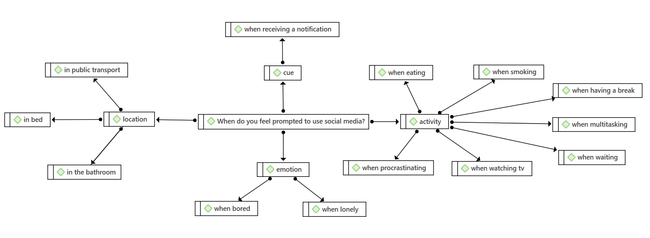
Figure 1: A visualization of reasons to start using social media.
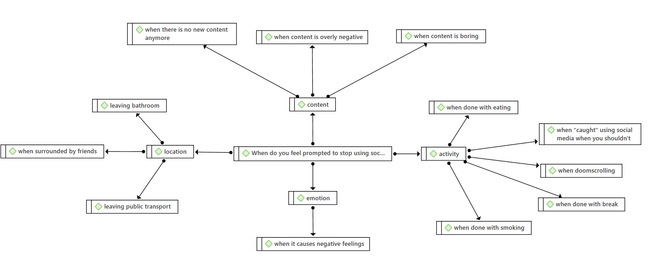
Figure 2: A visualization of reasons to stop using social media.
spent 3-5 hours, with only few people spending more than 5 or less than 1 hours on social media per day.
4.1.1 Begin and end of social media sessions. Participants were asked the question “When do you feel prompted to use social media?”. Figure 1 provides an overview of the web of the range of results. The results were divided into four categories: "location", "cue", "emotion" and "activity". Generally, social media is used during activities a person’s attention does not need to be entirely directed at, such as when eating or smoking. However, social media is also used when a person is supposed to fully direct their attention towards a task: “I also often put videos on in the background when I should be doing something else.” The only mentions of emotions are boredom, due to a lack of engagement, and loneliness. One participant, for example, stated “When I’m without something for a while that MUST get my attention, I want to grab my mobile already.”, while another one stated “when I feel like I’m missing out”.
Locations where social media is used are related to a lack of engagement. For example, as one participant stated: “When sitting in the train and I have nothing else to do”. Generally, social media is used when experiencing downtime, or when lacking engagement. It is clear that social media provides a source of distraction in many different situations, even as a coping mechanism for negative feelings or when a person should tend to different responsibilities. Participants were also asked the complementary question “When do you feel prompted to stop using social media?”. Figure 2 provides an overview of the web of the range of results. The answers to this question largely complement participants’ reasons for starting to use social media. For example, one participant’s reason to start is “when I’m on the train” and their reason to quit is “when I’m leaving the train”. When contexts and being in a certain location end, participants tend to quit using social media, as their attention is directed elsewhere. A new dimension here is content. When it is no longer wishful to scroll through social media due to the content, a user may be
prompted to stop. This can simply be “when I reach the end of the feed and posts start repeating” but it can also be “when I feel like I’m doomscrolling”. Overall, outside interruption and a negative feeling towards content are the main reasons to stop using social media.
4.1.2 Notifications. Participants were subsequently asked how soon they react to notifications. The results indicate that most participants do not seem to be burdened by notifications, as the majority answered: "Whenever it suits me". Only one participant was compelled to answer immediately. Furthermore, nearly all participants at least react to some types of notifications. Participants were also asked about how they perceive notifications. Participants were able to elaborate on why they choose to respond to or ignore certain types of notifications. Participants mentioned that they value notifications of messages directed to them personally, rather than general messages. As one participant stated: "I don’t respond immediately in group chats. I do respond immediately in person. Or at least as soon as possible.". They also value notifications on content that are perceived as useful or interesting to them, such as news and notifications that say it is a friend’s birthday. Notifications that are not appreciated are those deemed to be impersonal and automatically generated. One participant, for example, stated: "Basically, I respond to all notifications. Unless it is an automatically generated message or spam.". Lastly, participants were asked whether they have ever adjusted the settings of notifications for any social media, and how. 32 participants (78%) said they have. Participants provided different reasons. One reason is the number of notifications certain apps give, such as one participant on WhatsApp: "group app notifications where you immediately get 29973 messages". The method here is turning notifications off completely. Some participants kept visual notifications but turned off the sound. One participant stated: "I only use silent notifications for social media, so my phone does not vibrate when I get one in. That way, I still try to maintain something of control.". Notifications have also been adjusted according to context, such as turning off notifications when on holiday. To summarize, participants feel differently about notifications dependent on context, and in turn, deal with them differently. Notifications on personal messages and mentions are appreciated most of all and notifications that are generic are appreciated far less. Most participants have adjusted settings for notifications, indicating a clear issue with the basic version of this feature.
4.2 Designing transformations
Of the 30 total participants who were interested in partaking in follow-up research, 21 were interested in improving their social media use. A total of 14 participants responded to our invitation and were also able to partake in the interview during the provided allotted times. 11 of these participants were women and 3 were men. 10 of these participants were in the 18-25 age range and 4 were in the 26-35 age range.
4.2.1 Infinite scroll. As described in the literature review, the infinite scroll is already well-researched as an addictive feature, with no established solution. Thus, two different navigational methods
Table 1: A table featuring the evaluation of the initial design solutions for the infinite scroll.
rank Feature Disapproved
Unsure/ Mixed Approved
1. Pagination 0 (0%) 6 (43%) 8 (57%)
2. "load more" button 0 (0%) 7 (50%) 7 (50%)
3. Scrolling-time pop-up 3 (21%) 5 (36%) 6 (43%)
4. Purposeful content variation 5 (36%) 8 (57%) 1 (7%)
will be compared. First, a "load more" button is incorporated, where users have to click a button to load more posts. Secondly, a pagination feature breaks the infinite scroll up into separate pages. These two features, as shown in figure 3, will be compared in the evaluation. The literature has shown that scrolling through the feed can be made to be more active, rather than passive, so mindless scrolling is minimized or prevented. According to the results, people engage at different levels of activity and passivity with different kinds of content. Thus, a solution could be to intentionally incorporate content that could break the spell of mindless scrolling. Participants will be asked which type of content could be effective in this goal. Lastly, a commonly researched solution to mindless scrolling is to incorporate a nudge that tells the user how long they have been scrolling and to do something else. However, the literature review has shown that nudges like this have been experienced as invasive, do not work for everyone and may become ineffective in the long run. To confirm whether nudges are indeed invasive solutions, or can maybe be useful if incorporated differently, the described nudge will also be evaluated. Figure 4 shows an example of what such a nudge can look like. Table 1 provides a ranked overview of how the different features were evaluated. The interview results show that, overall, participants completely agreed that the infinite scroll should be changed in some type of way due to how it encourages mindless scrolling, though opinions are divided between the "load more" and pagination options. In regards to pagination, one participant mentioned that it may be easier to plan how much you use social media with a pagination feature: “maybe you can say for yourself, I’ll scroll one page and then stop”. and another one mentioned: "there’s more of an end to your feed". Another reason is that the "load more" feature may still keep you in the flow, as it is still really accessible. An alternative option here would be for a user to be able to set a different amount of posts they want to see on one page, so navigating through pages is not overly intense. One participant also stated: "Sometimes, I want to be in the flow mode of the infinite scroll, and sometimes I don’t on busy days". To summarize, the original infinite scroll was rejected, but it is still unclear whether pagination or the "load more" button would be most effective. Either way, these two alternatives are deemed to be better at deterring the user from mindlessly scrolling than the infinite scroll.
Defeat the Feed: Evaluating Interface Designs to Support Users in Managing their Social Media Use HT ’24, September 10–13, 2024, Poznan, Poland
Figure 3: Design alternatives for the infinite scroll.
Figure 4: An example of a nudge against mindless scrolling.
The scrolling-time pop-up received mixed results, but was accepted by some based on some alterations, like making it less intrusive and changing the text to be more directed at what the user should really be doing other than scrolling. Creating a variation in content was not well-accepted, as users generally saw no purpose for it and could not think of any way to implement it purposefully.
4.2.2 Notifications. According to the results of the survey, participants are generally unbothered by notifications, but are sometimes annoyed by certain types of notifications, and are able to choose when and what to respond to by themselves. However, as notifications are often designed to hide their intent, users cannot always make an informed choice on which notifications are important and which ones are not. One solution is that information can be increased to include the full message of a text. Since hiding information is an addictive
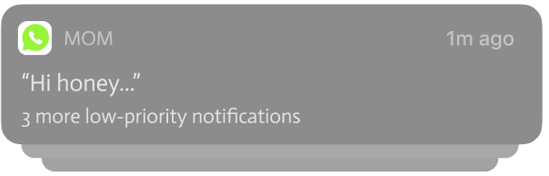
Figure 5: An example of how a high-priority notification will appear over low-priority notifications.
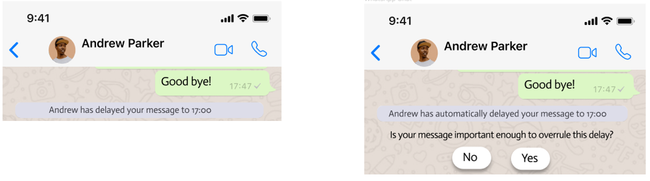
aspect of the notification design, doing the opposite by incorporating full information may improve the feature to aid users in self-filtering which notifications they want to attend to. A total lack of information will also be tested. In relation to the goal of aiding users to self-filter which notifications they want to attend to or not, it can be made easier for participants to decrease the compulsion to check their phones by allowing apps to filter different types of notifications for a user. Then, e.g., generic notifications could be removed, such as about app updates. These types of notifications are not appreciated by the participants, while notifications such as on personal messages are appreciated, which can be given priority. An example of a notification with a high-priority label can be seen in figure 5. Lastly, as notifications are a cue for inviting a user to social media, sometimes at times they should attend to other matters, the timing of the cue will be experimented with in the following solution. Since the results showed that participants are already interested in customizing their notification view, the ability to delay notifications will also be tested. Participants will also be asked if they would like other users to be able to override this delay. This solution could offer a way to further deter users from checking notifications when they should not. A visual example of the feature and its alternative option for the user to delay a message can be seen in figure 6. Table 2 provides a ranked overview of how the different features were evaluated. The most well-evaluated feature was the ability
Figure 6: An example of how a message can be delayed and how a user may override a delay.
to see the full message’s content inside a notification. Even for reasons unrelated to compulsive social media use, the feature was appreciated: "Especially with WhatsApp it is nice to think about your answer before you open the message", referring to the "marked as read" indicator putting pressure on people to respond soon.
Table 2: A table featuring the evaluation of the initial design solutions for notifications.
rank Feature Disapproved
Unsure/ Mixed
Approved
1. Providing full notification content 0 (0%) 0 (0%) 14 (100%)
2. Filtering notifications 0 (0%) 2 (14%) 12 (86%)
3. Adding priority labels 3 (21%) 5 (36%) 6 (43%)
4. Delaying notifications 3 (21%) 6 (43%) 5 (36%)
5. Providing no notification content 14 (100%) 0 (0%) 0 (0%)
Participants generally appreciated the ability of higher customization for filtering notifications. Some participants already had notifications on and off for certain apps, so were especially interested in filtering notifications in different ways within one app. For example: "I think it would be great to filter notifications from group chats that send messages all the time.", while wanting to keep notifications from personal messages. The ability to add priority labels and receive a ranked notification overview received mixed evaluations. Participants who appreciated the ability to prioritize notifications appreciated it for making some sense of their large amount of notifications: "It would be nice because I have a hard time setting priorities". Some participants felt unsure or disapproved about the ability to create a priority list: "It wouldn’t really matter because I like to clear all notifications.", also describing that the shift in thinking about how the notifications are no longer viewed chronologically might be difficult. Participants were intrigued by the ability to delay notifications, but were critical of them. Participants who appreciated the feature said, e.g.: "Better to open it all at once, rather than 40 times a day.". Participants were unsure about allowing other users to override your delay: "If it was really important, they would call", though one other participant worried about the possibility of emergencies where you may not be able to call. One participant was critical of the message the other person receives and said they would rather see it brought as "participant name is at work until 5 PM". Some participants disapproved of the feature, such as a participant who stated: "I would wait for 5 PM and then have an addictive reaction. It would make me anxious.", meaning
they would feel distracted by the idea of incoming notifications they do not yet know about. All participants disapproved of providing no notification content at all, confirming the notion that more information in a notification aids in self-filtering, as implied in one statement: "Then I would check out all notifications which is frustrating.". The evaluation showed that generally, a higher level of customisation and a higher level of information in notifications were appreciated by the participants and would be beneficial against compulsive social media use.
5 DISCUSSION
The results of this study confirm some of the reasons for engaging in excessive social media use, such as social media as a source of quick entertainment. Similar consequences to the issue were also identified, such as frustration and disappointment due to social comparison. This study, however, takes it a step further by also indicating how these reasons and consequences can be linked to particular design features. On the topic of addictive social media design, this study has contributed to the body of work on features that have already been identified as addictive: the infinite scroll and notifications. This study has confirmed that these are indeed problematic features and, moreover, takes a different aim by focusing on the positive aspects of addictive features as well. The results of this study can contribute to existing social media designs and can inform creators on how to design their platforms to foster healthier, more conscious use. Even if social media platforms do not want to alter their designs voluntarily, it will further substantiate the critiques from activists and ongoing lawsuits against addictive social media design to possibly still inspire, or force, necessary action from social media platforms.
6 CONCLUSIONS
This paper aimed to explore addictive social media design and possible non-invasive solutions. Perspectives and experiences related to social media in general and addictive features were discovered and explored. Based on these discoveries, potential non-invasive solutions were designed, which were also evaluated on potential effectiveness. People tend to enter social media when they do not need to tend to other responsibilities, but also often enter social media when they do, leading to attempts at multitasking. Altering the infinite scroll to require more input from the user is regarded to be the main solution to promote conscious scrolling, for instance by adding an opt-in subtle nudge as an option for users who need even more awareness of their mindless scrolling. For notifications, aiding in self-filtering is key. Users prefer the full message to be included in a notification, so that they can choose what to respond to. Further, users would prefer to customize the feature to make distinctions between different types of notifications. As there is no one-size-fits-all solution, a focus should be put on high levels of customization, the ability to choose how certain features are implemented.
Defeat the Feed: Evaluating Interface Designs to Support Users in Managing their Social Media Use HT ’24, September 10–13, 2024, Poznan, Poland
References
[1] Adam Alter. 2017. Irresistible: The rise of addictive technology and the business of keeping us hooked. Penguin.
[2] Tunc-Aksan Aygul and Sinem Evin Akbay. 2019. Smartphone addiction, fear of missing out, and perceived competence as predictors of social media addiction of adolescents. European Journal of Educational Research 8, 2 (2019), 559–566.
[3] Joseph B Bayer, Ian A Anderson, and Robert S Tokunaga. 2022. Building and breaking social media habits. Current Opinion in Psychology 45 (2022), 101303.
[4] Barry Brown, Moira McGregor, and Donald McMillan. 2014. 100 days of iPhone use: understanding the details of mobile device use. In Proceedings of the 16th international conference on Human-computer interaction with mobile devices & services. 223–232.
[5] Mihaly Csikszentmihalyi and Mihaly Csikzentmihaly. 1990. Flow: The psychology of optimal experience. Vol. 1990. Harper & Row New York.
[6] Vincent Henzel and Anders Håkansson. 2021. Hooked on virtual social life. Problematic social media use and associations with mental distress and addictive disorders. PloS one 16, 4 (2021), e0248406.
[7] Yubo Hou, Dan Xiong, Tonglin Jiang, Lily Song, and Qi Wang. 2019. Social media addiction: Its impact, mediation, and intervention. Cyberpsychology: Journal of psychosocial research on cyberspace 13, 1 (2019).
[8] Tina Kendall. 2021. From binge-watching to binge-scrolling: TikTok and the rhythms of# LockdownLife. Film Quarterly 75, 1 (2021), 41–46.
[9] Hyoungkoo Khang, Jung Kyu Kim, and Yeojin Kim. 2013. Self-traits and motivations as antecedents of digital media flow and addiction: The Internet, mobile phones, and video games. Computers in human behavior 29, 6 (2013), 2416–2424.
[10] Romualdas Malinauskas and Vilija Malinauskiene. 2019. A meta-analysis of psychological interventions for Internet/smartphone addiction among adolescents. Journal of behavioral addictions 8, 4 (2019), 613–624.
[11] Christian Montag, Bernd Lachmann, Marc Herrlich, and Katharina Zweig. 2019. Addictive features of social media/messenger platforms and freemium games
against the background of psychological and economic theories. International journal of environmental research and public health 16, 14 (2019), 2612.
[12] John A Naslund, Ameya Bondre, John Torous, and Kelly A Aschbrenner. 2020. Social media and mental health: benefits, risks, and opportunities for research and practice. Journal of technology in behavioral science 5 (2020), 245–257.
[13] Beryl Noë, Liam D Turner, David EJ Linden, Stuart M Allen, Bjorn Winkens, and Roger M Whitaker. 2019. Identifying indicators of smartphone addiction through user-app interaction. Computers in human behavior 99 (2019), 56–65.
[14] Aditya Kumar Purohit, Torben Jan Barev, Sofia Schöbel, Andreas Janson, and Adrian Holzer. 2023. Designing for DigitalWellbeing on a Smartphone: Cocreation of Digital Nudges to Mitigate Instagram Overuse. (2023).
[15] Aditya Kumar Purohit and Adrian Holzer. 2021. Unhooked by Design: Scrolling Mindfully on Social Media by Automating Digital Nudges.. In AMCIS, Vol. 21. 1–10.
[16] Cary Stothart, Ainsley Mitchum, and Courtney Yehnert. 2015. The attentional cost of receiving a cell phone notification. Journal of experimental psychology: human perception and performance 41, 4 (2015), 893.
[17] Patti M Valkenburg. 2022. Social media use and well-being: What we know and what we need to know. Current opinion in psychology 45 (2022), 101294.
[18] Patti M Valkenburg, Irene I van Driel, and Ine Beyens. 2022. The associations of active and passive social media use with well-being: A critical scoping review. New media & society 24, 2 (2022), 530–549.
[19] Haifeng Xu and Bernard C. Y. Tan. 2012. Why Do I Keep Checking Facebook: Effects of Message Characteristics On the Formation of Social Network Services Addiction. In International Conference on Interaction Sciences. https: //api.semanticscholar.org/CorpusID:26674051
[20] David Zendle and Henrietta Bowden-Jones. 2019. Is excessive use of social media an addiction?
[21] Laura Zimmermann. 2021. “Your screen-time app is keeping track”: consumers are happy to monitor but unlikely to reduce smartphone usage. Journal of the Association for Consumer Research 6, 3 (2021), 377–382.
Figures


Do you like what you are reading? Subscribe to receive updates.
Unsubscribe anytime