
ACM source attribution: Complete full-text transcription from ACM publisher HTML, cross-checked against supplied 7-page proceedings PDF. DOI: 10.1145/3648188.3675146.
As a Grain of Link: How Far Should We Take Link Granularity
Authors: Tiziano Citro , Dipartimento di Informatica, Università degli Studi di Salerno, Italy, tcitro@unisa.it; Maria Angela Pellegrino , Dipartimento di Informatica, Università degli Studi di Salerno, Italy, mapellegrino@unisa.it; Vittorio Scarano , Dipartimento di Informatica, Università degli Studi di Salerno, Italy, vitsca@unisa.it; Carmine Spagnuolo , Dipartimento di Informatica, Università degli Studi di Salerno, Italy, cspagnuolo@unisa.it
Abstract
Individuals can leverage data referencing in collective scenarios, akin to deixis, a common human interaction in which they can physically point to relevant information. While deixis is easily performed in online synchronous interactions, e.g., mouse pointing during screen sharing in video conferences, reproducing it in asynchronous online interactions is not trivial. A significant step towards finer mimicking in-person co-presence is enhancing the granularity of links to data, enabling users to reference specific pieces of data in their content. This paper reviews 43 digital platforms in 8 sub-categories, organized in 3 main categories, and proposes requirements, opportunities, and challenges of link granularity for asynchronous online interactions.
CCS Concepts
CCS Concepts: • Human-centered computing → Hypertext / hypermedia ;
Keywords
Link granularity , Comparison , Digital Platforms , Online Co-presence
ACM Reference Format
ACM Reference Format: Tiziano Citro, Maria Angela Pellegrino, Vittorio Scarano, and Carmine Spagnuolo. 2024. As a Grain of Link: How Far Should We Take Link Granularity. In 35th ACM Conference on Hypertext and Social Media (HT '24), September 10--13, 2024, Poznan, Poland. ACM, New York, NY, USA 7 Pages. https://doi.org/10.1145/3648188.3675146
1 INTRODUCTION
In the age of digital communication, online co-presence has become a fundamental aspect of how we engage with information and interact with others. Despite the convenience and accessibility of digital platforms, they frequently fall short of replicating the inherent freedom of in-person co-presence. In face-to-face interactions, individuals can employ physical gestures [46], such as pointing or gesturing, to reference and clarify relevant things. These actions serve as intuitive mechanisms for clarifying statements and directing attention to specific objects or data for easy exchange of information. A multitude of data is shared daily via digital platforms, serving diverse purposes and catering to varied audiences. Data differ in content and format, while the ability to refer to content as a whole or its components is up to the task, situation, audience, or discussion phase. Many situations can benefit from unambiguous references to shared content, such as reviewing articles by pinpointing pages and lines or sharing notes in educational settings [37, 52]. In the following, we will use three guiding scenarios to justify the desired link granularity and the requirements of digital platforms in supporting online co-presence.
The first scenario concerns fact-checking, where experts in the field and the crowd collaborate to identify information disorder in shared content [47], mainly within social media platforms like X, Facebook, and numerous others, which serve as hubs for disseminating content ranging from textual posts to multimedia elements such as images and videos. Amidst the abundant information on these platforms, checking shared content is crucial [51]. For instance, suppose fact-checkers are verifying the content of a social media post, potentially portraying false information. As they are social media users themselves, they are often accustomed to the possibility of linking to the post as a whole. Still, rather than the post's entire content, they might need to discuss a sentence in the text, a picture, or a video within the post. They could create more precise links if presented with the possibility of doing so. While we can suppose social media platforms allow users to share links to a post, it is required to verify to what extent they support the creation of links that precisely direct users to these finer details without decontextualized content.
The same necessity can be experienced in the second scenario about creative intelligence, which is the ability to propose innovative ideas while designing solutions [13]. With creative collective intelligence, users can afford to go beyond individual efforts by discussing innovative proposals with others across several digital environments. It requires tools used to produce solutions to support users by allowing them to precisely refer to authored content, even when working across different platforms. For instance, it affects productivity tools ranging from instant messaging to content creator and developer platforms.
In the third scenario, data visualizations and data stories [44] heavily rely on (linked) (open) data. Typically, discussions revolve around the dataset as a whole but may focus on fine-grain dataset aspects, such as a specific range of data or their visualizations.
According to the outlined three scenarios, fact-checking, collective creative intelligence, and data storytelling unfold within collective and data-driven settings. Participants could benefit from referencing specific pieces of content and navigating a diverse array of data formats, including textual, media, spreadsheets, and graph-like data. The granularity of these references tailors to the task and discussion at hand. In response to the necessity to refer to shared content at any desired level, we propose the concept of link granularity as a pivotal mechanism for enhancing both the creation and visualization of links. This concept centers on empowering users to create more precise links that pinpoint specific elements of meaningful content while improving the clarity and context provided to users when navigating these links. For instance, alongside the ability to link to an entire post on a social media platform, users could be provided with the capability to link to finer details within the post, such as attachments or segments of text. Moreover, when users share such links with others, recipients should be presented with a clear and comprehensive visualization of the precise content referenced by the link. An option could involve highlighting the attached media or the specific referenced text, accompanied by contextual cues that clarify the content within its overall context.
Our study analyzes the current granularity levels for link creation mechanisms and the adequacy of visualizations offered by different categories of digital platforms. Hence, it overviews the current landscape of link granularity practices, responding to the Research Question (RQ) “How far is link granularity currently taken?”.
We performed a quantitative and qualitative analysis of three categories of platforms, targeting social media platforms, (linked) open data platforms, and productivity tools. As a result, we experienced heterogeneous support for link creation and visualization mechanisms. Each category presents outstanding pretenders, but we are far from reaching a commonly accepted approach, even across tools in the same category. Still, link granularity can be taken further ahead, even when considering the best pretender per category.
The contribution of this paper is twofold, summarized as follows:
the proposal of link granularity as a way to improve link creation and visualization mechanisms (Section 2);
2 LINK GRANULARITY
The idea of link granularity is grounded on the general concept of granularity, as it pertains to the capability to represent and manipulate data, information, and knowledge across different levels of detail. For instance, consider a scenario where users want to reference content within a dataset. A conventional approach might involve coarse-grain referencing, where the entire dataset is cited as a link with side information to guide the interlocutor in correctly identifying the specific details of interest. Indications for identifying a cell in a data table might take the form of “Consider the column with header X and look at row Y”. As a result, the interlocutor has to follow these directions to identify the cell. However, what happens with multiple tables, perhaps stored in different tabs in a shared document? How do we make sure people are aligned on the same table? What happens when names are codes rather than human-readable labels? These realistic hypotheses give a rough idea of a task that can be easily solved in person by pointing to the cell of interest, which can become a pedantic and error-prone process in remote discussions. Consequently, our idea leans towards allowing users to reference specific elements within the dataset at a finer level of detail, ranging from individual cells within a table to a range of data. The idea applies to any shared content.
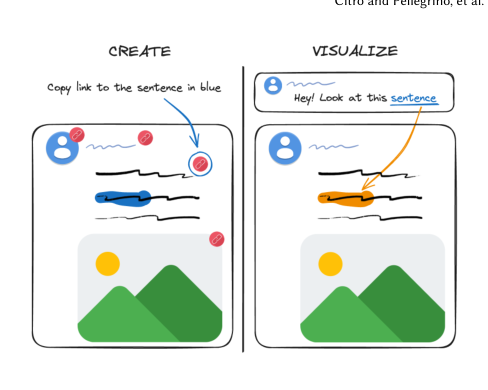
Figure 1: Granular link creation to a word in a post and the corresponding highlighted and contextualized visualization.
The first step towards our idea is the integration of link granularity into the various components platforms employ to present content to users. For instance, social media platforms commonly provide users with dedicated buttons and icons to share content via links. Additional components should be incorporated into content visualizations to augment these visual elements, enabling users to generate links to specific elements within the content. For instance, consider a post containing text, an associated user representing the content creator, and an attached image. Platforms should provide users with buttons or icons to generate links not only to the entire post but also to the user, text, specific portions of the text, and the image (see Figure 1-CREATE) for an example). This approach amplifies granularity, allowing users to share precise aspects of the content. Still, this could go even further in granularity, as one can deem it helpful to users engaging with the platform content.
At the same time, how the targets of these links are presented to users when accessed must reflect the granularity in link creation. For instance, consider a scenario like in Figure 1-CREATE where a user creates a link to a specific sentence within the text of a social media post and shares it with others. When recipients click on the link to access the post, the effectiveness of the link relies on the platform's ability to provide clear visual cues highlighting the referenced sentence, such as in Figure 1-VISUALIZE. The user experience is compromised without such visual cues, causing the link to be no different from the one to the entire post.
Simultaneously, preserving contextual information is crucial. While users can link to media on many platforms using browser capabilities, these links often lack context from where users sourced them. For instance, users may generate links to specific images using browser features on social media platforms. However, clicking these links mostly leads users to the image without referencing the original post or its surrounding content. The disconnect between the linked media and its context poses a significant challenge, as users are left without the necessary background information to understand its significance fully.
3 PLATFORMS COMPARISON
This section compares digital platforms on the granularity offered for creating links and the support for highlighted and contextualized visualization of link targets, i.e., elements referenced by links.
Selection Criteria.. The platforms considered in our comparison belong to social media platforms, (linked) open data platforms, and productivity tools. The authors agree on each category's most commonly used digital platforms, considering official online statistics. More in detail, social media platforms are identified by considering the most popular social networks worldwide as of January 2024, ranked by number of monthly active users in millions according to Statista1 which makes available data collected by research, market and opinion institutions, as well as statistics relating to the economic and state spheres. We explore the open data platforms suggested by the European Commission2, and we integrate those with platforms commonly used to publish linked open data and knowledge graphs that are used as a reference within the semantic web community. Finally, we consider a wide range of productivity tools suggested online for collaborative editing, instant messaging, and other tools that can be used to co-design solutions.
Table 1: Scores for social media platforms where platforms are sorted by number of monthly active users (in millions). LEGEND: within the creation phase (C), * means browser-enabled, ** means that dedicated mechanisms are enabled but are not obvious to exploit (e.g., a multi-step procedure is required), and *** means that the platform allows for an easy-to-use and not ambiguous dedicated mechanism for creating links. About the scores attached to the visualization phase (V), * means that the link is decontextualized, ** that the linked content is visualized surrounded by its context, and *** means that the linked content is visualized surrounded by its context while also highlighted to make evident the content used to create the link. - means that the feature is not supported, while blanks means not applicable. ✓ means making use of it (only used in Table 2).
Name | Shared Content (SC) | SC Author | SC Text | SC Attachment | User | Comment(s) | ||||||
C | V | C | V | C | V | C | V | C | V | C | V | |
Facebook [27] | *** (∼) | ** | * | * | - | - | * | * | * | ** | - | - |
YouTube [38] | *** (!) | *** | * | * | - | - | * | * | - | - | ||
WhatsApp [28] | - | - | - | - | - | - | * | * | * | * | - | - |
Instagram [29] | *** | ** | * | * | - | - | - | - | ** | ** | - | - |
TikTok [5] | *** | ** | * | * | - | - | *** | ** | *** | ** | - | - |
Reddit [33] | *** | ** | * | * | - | - | * | ** | * | ** | *** | *** |
Telegram [35] | *** (∼) | ** | - | - | - | - | - | - | ** (∼) | ** | - | - |
Discord [26] | *** | *** | - | - | - | - | * | * | - | - | *** | *** |
X/Twitter [34] | *** | ** | * | * | - | - | *** | ** | *** | ** | *** | *** |
LinkedIn [7] | *** | ** | * | * | - | - | * | * | * | ** | *** | *** |
Pinterest [25] | *** | ** | * | * | - | - | *** | ** | - | - | ||
Threads [31] | *** | ** | * | * | - | - | * | * | * | ** | *** | *** |
Evaluation Criteria.. We analyze the existing mechanisms for creating links to shared content on social media platforms. It is worth noting that we identified a terminology that is broad enough to model the content that can be linked on each social media platform without using platform-oriented terminology. Consequently, shared content generally identifies content that users share on the platforms, such as videos on YouTube and posts on Facebook. Concerning (linked) open data platforms, we analyze the granularity options for referring to specific entities or attributes within the datasets. Lastly, our study evaluates productivity tools facilitating collaboration and information sharing regarding the granularity levels supported for linking to various types of content, such as documents and specific sections within them.
Alongside the creation mechanisms, we assess the efficacy of the visualizations provided by the platforms in offering highlighted and contextual cues, ensuring that users can comprehend the linked content within its original context.
Evaluation Process.. The assessment is performed using the browser Mozilla Firefox3 since it is free and open-source. The evaluators focus on explicit mechanisms the platforms provide to create links, such as buttons and icons and clicking or selecting components to link to. They also explore the context menu, often experiencing browser-enabled link creation like those automatically allowed for images and tabs managed as page fragments. Even if mechanisms explicitly implemented by the platforms are preferred, results also document browser-enabled link creation. For platforms that can be accessed by heterogeneous devices, such as via web, desktop, and mobile applications, the evaluators register the best support for linking offered by one of the applications.
Results.. This section overviews the final scores the evaluators agree on per each platform, clustered according to platform categories. Table 1 overviews scores for social media platforms, Table 2 those for (linked) open data, and Table 3 for productivity tools.
Table 2: Scores for (linked) open data platforms. Refer to Table1-LEGEND for details about the table content.
Open Data Platforms | ||||||||||||||
Name | Dataset | Row(s) | Column(s) | Cell(s) | Metadata | Data charts | Share on | Embedding | ||||||
C | V | C | V | C | V | C | V | C | V | C | V | socials | via iframe | |
CKAN [14] | ** | * | - | - | - | - | - | - | - | - | ** | * | ✓ | ✓ |
DataHub [3] | - | - | - | - | - | - | - | - | * | ** | - | - | - | - |
data.world datasets [12] | * | ** | - | - | ** | * | - | - | - | - | - | - | ||
DKAN [2] | - | - | - | - | - | - | - | - | - | - | - | - | ||
Google datasets [22] | *** | ** | - | - | - | - | - | - | - | - | ✓ | - | ||
Kaggle datasets [21] | - | - | - | - | - | - | - | - | - | - | - | - | ✓ | - |
OpenDataSoft [45] | *** | * | - | - | - | - | - | - | - | - | *** | * | ✓ | ✓ |
Socrata [50] | *** | ** | - | - | - | - | - | - | - | - | *** | ** | ✓ | ✓ |
Linked Open Data, Knowledge Graphs (KGs) and Ontologies | ||||||||||||||
Name | Resource | Node(s) | Link(s) | Metadata | Share on | Embedding | ||||||||
C | V | C | V | C | V | C | V | socials | via iframe | |||||
ARCO [20] | - | - | * | *** | * | *** | - | - | - | - | ||||
CIDOC-CRM [23] | *** | *** | *** | *** | *** | *** | - | - | - | - | ||||
DBpedia (KG) [19] | * | * | * | * | - | - | - | - | ||||||
Europeana (KG) [6] | ** | * | - | - | - | - | ✓ | ✓ | ||||||
LODCloud [1] | - | - | * | * | - | - | * | * | - | - | ||||
LOD in DataHub [3] | - | - | - | - | - | - | - | - | ✓ | ✓ | ||||
Wikidata (KG) [18] | * | * | * | * | - | - | - | - |
Table 3: Scores for productivity tools. Refer to Table1-LEGEND for details about the table content.
TASK MANAGEMENT | ||||||||||||||||||||||||||||||||||||||||||||||||||||||||||||||||
Name | Card | Members | Attachment | Workspace | Discussion | User | ||||||||||||||||||||||||||||||||||||||||||||||||||||||||||
C | V | C | V | C | V | C | V | C | V | C | V | |||||||||||||||||||||||||||||||||||||||||||||||||||||
Asana [24] | *** | *** | - | - | * | - | *** | *** | *** | *** | - | - | ||||||||||||||||||||||||||||||||||||||||||||||||||||
Trello [48] | *** | *** | - | - | * | * | *** | *** | - | - | - | - | ||||||||||||||||||||||||||||||||||||||||||||||||||||
Notion [32] | *** (!) | *** | - | - | *** | *** | - | - | *** | ** | - | - | ||||||||||||||||||||||||||||||||||||||||||||||||||||
DOCUMENT EDITOR | ||||||||||||||||||||||||||||||||||||||||||||||||||||||||||||||||
Name | Document | Text | Discussion | User | ||||||||||||||||||||||||||||||||||||||||||||||||||||||||||||
C | V | C | V | C | V | C | V | |||||||||||||||||||||||||||||||||||||||||||||||||||||||||
Google Docs [39] | *** | *** | * ∼ | *** | *** | *** | - | - | ||||||||||||||||||||||||||||||||||||||||||||||||||||||||
LibreOffice Writer [17] | - | - | - | - | - | - | - | - | ||||||||||||||||||||||||||||||||||||||||||||||||||||||||
Microsoft Word [8] | *** | *** | - | - | *** | *** | - | - | ||||||||||||||||||||||||||||||||||||||||||||||||||||||||
PRESENTATION EDITOR | ||||||||||||||||||||||||||||||||||||||||||||||||||||||||||||||||
Name | Presentation | Slide | Text | Discussion | User | |||||||||||||||||||||||||||||||||||||||||||||||||||||||||||
C | V | C | V | C | V | C | V | C | V | |||||||||||||||||||||||||||||||||||||||||||||||||||||||
Google Slides [41] | *** | *** | - | - | - | - | *** | *** | - | - | ||||||||||||||||||||||||||||||||||||||||||||||||||||||
LibreOffice Impress [16] | - | - | - | - | - | - | - | - | - | - | ||||||||||||||||||||||||||||||||||||||||||||||||||||||
Microsoft PowerPoint [10] | *** | *** | *** | *** | - | - | *** | *** | - | - | ||||||||||||||||||||||||||||||||||||||||||||||||||||||
SPREADSHEET EDITOR | ||||||||||||||||||||||||||||||||||||||||||||||||||||||||||||||||
Name | Spreadsheet | Row | Column | Range | Cell | Discussion | User | |||||||||||||||||||||||||||||||||||||||||||||||||||||||||
C | V | C | V | C | V | C | V | C | V | C | V | C | V | |||||||||||||||||||||||||||||||||||||||||||||||||||
Google Sheets [40] | *** | *** | *** | *** | *** | *** | *** | *** | *** | *** | *** | *** | - | - | ||||||||||||||||||||||||||||||||||||||||||||||||||
LibreOffice Calc [15] | - | - | - | - | - | - | - | - | - | - | - | - | - | - | ||||||||||||||||||||||||||||||||||||||||||||||||||
Microsoft Excel [9] | *** | *** | *** | *** | *** | *** | *** | *** | *** | *** | *** | *** | - | - | ||||||||||||||||||||||||||||||||||||||||||||||||||
INSTANT MESSAGING PLATFORMS | ||||||||||||||||||||||||||||||||||||||||||||||||||||||||||||||||
Name | Channel | Message | Text | Author | Discussion | User | ||||||||||||||||||||||||||||||||||||||||||||||||||||||||||
C | V | C | V | C | V | C | V | C | V | C | V | |||||||||||||||||||||||||||||||||||||||||||||||||||||
Mattermost [30] | *** | *** | *** | *** | - | - | - | - | *** | *** | - | - | ||||||||||||||||||||||||||||||||||||||||||||||||||||
Slack [42] | *** | *** | *** | *** | - | - | *** | ** | *** | *** | *** | ** | ||||||||||||||||||||||||||||||||||||||||||||||||||||
Teams [11] | *** | *** | *** | *** | - | - | - | - | *** | *** | - | - | ||||||||||||||||||||||||||||||||||||||||||||||||||||
Zoom [36] | - | - | - | - | - | - | - | - | - | - | - | - |
Each table's columns model the content that can be shared on the reviewed platform and the corresponding granularity of the content. For instance, besides referring to the shared content as a whole, the evaluators considered the possibility of linking to its components, such as a post's author, text, and attachments. Scores are expressed in terms of stars concerning the creation and the visualization phase, ranging from one to three stars, with a single star as the minimum effort in managing links and three stars as desiderata. More in detail, the more basic linking creation mechanism is the exploitation of the browser-enabled approach (single star), followed by dedicated mechanisms implemented within the platforms (at least two stars), which should be prominently displayed and easy to use (three stars). Concerning the visualization stage, the easiest visualization option is rendering decontextualized content, as it is usually the case with images visualized without any details concerning the surrounding content. While this option results in a single star, the platform is assigned two stars when the linked content is visualized alongside its context. In comparison, three stars are attached to platforms that can contextualize and highlight the referred content to capture the attention of link recipients. For example, when copying the link to a comment in a post, the comment can be displayed as the first comment attached to the corresponding post. Some platforms implement outstanding mechanisms that should be used as references and are explicitly marked with ! in the results tables. For instance, YouTube supports the creation of links to the start or specific seconds of the video, offering an easy-to-use approach for creating links at a fine grain.
4 DISCUSSION
This section details the results by initially addressing RQ through the reported findings from assessing and comparing digital platforms across diverse domains. Subsequently, it identifies opportunities and challenges in supporting fine-grain linking.
4.1 Current State of Link Granularity (RQ)
We can observe a wide use of links in all categories, even at a fine grain. Considering Table 1, most social media platforms support the reference to the shared content as a whole and their components, mainly to attachments. Links to posts’ authors are always created by exploiting the browser-enabled feature, as documented by the single star in the SC Author column. Such links result in a decontextualized visualization where link recipients can explore the user profile rather than access the highlighted author of the shared content. Regarding the mechanism for linking to users’ profiles, we are rather far from a standard, as all the platforms deal with the creation and visualization stages differently, never supporting the highlight of the linked user's profile components. Platforms that support links to comment(s) excel at enabling easy-to-use link creation and visualizing them by highlighting the referred comment alongside the shared content as context. It is an interesting aspect that supports the hypothesis that linking can facilitate discussions. It is surprising that none of the explored social media platforms supports linking to sentences in the text and content's authors, which may be relevant for fact-checking. Furthermore, decontextualizing attachments makes verifying the coherence between text and attachments in the shared content challenging.
Productivity tools in Table 3 enable link creation and visualization, above all for what concerns discussions and the authored content in each identified sub-category, both as a whole and at a fine grain. However, sentences in the text cannot be linked in this case either. While the lack of support in referring to text might raise concerns regarding its utility, consider that both the academy and industry recognize this necessity. Similarly to [49], Google implemented a feature to create precise links to part of textual content on web pages in Google Chrome. Hence, it can be used as evidence of the need to make the text referable.
Surprisingly, the category of the (linked) open data platforms is the one that has less support for link creation, as summarized in Table 2. When supported, users can refer to the dataset as a whole, rarely supporting a fine-grain granularity at the column level but never enabling the possibility to refer to rows and cells. While all the open data platforms need to represent metadata to describe the dataset in terms of authors, license, description, and additional information, users can rarely refer to them, with DataHub and LODCloud as the only exceptions. With a focus on linked open data, knowledge graphs can easily exploit URIs used to name nodes and edges to create links. However, the link-creation mechanism mainly relies on browser-enabled features. At the same time, CIDOC-CRM ontology is an outstanding example in the direction of unambiguously supporting users to link to resources both as a whole and at a fine grain. While the link creation mechanism is almost limited among (linked) open data platforms, most allow sharing content on socials and embedding content via iframes. These features underline the ability to wrap resources in reusable and linkable references, worsening the lack of link-creation mechanisms. The management of data charts is even more compromised, as they can sometimes be linked as a whole. Still, the visualization options do not support highlighting, and none of the considered platforms allow users to refer to chart components, such as bars in histograms. Limited support in referring to data and their visualization requires users to establish their communication patterns to link data. A promising approach in this direction is presented in [43] that supports link creation to visualizations’ components at a high level of granularity when discussing cybersecurity-related data.
4.2 Opportunities and Challenges
Integrating granularity into link-creation mechanisms could provide several benefits tailored to diverse use cases and requirements. First, it could increase precision by allowing users to direct attention to specific content, thereby reducing communication ambiguity. Second, it could foster efficiency by facilitating access to relevant information and flexibility, empowering users to tailor the granularity of the links they create according to their needs.
Dynamic Link Targets.. Links reflect the dynamic nature of digital content because the target of a link may not remain static over time. This volatility introduces both opportunities and challenges.
On the one hand, there is the risk of the intended meaning behind shared links becoming compromised or lost entirely due to changes in the linked content. Consider, for example, a scenario where a user shares a link to a social media post discussing temperature changes over the years. While the original post may accurately convey pertinent data regarding temperature fluctuations, subsequent changes to the post could distort the information initially shared. Such a situation could occur if the post's content is modified through updates or edits, resulting in discrepancies that deviate from the original intent of the user who shared the link to the post. Such changes could lead users relying on the link to access information to be misled or misinformed if the content has been altered without proper indication or acknowledgment of the changes and could also damage the reputation of the sharing user. Platforms could address this challenge by implementing mechanisms that promote link integrity and transparency, such as version control to ensure links always point to the same version of content and notification to users when they access links with a changed target, allowing them to reassess the information and determine its continued relevance. Introducing symbols in link representation to denote the nature of link targets, as in [4], could be a promising solution to mitigate the challenge of volatile content while leveraging its dynamic potential. Symbols such as ? could denote content that might change, and ! could indicate static content.
On the other hand, the dynamic nature of link targets offers advantages like the potential for content enrichment and updates. Users can access more up-to-date and relevant information when linked content evolves through updates or revisions. Such a feature can be helpful when linking open data or documents. Furthermore, the dynamic nature of linked content presents opportunities for collaboration. As content evolves, users can contribute their insights, feedback, and additional information, enriching the depth and breadth of the linked content. In this way, collaborative approaches can foster community and collective knowledge-building, empowering users to actively shape the content they consume.
Unambiguous References and User Interface Design.. Fine-grain referencing necessitates that all elements users may point to via links should be uniquely identifiable, typically through some form of identifier (ID). This requirement challenges the underlying implementation of mechanisms aiming to incorporate link granularity into their visualizations. The primary challenge is ensuring that every element within the platform, whether textual content, multimedia assets, spreadsheet cells, or other data points, is assigned a unique and unambiguous ID. Furthermore, platforms should enhance their content visualization by including dedicated visual components that facilitate the generation of fine-grain links. These visual elements serve as intuitive tools for users to pinpoint specific elements within the content. Simultaneously, linked content must be visualized within its broader context. Visualization mechanisms should ensure that linked content is presented alongside the larger context in which it resides. Additionally, visualizations should come with mechanisms that react to user interactions with linked content. For example, when a user clicks on a link targeting a specific sentence within a post's text, the visualization should highlight only the referenced sentence while still displaying the entire post to ensure users can access the linked sentence but also an overview of the context in which the referenced content exists.
Link Distance.. Fine-grain link capabilities allow platforms to precisely track links created to reference specific elements, enabling the implementation of a link history mechanism. Users can retrace all previous references to a particular component through its link history. This mechanism provides users with information about other links created to elements closely related to the referenced one. Determining what constitutes closeness between elements is left to each platform's discretion. For instance, in the case of a link to a sentence within a document, close links could refer to links pointing to sentences that appear near the referenced one in the text. However, effectively leveraging such a feature requires a backlinking mechanism to enable users to access the locations where links in the history were previously used, providing valuable information about the context and content surrounding those references. Incorporating a backlinking mechanism empowers users to navigate through the interconnected web of linked content to gain insights into how specific elements have been utilized and referenced across different contexts and discussions.
Link Similarity.. The fine-grain link creation enables users to specify precise targets for their links but can also facilitate customization of the visualization of link targets. Consider, once again, users engaged in fact-checking a post on climate change, with a specific focus on temperature changes in a particular location worldwide. When users click on such a link, providing additional content similar to the linked post could be highly beneficial. For instance, the platform could employ a mechanism to calculate the similarity between the linked content and other relevant content, such as recent posts discussing temperature changes in the same location shared by other users or by the same user who shared the original post. By leveraging link similarity, platforms can present users with additional contextually relevant content, facilitating the understanding and exploration of information. Link similarity can be applied across various types of content, enabling platforms to provide users with contextually relevant information tailored to their specific needs. For example, consider a scenario where users analyze a sentence within a document. Platforms could identify other text passages expressing similar concepts or themes, offering users additional perspectives and insights to improve their understanding. Similarly, spreadsheet data could use link similarity to identify cells with similar values or patterns. This functionality would enable users to explore related data points, facilitating comparative analysis and trend identification within the dataset. Furthermore, this metric could be applied to multimedia content to discover visually similar content or related media assets.
5 CONCLUSION
The age of digital co-presence underscores the need for more precise and contextual referencing of content, as it happens during in-person interactions where individuals are used to gesturing to facilitate exchanges. We propose link granularity as a mechanism for fine-grain link creation and visualization to address this necessity. Link granularity can facilitate more informed and immediate co-presence by empowering users to create precise links that pinpoint specific elements of interest. We analyze the current practices in link granularity across digital platforms, revealing a heterogeneous landscape with varying levels of support and implementation. While some platforms excel in specific link creation and visualization aspects, there remains room for improvement to achieve a universally accepted approach.
ACKNOWLEDGMENTS
This research was partially supported by CS-AWARE-NEXT, Call HORIZON-CL3-2021-CS-01, under Grant Agreement n. 101069543.
REFERENCES
2007. LODCloud. https://lod-cloud.net Last accessed 28 March 2024.
2014. DKAN Open Data Portal. https://dkan.readthedocs.io Last accessed 28 March 2024.
2022. DataHub. https://datahub.io Last accessed 28 March 2024.
Alessio Antonini and Sam Brooker. 2023. Name Links: an Aesthetic Discussion. In Proceedings of the 34th ACM Conference on Hypertext and Social Media (Rome, Italy) (HT ’23). Association for Computing Machinery, New York, NY, USA, Article 20, 6 pages. https://doi.org/10.1145/3603163.3609039
ByteDance. 2016. Tiktok. https://tiktok.com Last accessed 28 March 2024.
European commission. 2008. Europeana. https://www.europeana.eu Last accessed 28 March 2024.
LinkedIn Corporation. 2003. Linkedin. https://linkedin.com Last accessed 28 March 2024.
Microsoft Corporation. 1983. Microsoft Word. https://microsoft.com/en-us/microsoft-365/word Last accessed 28 March 2024.
Microsoft Corporation. 1985. Microsoft Excel. https://microsoft.com/en-us/microsoft-365/excel Last accessed 28 March 2024.
Microsoft Corporation. 1987. Microsoft PowerPoint. https://microsoft.com/en-us/microsoft-365/powerpoint Last accessed 28 March 2024.
Microsoft Corporation. 2016. Teams. https://teams.microsoft.com Last accessed 28 March 2024.
data.world, inc. [n. d.]. data.world. https://data.world Last accessed 28 March 2024.
Rene Lopez Flores, Stéphane Negny, Jean Pierre Belaud, and Jean-Marc Le Lann. 2015. Collective intelligence to solve creative problems in conceptual design phase. Procedia Engineering 131 (2015), 850–860. https://doi.org/10.1016/j.proeng.2015.12.394
Open Knowledge Foundation. 2005. Comprehensive Knowledge Archive Network (CKAN). https://ckan.org Last accessed 28 March 2024.
The Document Foundation. 2011. LibreOffice Calc. https://libreoffice.org/discover/calc Last accessed 28 March 2024.
The Document Foundation. 2011. LibreOffice Impress. https://libreoffice.org/discover/impress Last accessed 28 March 2024.
The Document Foundation. 2011. LibreOffice Writer. https://libreoffice.org/discover/writer Last accessed 28 March 2024.
Wikimedia Foundation. 2012. Wikidata. https://www.wikidata.org Last accessed 28 March 2024.
Free Unviersity of Berlin and University of Lipsia and OpenLinkSoftware. 2007. DBpedia. https://www.dbpedia.org Last accessed 28 March 2024.
Aldo Gangemi, Andrea Nuzzolese, Chiara Veninata, Ludovica Marinucci, Maria Letizia Mancenelli, Valentina Carriero, Valentina Presutti, Luigi Asprino, and Margherita Porena. 2019. ArCo. http://wit.istc.cnr.it/arco Last accessed 28 March 2024.
Google. 2010. Kaggle datasets. https://www.kaggle.com/datasets Last accessed 28 March 2024.
Google, inc. 2018. Dataset Search. https://datasetsearch.research.google.com Last accessed 28 March 2024.
CIDOC CRM Special Interest Group. 1999. CIDOC-CRM. https://www.cidoc-crm.org Last accessed 28 March 2024.
Asana Inc.2008. Asana. https://asana.com Last accessed 28 March 2024.
Cold Brew Labs Inc.2010. Pinterest. https://pinterest.it Last accessed 28 March 2024.
Discord Inc.2012. Discord. https://discord.com Last accessed 28 March 2024.
Meta Inc.2004. Facebook. https://facebook.com Last accessed 28 March 2024.
Meta Inc.2009. WhatsApp. https://whatsapp.com Last accessed 28 March 2024.
Meta Inc.2010. Instagram. https://instagram.com Last accessed 28 March 2024.
Mattermost Inc.2015. Mattermost. https://mattermost.com Last accessed 28 March 2024.
Meta Inc.2023. Threads. https://threads.net Last accessed 28 March 2024.
Notion Labs Inc.2016. Notion. https://notion.so Last accessed 28 March 2024.
Reddit Inc.2005. Reddit. https://reddit.com Last accessed 28 March 2024.
Twitter Inc.2006. X/Twitter. https://twitter.com Last accessed 28 March 2024.
Telegram Group Inc.2013. Telegram. https://telegram.org Last accessed 28 March 2024.
Zoom Video Communications Inc.2011. Zoom. https://zoom.com Last accessed 28 March 2024.
Juho Kim, Philip J. Guo, Carrie J. Cai, Shang-Wen (Daniel) Li, Krzysztof Z. Gajos, and Robert C. Miller. 2014. Data-driven interaction techniques for improving navigation of educational videos. In Proceedings of the 27th Annual ACM Symposium on User Interface Software and Technology. ACM, New York, NY, USA, 563–572. https://doi.org/10.1145/2642918.2647389
Google LLC. 2005. Youtube. https://youtube.com Last accessed 28 March 2024.
Google LLC. 2006. Google Docs. https://docs.google.com/docs Last accessed 28 March 2024.
Google LLC. 2006. Google Sheets. https://docs.google.com/sheets Last accessed 28 March 2024.
Google LLC. 2006. Google Slides. https://docs.google.com/presentation Last accessed 28 March 2024.
Slack Technologies LLC. 2013. Slack. https://slack.com Last accessed 28 March 2024.
Christian Luidold, Thomas Schaberreiter, Christian Wieser, Adamantios Koumpis, Cinzia Cappiello, Tiziano Citro, Jerry Andriessen, and Juha Röning. 2023. Increasing Cybersecurity Awareness and Collaboration in Organisations and Local / Regional Networks: The CS-AWARE-NEXT Projecte. In Proceedings of the 1st Sustainable, Secure, and Smart Collaboration Workshop in conjunction with CHITALY 2023- Biannual Conference of the Italian SIGCHI Chapter, (Turin, Italy) (CEUR Workshop Proceedings, Vol. 3574). CEUR-WS.org, 46–72. https://ceur-ws.org/Vol-3574/paper_5.pdf
Adegboyega Ojo and Bahareh Heravi. 2018. Patterns in award winning data storytelling: Story types, enabling tools and competences. Digital journalism 6, 6 (2018), 693–718. https://doi.org/10.1080/21670811.2017.1403291
OpenDataSoft. 2011. opendatasoft. https://www.opendatasoft.com Last accessed 28 March 2024.
Cathal O'Madagain, Gregor Kachel, and Brent Strickland. 2019. The origin of pointing: Evidence for the touch hypothesis. Science Advances 5, 7 (2019), eaav2558. https://doi.org/10.1126/sciadv.aav2558
Bella Palomo and Jon Sedano. 2021. Cross-Media Alliances to Stop Disinformation: A Real Solution?Media and Communication; Vol 9, No 1 (2021): Disinformation and Democracy: Media Strategies and Audience Attitudes (2021). https://doi.org/10.17645/mac.v9i1.3535
Atlassian Corporation Plc.2011. Trello. https://trello.com Last accessed 28 March 2024.
Daniel Roßner and Claus Atzenbeck. 2021. Demonstration of Weblinks: A Rich Linking Layer Over the Web. In Proceedings of the 32nd ACM Conference on Hypertext and Social Media (Virtual Event, USA) (HT ’21). Association for Computing Machinery, New York, NY, USA, 283–286. https://doi.org/10.1145/3465336.3475123
Socrata. 2007. Socrata. https://dev.socrata.com Last accessed 28 March 2024.
Sander Van der Linden, Jon Roozenbeek, et al. 2020. Psychological inoculation against fake news. The psychology of fake news: Accepting, sharing, and correcting misinformation (2020), 147–169. https://doi.org/10.4324/9780429295379-11
Dongwook Yoon. 2015. Enriching Online Classroom Communication with Collaborative Multi-Modal Annotations. In Adjunct Proceedings of the 28th Annual Symposium on User Interface Software & Technology (Daegu, South Korea). ACM, 21–24. https://doi.org/10.1145/2815585.2815591
FOOTNOTE
⁎Corresponding author
1Statista: https://www.statista.com
3Mozilla Firefox: https://www.mozilla.org

This work is licensed under a Creative Commons Attribution- NonCommercial-ShareAlike International 4.0 License.
HT '24, September 10–13, 2024, Poznan, Poland
© 2024 Copyright held by the owner/author(s).
ACM ISBN 979-8-4007-0595-3/24/09.
Do you like what you are reading? Subscribe to receive updates.
Unsubscribe anytime