
Experiencing The Authorial Burden
Authors: Joey Donald Jones , Electronics and Computer Science, University of Southampton, United Kingdom, j.d.jones@soton.ac.uk; David Millard , Electronics and Computer Science, University of Southampton, United Kingdom, dem@ecs.soton.ac.uk; Keywords: Authoring , Hypertext , Hypertext Fiction , Literary Hypertext , Interactive Fiction , Interactive Digital Narrative , Game Design , Design Patterns
Published in: HT '24: 35th ACM Conference on Hypertext and Social Media, Poznan, Poland, September 10–13, 2024 DOI: 10.1145/3648188.3675134 License: CC BY 4.0
Abstract
The Authoring Burden describes the overhead of writing an Interactive Digital Narrative (IDN) as opposed to a linear story. There are many methods and tools that have been proposed for writing IDNs with the implicit goal of reducing this burden, but because there is no comprehensive model of the Authoring Burden assessing the impact of these approaches is difficult. We have undertaken interviews with IDN authors (n=14) to understand how they manage the authoring burden within their own projects. Based on these interviews, and drawing on the existing literature, we propose a model of the Authoring Burden comprised of three parts: Content Creation, Dynamic Authoring, and Programming/Tool Creation. The initial size of this burden is set by the Author's Goals informed by their Capability and the Audience/Publishing Context. We also find 29 strategies employed by authors to manage the burden. There are five distinct types. Embracing and Reducing strategies impact the overall scale of the challenge, whereas Generative, Reuse, and Decoupling strategies move work between the three parts of the model. We validate our model with focus groups comprising different sets of experts (n=8). Our model shows that many strategies for managing the burden transform rather than reduce work, and that the most appropriate strategy for a given author will be highly dependent on their personal goals and capabilities. It therefore highlights the heterogeneity of IDN as both a strength, but also a challenge to theorists and tool designers.
1 INTRODUCTION
The nature of interactive narrative authorship imposes a workload on the author: whether it is a hypertext, a simulated environment, a set of scenes or even a database, every plot branch, alternative description or dialogue choice creates extra writing labour over and above the labour inherent in writing narratives. A digital work, where it isn't as limited by material restrictions such as page counts, can also end up much larger than non-digital interactive narratives, such as choose-your-own-adventure novels or plays with alternative endings. This overhead when writing for an interactive system is referred to as the ‘authorial burden’ [13].
Frequently in the literature, there are claims that a new tool or approach will help alleviate the authorial burden. To pick some examples: this claim is made in support of Ryan et al's dialogue combination annotation scheme [19]; Talbot & Youngblood's behaviour markup of play scripts [21]; and Dobrovosky et al’s argument for using machine learning to create artificial intelligence of non-player characters in Serious Games [7]. In each case, the authors justify an approach to authorship that focuses on the use of automation with the justification that it will save on author time. These arguments invite the question whether the aesthetic trade-off for the author is worthwhile – pouring all of the paint directly from the tin onto the canvas would save a painter time, but usually wouldn't enable their intended effects. There is also the question of whether the labour of annotating scripts, editing machine-generated output and programming behaviours is more interesting and worthwhile to the authors of interactive narrative than the creative labour of making bespoke authored content. How do IDN authors currently experience and mitigate the authorial burden?
With the intention of exploring this question, we undertook a series of fourteen qualitative interviews with authors of narrative-based game forms, including text-adventures, visual novels, and choice-based fiction. Out of these interviews, a model was developed of the authorial burden and the strategies used to overcome or transform it, as well as capturing the context in which authoring is occurring and its influence on those decisions. This model was then discussed with three further groups of authors, who acted as expert panels to validate the model and refine it further.
In Section 2 of this paper, we present an overview of interactive narrative authoring, the authorial burden, and previous conceptual work in this space. In Section 3, we present the methodology for the interview series and expert panels, and in Section 4 we provide an overview of the results of the interviews in the form of our conceptual model of the authorial burden. In Section 5 we discuss the outcomes of the expert panel validation exercise. Section 6 concludes with our key findings and suggestions for future work.
2 BACKGROUND
Interactive digital narratives can take many different forms, from choice-based hypertext and Twine stories like With Those We Love Alive (Porpentine, 2013), parser-based text adventures such as Counterfeit Monkey (Short, 2012), storylet based works like Fallen London, interactive films such as Bandersnatch, procedurally managed dramas like Façade, and more. Following Koenitz, we can say interactive digital narratives are ‘expressive narrative forms implemented as a computational system [...] and experienced through a participatory process’ [16]). This echoes Crawford's earlier requirements for an ‘interactive’ narrative as requiring a system which listens (is participatory), thinks (is computational), and speaks (is expressive) [6]. In a similar way to how a playwright or composer creates the means for a potential performance, the author of interactive narrative creates a system for generating possible narrative experiences [15]. What is dissimilar is that the eventual experience is partially co-created through reader/player decisions. The interactive narrative that is experienced can be considered as an event, and the program which allows that experience as a systems of variations [5].
A traditional novelist may hold in mind different visions of a work or produce multiple drafts or variants, in what has been referred to as fluid text [4]. However, the labour of producing a program that can dynamically reveal alternative traversals of a work produces additional labour for the author of interactive digital narrative who faces combinatorial problems arising from the interactive structure of their works. An often cited early exploration of the authorial burden is found in Bruckman's 1990 paper on the ‘Combinatorics of Storytelling’ [3], where she describes the burden of exponential growth of branches in the context of interactive film. If you have one scene which can lead to two other possible scenes, and those second set of scenes can lead to two different scenes, the content needed to be written doubles at each step. This is referred to by Garbe as the Authoring Wall, an exponential demand for written content (though it can apply to any other kind of content as well, such as art and animation) [10]. Strategies that seek to manage this branching through structural patterns, or state tracking, will instead tend to grow in complexity: the author has to keep in mind a ‘possibility space’ when writing the narrative, and more possible combinations of story-state increase the mental overhead [11]. This may often eventually slow the production of new content, as the number of possible states needed to account for becomes hard to conceptualise, in what Garbe refers to as the Complexity Ceiling [10].
The burden is often referred to as a problem for new tools or approaches to solve. For instance, Fendt et al propose the strategy of using fake choices for overcoming the authorial burden [9], an approach later taken up by Dominguez [8] in the context of narrative roleplaying games. Later the term is used two separate papers by Ryan, with combinatorial dialogue authoring [19], natural language generation [18] proposed as strategies for overcoming this burden.
Kitromili 2020’s interview series explored interactive narrative authors’ experiences of the authoring process as a whole, and her approach informed our own investigation [14]. Within her schema of authoring issues, the authorial burden can be considered one form of scalability issue. Recent conceptual work in this area has been done by Jones [13], who presents a taxonomy of strategies that authors can use to approach the authorial burden. This was used to organise the strategy codes in the interviews presented in this paper and will be discussed below.
Our objective is to develop these ideas on limits and approaches into a more comprehensive model of the choices that authors are making to managing the authorial burden. Our intention is to take into account both the scale of content (the authoring wall) and the complexity of state management (the complexity ceiling). With this goal in mind we interviewed a number of interactive narrative authors to understand how they approached the problem.
3 METHODOLOGY
Interactive digital narrative writers and designers are experts in their own craft, and grapple with design and implementation questions at every stage of a work's development. Between April and December 2022, the first author undertook a series of semi-structured interviews with creators of IDN about their writing process in relation to issues of scope management. The study was approved by the University's ethics committee (study number: ERGO/FEPS/70996).
A qualitative, inductive approach was chosen as most appropriate for gathering genuine first-hand insights from authors without pre-judging their difficulties or priorities. The IDN authors were chosen through a mix of opportunistic use of personal contacts and snowballing. As the first author is a published IDN author, and thus embedded in interactive narrative creation, there were unique opportunities to speak with people who may otherwise have been more unknown or less reachable. Moreover, the specific advantage of peer-to-peer interviewing of experts, over the model of the expert and the outsider, is that a greater store of knowledge is initially shared and thereby more knowledge can be revealed during the interview [2]. An initial roster of participants was drawn from existing connections, and at the end of each interview they were asked who they would recommend speaking with, leading to four more interview subjects that were successfully contacted and interviewed. This snowballing allowed for more variety in the participants, though with much smaller success rate in requests. People are more likely to give a significant chunk of their time to someone they are familiar with than to someone who contacts them coldly.
Table 1: Table of Interviewees
Participant Number | Main interactive narrative types | Snowballed |
P1 | Branching choice-based | P7 |
P2 | Parser-based text adventure, procedurally generative text | |
P3 | Visual Novel | |
P4 | Branching choice-based, parser-based text adventure | |
P5 | Parser-based text adventure | P11 |
P6 | Homebrew choice-based engine | P14 |
P7 | Drama engine, agent-based | |
P8 | Parser-based text adventure | P9 |
P9 | Parser-based text adventure | |
P10 | Choice-based, narrative generation | |
P11 | Parser-based text adventure, storylet based | |
P12 | Choice-based, Storylet-based | |
P13 | Choice-based | |
P14 | Choice-based, narrative generation |
The aim of this process was not to achieve a demographic representation, (which for this form of long-form interview would not be feasible), but rather to hear from people working across a range of core interactive narrative forms (see Table 1) in both hobbyist and commercial contexts. In total 14 people were interviewed, 8 of whom had written works for a commercial market, with the rest primarily producing freely available games. Every author (or often co-author) of commercial games had also developed non-commercial works (a common practice for game developers). Many of the participants took part in the interactive fiction community, submitting freely-playable works to game jams and competitions. All of the interviewees had worked with media and story structures beyond the specific work for which they were interviewed, which provided additional insight.
Before each interview, authors were given a participant information sheet to read the details of how the study would be performed and its intended focus. Each signed a consent form. The interviews took place over a recorded video call. They were asked a series of questions on how they came to write one of their published works, the challenges related to managing scope and authorial burden, and the approaches they used to overcome these challenges. The interviews were semi-structured around a series of ‘experience questions’ designed to encourage rich responses about each author's specific design practises [12]. Often follow-up questions would be asked for additional clarity, and authors were usually encouraged to speak at length when they came to matters of particular interest to their craft. Each interview lasted approximately an hour.
The recorded interviews where later inductively coded, primarily by the first author. From what the participants said, common themes relating to the authorial burden were identified, as well as the wider context in which they came to author their works (which in turn shaped the workload). This process was done iteratively with the assistance of the other authors, with earlier interviews re-coded with relevant codes that were added after later interviews.
Synthesising the insights of the interviews, a conceptual model of the authorial burden, based around the main themes, was created. This model in turn was presented back to a different group of IDN authors in a series of expert panels for validation. For the panels, the participants were recruited through posts on social media and relevant forums, ensuring a different mix of people. In total, eight authors of interactive narrative took part in three panels (two with three people, one of two). All panelists had made at least one released parser-based or hypertext work, with most having made several.
In each case, the conceptual model of the authorial burden was introduced to the panelists both before the interview in preparatory documents and at the start of each discussion session. The panels were structured as more open conversations than in the original interviews, with questions around the model discussed both directly and implicitly, and – in line with embracing strength of co-expert interviewing – the participants were encouraged to ask one another follow-up questions. The goal of the panels was to test the conceptual model, with experts in the field best placed to offer verification, challenges, and caveats.
4 RESULTS
Table 2: List of themes and codes (excluding strategies), with number of times mentioned and the number of participants who mentioned the code, and a brief definition.
Codes | P | M | Definition | |||||||||
Dynamic Authoring | 12 | 26 | Authoring stateful game narrative. | |||||||||
Feature Creep | 6 | 11 | Expansion of scope during a project. | |||||||||
Programming Labor | 6 | 9 | Producing computer-facing code. | |||||||||
Scopability | 11 | 27 | How possible it is to judge workload at the outset. | |||||||||
--- | Authorial | Burden | Writing Burden | 11 | 19 | Narrative text workload. | ||||||
Motivation To Write | 11 | 34 | Reasons for writing interactive narrative. | |||||||||
Technical Limitation | 10 | 24 | Drawbacks of existing authoring tools. | |||||||||
Tool Mastery | 12 | 25 | Author ability with authoring tools. | |||||||||
Capabilities | Writing Ability | 6 | 20 | Author ability with writing. | ||||||||
Agency | 5 | 7 | Implementing gameplay with a feeling of freedom of choice. | |||||||||
Evenness | 5 | 7 | Maintaining quality between branches. | |||||||||
Genre | 10 | 21 | Impact of genre on game structure. | |||||||||
Legibility To Player | 9 | 28 | Making the impact of player's choices clear. | |||||||||
Narrative Quality | 8 | 18 | Good prose, dialogue, story, use of language etc. | |||||||||
Player Affordances | 8 | 19 | Accessibility, hinting, and other player aids. | |||||||||
Puzzle Design | 8 | 22 | Creation of puzzles. | |||||||||
Replayability | 7 | 7 | Designing for a repeatable, varied experience. | |||||||||
--- | Design | Goals | Types of Choices | 8 | 14 | Different forms of player choices. | ||||||
Audience Feedback | 10 | 13 | Actual and expected response from players. | |||||||||
--- | Release | Environment | Publishing Context | 12 | 22 | How and where a work is distributed. |
Table 3: List of strategy codes, with number of participants (P) who mentioned the code, total number of unique mentions (M), and a short definition.
--- | Strategy | Themes | Codes | P | M | Definition | ||||||
Episodification | 3 | 4 | Splitting narrative into self-contained segments. | |||||||||
Modularisation | 4 | 6 | Repeatable or expandable segments of gameplay. | |||||||||
Decoupling | Storylets & Plot Clouds | 3 | 4 | Dynamic selection of narrative chunks. | ||||||||
Automation | 4 | 8 | Programming labour to save future rote work. | |||||||||
Collaboration | 8 | 16 | Increasing the number of authors. | |||||||||
Flow | 9 | 25 | Enhancing creative capacity of an author. | |||||||||
Iterative Writing | 5 | 9 | Implementing ideas had during production. | |||||||||
Knowledge Management | 1 | 1 | Using tools to manage epistemic state. | |||||||||
More Time | 7 | 9 | Expanding production time. | |||||||||
No Rewrites | 3 | 3 | Avoiding editing and redrafting. | |||||||||
Planning & Prototyping | 8 | 12 | Planning the design before writing. | |||||||||
Tool Creation | 5 | 9 | Developing tools to aid authoring. | |||||||||
Visualisation | 4 | 7 | Diagramming design structures. | |||||||||
Embracing | Writing Out Of Sequence | 3 | 3 | Authoring later parts of a narrative earlier. | ||||||||
Procedural Content | 9 | 21 | Programming rules to automate creation. | |||||||||
Generating | Story Sifting | 1 | 2 | Surfacing implicit narrative. | ||||||||
Abstraction | 2 | 2 | Using non-realist elements to simplify. | |||||||||
Cutting | 10 | 20 | Removing planned or written content. | |||||||||
Reducing Actions | 5 | 23 | Limiting player verbs or choice range. | |||||||||
Reducing Objects | 8 | 17 | Limiting items, characters, or locations. | |||||||||
Reducing Play-Time | 2 | 2 | Shortening the experienced length of the work. | |||||||||
Reducing Tracking | 2 | 2 | Limiting the statefulness of the narrative. | |||||||||
Reducing | Words vs Assets | 2 | 5 | Using text and dialogue over visual assets. | ||||||||
Cumulative Variables | 3 | 5 | Accretive agency rather than immediate branching | |||||||||
House Style | 1 | 3 | Established design patterns for multiple authors. | |||||||||
Recycling Work | 4 | 5 | Keeping and repurposing unused ideas and work. | |||||||||
Shared Assets | 2 | 3 | Reusing game elements in different contexts. | |||||||||
Structural Patterns | 8 | 31 | Merging, looping, and other design structures. | |||||||||
Reusing | World Model | 4 | 8 | Implementing repeatable default game behaviour. |
In the interviews a total of 19 codes were identified across four themes: burdens, capabilities, authorial goals, and release environment. These are shown in Table 2 with code counts and brief definitions.
In addition we identified 29 additional codes across a fifth theme: strategies. Each of these codes represented a specific approach to managing the authorial burden. These are shown in Table 3 organised into the five sub-categories identified by Jones [13]: strategies that reduce what needs to be created, reuse content, decouple content, generate content, or embrace the burden. Unlike our main coding activity discovering and ascribing the strategies to these sub-categories was deductive insofar as the categories were pre-theorised.
In the following sections we will explore each of these themes in turn. Participants are referenced as P1 - P14.
4.1 Burdens
“It's always more work than anticipated, right? And the question is whether you keep ploughing. A lot of game concepts start out as something very small, right? They start as a joke. They start as a shitpost. They start out as a vibe. And it never seems to be as big an idea. Sometimes you have some clue, but you never know all the challenges when you first have the idea.” - P2
Most of the participants directly spoke about the Writing Burden of creating content for an interactive system. Although as P11 expressed, ‘the word count or the branch number or the play time or all these standard metrics that people use to measure the size and scope of games’ could be deceptive and not ‘map on really with the workload for the writing’. Dynamic Authoring, writing lots of conditional or variable content that can require different game-states to instantiate, could be lengthy or difficult due to its ‘combinatorial complexity’ (P4). It could also involve the ‘hard work’ of ‘creating grammars: taking sentences that you would like the work to be able to output and generalizing them... while still keeping underlying structure’ (P2).
Programming Labor — the creation of new game-behaviour, or developing new tools — was identified by some as a ‘frustration’ (P5), for others it was just a different kind of work that allows authors to use ‘different parts of [their] brain’ (P6).
Scopability, the possibility of judging the amount of work required for a project, was usually low at the start of making games. As P2 explained, ‘the idea in your head at the start of a project is never what it comes out at the end’, because ‘in order to make a project work, you have to nail down certain structural things which may change everything, and that includes what is the proper size of the thing’. This means that ‘it is not practical to scope a project once and then be done with it’. Scoping, then, was more often an ongoing process throughout the creation of the game, especially as Feature Creep would increase workload as new ideas emerged during creation or testing. What could seem at the start like ‘a quick, easy project that wouldn't take that long’, could soon ‘balloon out of control’ (P14). Feature creep was often seen as inevitable (‘we ran over, obviously, like you do in every game’ —P10), but this was not always a bad thing. Sometimes the author finds a better way to implement their work, often from early play testing, as P9 experienced: ‘eventually I saw how I could do things better... I started seeing these possibilities really as I started playing the game and started getting transcripts’.
4.2 Capabilities
“Just because I know what good writing looks like doesn't mean I can produce it.” - P4
Authors of interactive narrative have different abilities and interests. Authors can and do increase their technical and creative abilities, but at any given moment in a project there is a limit to what they can achieve on their own which varies substantially from author to author. They would come to each project with their own prior Writing Ability, or ‘design knowledge, something that the author builds up themselves in relation to what they're working on and the environment in which they're creating’ (P10).
Digital narrative is created with programming tools such as domain specific languages and game engines, and authors varied in their Tool Mastery. The tools themselves each have their own Technical Limitations to what can be achieved with them and sometimes ‘even just getting things to work’ could be ‘slow’ (P14). But moreover, once familiar with one tool, authors experience a considerable ‘cost in becoming familiar with something else’ (P1). This opportunity cost of time and effort in switching to more appropriate tools meant authors could often make do with what they were already familiar with.
4.3 Authorial Goals
“My usual approach whenever there's a lot of content, is if anybody goes through and reads all of it, I want them to feel rewarded rather than to be cheated.” - P1
An author of interactive narrative may have any number of goals for their work which will have concomitant impacts on the burden of work. Implementing high player Agency where a player ‘could actually make a real decision that had a major effect on the story’ (P4) or Replayability, were large factors driving the requirement to write lots of additional content. This extra content could vary in Legibility to the Player. A lot of work creating textual variation or deeper games mechanics could be done without it necessarily being ‘visible’ (P4, P13), ‘transparent’ (P8), ‘exposed’ (P7), or ‘surfaced’ (P11) to the player.
Content could be more complex to write if there was Puzzle Design needed. Authoring could be slower when attempting to maintain Narrative Quality, which some author expressed as paramount. As P7 expressed, ‘graphical fidelity and gameplay mechanics have gotten polished to a point that really narrative is the way you differentiate your IP’. When there were parallel paths through a narrative, maintaining Evenness of authoring effort could be an issue: ‘what felt the hardest was to have was to maintain roughly equal discoverability of each path’, P4 maintained, not wanting ‘to spend a significant amount of time on a path that only 0.1% of players would do’.
The Genre itself often directly shaped the strategies authors could employ to keep content production manageable: a comedy game with less consistency of tone might be easier to write for when the author ‘couldn't really come up with a viable choice of two actual serious things’ a player might do (P1). A horror game could afford to ‘brutally’ end stray plot branches so ‘only a handful of paths move forward’ (P3). Conversely, implementing Player Affordances, such as hint systems and additional responses or making an ‘effort with accessibility’ (P3) sometimes added to Feature Creep.
4.4 Release Environment
“Events and competitions are useful in that they bring a sense of community around, they bring deadlines... a lot of the projects I've actually finished have been for some kind of some kind of contest or some kind of event.” - P2
Interactive narratives aren't created in a vacuum. A work that isn't just a personal creation is made for an intended audience, which may or may not be commercial. The authorial goals are impacted by the feedback from non-authors related to the project: testers, publishers, and other collaborators. This Audience Feedback can impact design throughout the creation process, but also between works. Authors would reflect on ‘good feedback’ (P8) of previous games. The Publishing Context— whether the game was made for a game jam, competition, or a commercial market (and what that market was) — impacted the author's drive to finish a work, as well as shaping the content and size of the project. One author was motivated to finish a work for a ‘book deal’ (P1) while another ‘enjoy[ed] having the deadlines’ (P9) that competitions would bring.
4.5 Strategies
Our largest theme, detailed in Table 3 was a list of strategies used by authors to manage the authorial burden. The design elements of interactive narrative (their underlying structure, and the ways the player can interact with them) aren't chosen solely due to the impact on writing, but rather there is an interplay with the author's goals for the game, and what they have to do to make it happen. Some strategies are implemented on a project-wide scale, others on a scene-by-scene basis. Some appear in the initial design, others, such as cutting-content, are implemented in an ad hoc way during creation as required. We found that the categories can and do overlap with one another.
4.5.1 Decoupling. “The content model that we had... allowed scenes to dynamically reshuffle themselves in ways that made sense, and yet did not require us to make as much new content in order for it to work.” — P7
Decoupling strategies are those in which content is written that doesn't depend on most of the earlier content happening before it, and so can be written much the same regardless of existing state. These strategies were often implemented on a project-wide scale. Content could be broken up in to distinct chapters with Episodification, ‘trying to keep [the chapters] separate mostly’ (P8). Works could be written with Modularisation where the same story segments could ‘happen at different points... flexibly’ (P13). Modular content could be ‘dynamically reshuffle[d]’ (P7) or delivered as ‘conversational buckets’ in the form of semi-independent story segments, sometimes described as Storylets or Plot Clouds.
4.5.2 Embracing. “Every idea you have, write it down, write it somewhere. It'll be useful somehow. Just get everything in. Don't editorialize yourself too much… write through it.” —P14
Rather than seek to change the work itself, the authorial burden could be embraced (much as Stern encouraged designers to do with combinatorial explosion, one element of authorial burden) [20]. This can be done on the technical side, through Automation of rote processes, or Tool Creation, making more appropriate languages, engines, generators and the like for the particular project. This ranged from ‘script validation’ (P7) to a ‘custom domain specific language’ (P10). These approaches are the sort often advocated in the academic literature.
Existing tools for Visualisation or Knowledge Management could be employed to better conceptualise the work being done. Often less technical means were used for this, such as ‘hand drawn flow charts’ (P3). The writing process itself could be adjusted, though authors differed considerably on what they found useful. Some authors reported success with a period of extensive Planning and Prototyping beforehand, including ‘engineering of the system... from a paper prototype’ (P10). During creation, Writing Out Of Sequence could be used, producing, for example, ‘chunks of the dialogue trees’ (P8) in whatever order inspiration struck them. A bold strategy was omitting self-editing and focusing on getting as much done with No Rewrites.
The capacity of the authors themselves could be extended. This could mean bringing in more team members with Collaboration. This might split the workload, but also help with the complexity overall, with P2 maintaining that ‘it is much easier to work in a group than it is to work… for sustained periods on complicated projects alone’. Authors could attempt to induce a greater experience of Flow to write for longer with fewer distractions. P3 wrote one project ‘in probably four or five very long sittings: five to ten hours of just sitting down and doing the writing’. Where commercial pressures such as wages and release windows weren't a factor, simply allowing More Time for the project was common: ‘the difference between a personal project and a studio project,’ P10 described, was that with a ‘passion project... if you're blowing your scope, you can say this is going to be a five year project instead of a two year project’.
4.5.3 Generating. “ProcGen... makes for very good snippets of narrative, but not for very good overarching narrative” - P2
There is a common belief among non-authors that content could be generated very quickly and cheaply from Artificial Intelligence or Procedural Content generation more broadly (e.g. in Dobrovsky et al [7]). However, the participants didn't typically conceptualise generation as a means to save authoring time: ‘sometimes this is phrased as [procedural generation] gives you twice the content for only five times the work’ (P2). Authors often had a more nuanced view of the power and expressiveness of procedural approaches. This was particularly explored by P14, who said, ‘I don't believe in procedural generation of content. I believe in procedural assembly of authored content. So you have you have a pool of interesting things which have been written by human because humans are interesting and computers aren't. And the computer is just gluing them, so we can maximize the usage of all the content that we write.’
A different generative approach was mentioned by P10: using Story Sifting techniques to create narratives out of generated content or emergent gameplay. ‘The idea is that you have a series of events that are presented to the system... And what the system does is say from here, which sequences am I interested in? Which one of those are good stories?’ (P10)
4.5.4 Reducing. “Can I actually justify to myself that I'm subjecting the player to this much text?... I can probably say the same funny thing in in one sentence and just delete everything before... And then of course, in doing that, you delete a bunch of nouns and there's a bunch of other stuff that you don't need to implement and just by saying less you make less to implement.” - P5
Perhaps the most straightforward way of limiting the authorial burden in a project after it has commenced is just to limit ambitions through Cutting content. In the initial design and beyond, the amount of varying content can be limited by Reducing Objects, the ‘extraneous things’ (P13) such as items, places, or characters. It can be limited by Reducing Actions, limiting the choices, verbs or other interaction methods available to the players. Implementing actions, especially where they create combinatorial complexity, ‘can cause a lot of headaches’ (P11) which can be ameliorated by limited the range of ways the player can interact with the work. Complexity can be reduced through greater decoupling of content segments by Reducing Tracking of game-state, limiting the number of ‘eternal flags’ (P8) being checked. Overall workload can be reduced by limiting through Reducing Play Time. This latter approach was explored by P2: ‘most of the work was about packing in an awful lot of experience into a very small time and that takes a lot of work and you can't have that kind of density of experience over a multi-hour project’.
The medium of the work itself can allow reduction of both static and dynamic authoring. Abstraction, such as cutting elements extraneous to the narrative that might add to the realism of the situation but would be more work to implement such as checking ‘who's in the room when you have a conversation’ (P7), or adding game-like elements that don't necessarily make sense in-fiction, including arbitrary limitations on action. Interactive narratives that are primarily based in text can leverage the benefits of using Words vs Assets, in that the author can declare things about the world much quicker and cheaply in text: ‘you can write a huge game and you're not having to worry about making the 3D models or finding all the voice actors... because you're just writing sentences’ (P5).
4.5.5 Reusing. “I had been keeping a collection of different story ideas and it just so happened that I figured out a way to to put several together.” —P3
Within a work, content can be reused. This can be through using Shared Assets, repurposing the same creation or ‘programming structure’ (P8) in different contexts. Another common way is using Structural Patterns such as ‘branch and bottleneck’ (P1), or using game loops, so that the same content can appear again (this can overlap with Moduluarisation and other Decoupling strategies, though content can be Decoupled without Reusing elements, and content can be Reused without necessarily Decoupling sections)
The author can use a World Model— ‘a sensible default with interesting overrides’ (P14). Having a set of rules for default behaviour allows locations, objects, and characters that can reappear (this is a core feature of text adventures). States can be tracked as variables that accumulate, such as relationship ‘affinity scores’ (P3), or in-game resources like money, reusing the same Cumulative Variables that can be changed in multiple places in the work. This can allow players to make choices that ‘would add to stats’ allowing agential play without immediately ‘branching the plot’ (P12).
Ideas and content can be reused between works, Recycling Work between projects. Institutional knowledge can be built up in a studio or publisher in sets of guidance on House Style, thereby ‘institutionalizing design knowledge’ (P10).
4.6 Conceptual Model of the Authorial Burden
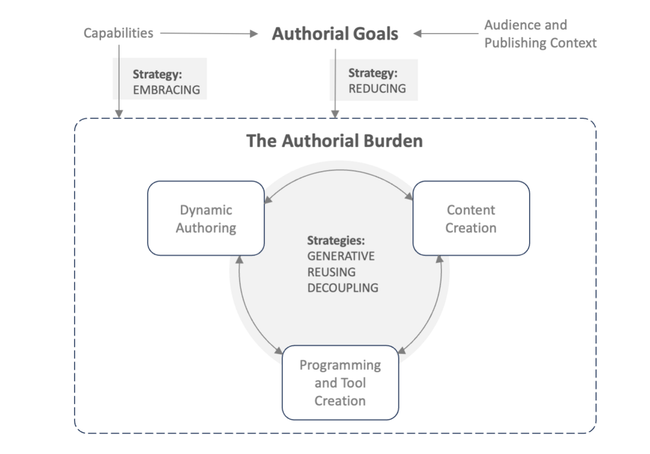
A model illustrating different forms of authoring labour: content creation, dynamic authoring, and programming and tool creation. Generative, Reusing and Decoupling strategies shift the burden of work between different forms of authoring, while Embracing strategies may increase authorial capacity to create. Authorial goals for a work are formed in the context of authors’ Capabilities and the Audience and Publishing context. Reducing strategies impact the Authorial Goals, changing the overall shape of the work itself.
Figure 1: A conceptual Model of the Authorial Burden
Figure 1 illustrates how we have brought the insights above together into a conceptual model of the authorial burden. Authors have a vision for the games they want to create which determines their Authorial Goals. These goals are shaped by their Capabilities (their skills in writing, the tools they know, their imagination etc.), and the Audience and Publishing Context (including competitions, game jams, commercial launches, publishers). Often the vision is incomplete, and they write to find out more!
The design emerging from these goals sets the initial Authorial Burden (which may or may not be known before they start writing), the relative size of which is also influenced by the author's capability (a given project would be easier for an experienced author with relevant skills than an inexperienced one without those skills). There are three different kinds of work involved:
Static Authoring: creating more unchanging content. (e.g. writing lots of descriptions)
Dynamic Authoring: creating content which might appear based on some conditions, or appear in different contexts. (e.g. writing lists of objects and descriptions that can be recombined to create many different objects)
Programming/Tool Creation: expanding system capacities (e.g. creating a new game engine or scripting language to do something that couldn't easily be done in existing tools)
As part of an authors’ initial design, or later when they realise there's too much work, they implement strategies for managing the burden. These strategies can:
REDUCE the overall workload (e.g. cutting content) effectively adjusting the goals
EMBRACE the project as it is, and try to increase capacity instead (more writers, more time taken, crunch, improving skills)
REUSE elements (writing, code, assets)
DECOUPLE content, separating it into self-contained sections to manage complexity
GENERATE content (e.g. through procedural generation)
The first two strategies impact the relative size of the burden by either adjusting the goals (REDUCE) or increasing the capability of the author (EMBRACE).
The last three strategies (GENERATE, REUSE, DECOUPLE) do not necessarily change the size of the burden but instead primarily change the nature of the work. For example, a description generator might reduce the amount of unique descriptions you need to write (Content Creation is reduced), but it is still work to make the generator to begin with (Tool Creation is increased), and to populate it with enough content so that it feels varied and interesting enough (Dynamic Authoring is increased).
5 VALIDATION WITH EXPERTS
As described in Section 3 we presented the model back to a different set of experts through three panel discussions in order to validate the model. In this section we will explore the outcomes of those discussions and present the implications of the conceptual model on how the authorial burden, and scope issues more broadly, are talked about in the context of interactive narrative; look at questions and caveats raised by the experts; and sketch out potential avenues for future research in this area.
5.1 Implications
Rarely can creative work be sped up without changing the process of creation and the form that the output takes, and often alleviating one aspect left more time for other work rather than reducing labour overall. As one panelist put it, after interrogating the design and removing content, ‘what I found was I didn't write less as a result... I was picking what I wanted to write about’. Our model of the authorial burden emphasises that every proposed strategy to alleviate authorial burden changes the kind of creative labour that is performed (and thereby not always reducing work absolutely), and that these changes may not align with author visions, interests or skill-sets, or be appropriate for the intended audience of the work. This was repeatedly born out in the interviews and confirmed in the expert panels: often authors will use a strategy to move work into a domain they find more interesting or are more comfortable creating within. For instance, game designers who are also tool-makers are often seen spending time programming a specific engine to meet their requirements, rather than trying to amend their vision to fit with an existing tool, even though that would usually be quicker. Conversely, less technically-minded authors will often stay with a tool long after it has ceased meeting all their requirements, due to the high opportunity cost of switching to something better suited or attempting to make a tool themselves.
Authorial ‘burden’ is often not experienced as burdensome, and one common feedback from the panelists was about the negative connotations of the term itself. Creative labour is the part that's enjoyable for the author, and there is little desire to abstract it away. As one panelist said, ‘sometimes the strategy doesn't reduce the workload, it frames it in a way that you actually enjoy doing’. While commercial games are made under context of time and financial constraints, hobbyists are more likely to approach the craft in a similar way to many novelists: as an enjoyable but not particularly profitable past-time.
One panelist who had worked with machine-generated prose pointed out that it was a lot of work to get it to output desired content, and the content created needed a lot of editing to ‘force disparate content to make sense’, but in taking a ‘bottom up’ approach, it could be used as a source of creative inspiration. Others were even less enthusiastic: ‘It's never “how I'm using it in my own work” and always “here's how it's going to disrupt that other industry that I know nothing about” ’, one said while another reflected that ‘there's no part of [my writing] where I'm like, “I wish an AI would do this for me”. If I didn't find it interesting I just wouldn't do it.’
The aesthetic texture of hand-crafted content is very different to the ‘procedural oatmeal’ that can arise through machine generation. So even when the designers do want to avoid authoring work (e.g., to meet commercial constraints), the techniques touted to alleviate authorial burden often typically would not meet the desired quality and specificity of output. Where generative approaches are sought by authors, they are picked for their specific affordances. One participant stressed the distinctiveness of generation as its own artistic medium: ‘you are not going to save work overall if you want the same kind of product’, but, ‘you can save some kinds of work and introduce some kinds of variety: the question is whether those kinds of variety are valuable to you.’
This same dynamic is present in non-generative strategies as well. For example, the use of illusory agency has been proposed as a way to avoid authorial burden by offering choices but always redirecting to the same branch regardless [9]. While merging branches has long been recognised as a fundamental technique of hypertext authoring [1], committing to only or primarily using illusory agency in a game that is positioned to players as being high agency is in itself a specific vision for a work, and one which would become obvious on replay or review of that work: the illusion cannot hold indefinitely. Authors make games that according to a vision, and that vision is rarely ‘pretend to be some other game-type entirely’. If having high player agency is the design goal that is creating the authorial burden, removing that player agency doesn't solve the burden, rather it creates some other game entirely.
5.2 Challenges
During the panel some explanatory challenges arose for the model. The 5-part schema of strategies [13] was a clarifying lens to view authorial design choices but it elides the temporal aspects of design. For instance, one expert in the first panel discussed how she would ‘collapse continuities’ in her hypertext fiction as part of an iterative process of shrinking the initial workplan by merging different split branches. While this is both a reducing and reusing strategy (specifically, cutting some proposed branches by way of reusing others), it is also a strategy for a specific time in the design process: when an initial hypertextual pattern has been planned but has yet to be fully implemented.
Another way of splitting the strategies would be to consider which take place at which stage of authoring, and the scope of each strategy, from the level of a single scene or room, all the way to game-wide changes. So many of the strategies to managing the authorial burden happen at the outset of the project, with expectations of how much work it will be shaping the initial vision for a game. In Pinchbeck's examination of the design of Dear Esther, he remarks that the whole setting and structure of the game was made with ‘the economics of building’ in mind: setting the game on a remote island was explicitly a strategy to diegetically limit objects to implement, especially other people [17]. As per Kitromili [14], authoring interactive narrative is made up of different activities from ideation and planning to writing and editing, and strategies for managing work are appropriate to different stages.
One panelist offered the challenge: instead of the ‘authorial burden’, what about the ‘authorial responsibility’? ‘Burden’ has the connotation of something that must be shouldered or shirked. As a term, it leaves something to be desired. Still, the term does leave the correct impression that authorial choices each leave a weight of work to be done, and that the structure of interactive narratives, especially those with plot branches or variable narrative combinations, itself creates more of this work, whether or not it is felt as a burden.
Another panelist felt that author work in presentation, in user interface, and in marketing, is its own kind of labour, which has concomitant strategies that may or may not work (he described snake-oil salesmen promising ‘500 clicks with this one tool’). Indeed, care should be taken not to present ‘authorial burden’ as a synonym for all authorial labour, including the creation of paratextual elements, but rather as a description of the work that arises specifically out of the interactive nature of the story. The author might take care over how their hypertext is presented to a competition, but that care is typically independent of the labour that was needed to flesh out the different plot branches they decided to implement.
Finally, a panelist who was foremost a game engine designer and secondarily a game author, was keen to highlight the specific burdens in tool creation. Even before someone makes a game with a tool, the designer programmer must wrestle with the work that emerges out of their programming design decisions. While this programming labour can be an activity undertaken by some authors, and many of the work management strategies are similar (such as modularisation or loose-coupling), an author of a tool for making games has a different kind of aim than the creator of a game. A hypertext system or text adventure engine might embody some assumptions about possible stories (especially if they implement a world-model) but it isn't itself a story. The combination of variable state management and the management of narrative continuity is what makes interactive narrative authoring so thorny. They have all the problems that face the programmer and the novelist as well as the unique problems from arise from the intersection of the different crafts.
6 CONCLUSION
Alleviating an authorial burden is the implicit motivation (and often explicit motivation) of much tool development in the field of interactive digital narrative, but the concept of the authorial burden itself was undertheorised. This paper fills out this gap through developing a conceptual model of the authorial burden that faces authors of IDN. This model was developed out of lengthy, rich, qualitative interviews with authors themselves (with wide experience of a range of interactive narrative sub-types). One of the core insights of the model is that the strategies authors use to manage labour do not necessarily reduce it overall, but rather move it between forms that might better match their authorial goals and skills. Newly proposed tools and design approaches should be mindful about whether or not they are seeking to shift the burden of work away from the areas authors actually find creatively fulfilling.
The model of the authorial burden describes and situates various kinds of strategies that authors use. This framework allows better understanding of whether a design strategy reduces labour overall, or shifts it to a different form of burden, and whether it does so by compromising the initial vision of the work. Furthermore, categories that REDUCE, EMBRACE, REUSE, DECOUPLE or GENERATE are themselves theoretically generative: designers can use these as spurs to identifying novel solutions to thorny authorial burden problems on any given project.
One limitation of the study is that although many specific strategies were identified, many more could be described through discussions with even more authors. The study itself was focused on the creation of works with a strong authorial vision, usually written by one or two people, or at most a small team. Approaches and constraints are likely to be different for larger projects, although it should still be possible to conceptualise the strategies used by big studios within the model.
Engaging with the craft knowledge that interactive narrative authors possess is invaluable to understanding the process of authoring. Our model of the authorial burden helps to capture some of this craft knowledge and provides a theoretical foundation for future work on IDN authoring. We also hope that it inspires others to undertake field-work that engages with authors, ultimately leading to a better understanding of the real challenges that authors face in their creative practise.
REFERENCES
Mark Bernstein. 1998. Patterns of hypertext. In 9th ACM Hypertext and Hypermedia(HYPERTEXT ’98). Association for Computing Machinery, New York, NY, USA, 21–29. https://doi.org/10.1145/276627.276630
Alexander Bogner and Wolfgang Menz. 2009. The Theory-Generating Expert Interview: Epistemological Interest, Forms of Knowledge, Interaction. In Interviewing Experts, Alexander Bogner, Beate Littig, and Wolfgang Menz (Eds.). Palgrave Macmillan UK, London, 43–80. https://doi.org/10.1057/9780230244276_3
Amy Bruckman. 1990. The Combinatorics of Storytelling: "Mystery Train Interactive". Technical Report. The MIT Laboratory.
John Bryant. 2002. The Fluid Text: A Theory of Revision and Editing for Book and Screen. University of Michigan Press, Michigan, USA. Google-Books-ID: 1w4wpOdPbu4C.
JR Carpenter. 2017. In the event of a variable text. Convergence 23, 1 (Feb. 2017), 98–114. https://doi.org/10.1177/1354856516678357 Publisher: SAGE Publications Ltd.
Chris Crawford. 2020. Fundamentals of Interactivity | Interactive Storytelling Tools for Writers | Chris Crawford. Retrieved March 15, 2024 from http://www.erasmatazz.com/library/the-journal-of-computer/jcgd-volume-7/fundamentals-of-interactivi.html
Aline Dobrovsky, Uwe M. Borghoff, and Marko Hofmann. 2017. Applying and Augmenting Deep Reinforcement Learning in Serious Games through Interaction. Periodica Polytechnica Electrical Engineering and Computer Science 61, 2 (May 2017), 198–208. https://doi.org/10.3311/PPee.10313 Number: 2.
Ignacio X. Domínguez, Rogelio E. Cardona-Rivera, James K. Vance, and David L. Roberts. 2016. The Mimesis Effect: The Effect of Roles on Player Choice in Interactive Narrative Role-Playing Games. In Proceedings of the 2016 CHI Conference on Human Factors in Computing Systems. Association for Computing Machinery, New York, NY, USA, 3438–3449. https://doi.org/10.1145/2858036.2858141
Matthew William Fendt, Brent Harrison, Stephen G. Ware, Rogelio E. Cardona-Rivera, and David L. Roberts. 2012. Achieving the Illusion of Agency. In Interactive Storytelling(Lecture Notes in Computer Science), David Oyarzun, Federico Peinado, R. Michael Young, Ane Elizalde, and Gonzalo Méndez (Eds.). Springer, Berlin, Heidelberg, 114–125. https://doi.org/10.1007/978-3-642-34851-8_11
Jacob Garbe. 2020. Increasing Authorial Leverage in Generative Narrative Systems. Ph. D. Dissertation. UC Santa Cruz.
Jacob Garbe, Max Kreminski, Ben Samuel, Noah Wardrip-Fruin, and Michael Mateas. 2019. StoryAssembler: an engine for generating dynamic choice-driven narratives. In 14th International Conference on the Foundations of Digital Games(FDG ’19). Association for Computing Machinery, New York, NY, USA, 1–10. https://doi.org/10.1145/3337722.3337732
S.E. Hove and B. Anda. 2005. Experiences from conducting semi-structured interviews in empirical software engineering research. In 11th IEEE International Software Metrics Symposium (METRICS’05). IEEE, Como, Italy, 10 pp.–23. https://doi.org/10.1109/METRICS.2005.24 ISSN: 1530-1435.
Joey Donald Jones. 2022. Authorial Burden. In The Authoring Problem: Challenges in Supporting Authoring for Interactive Digital Narratives, Charlie Hargood, David E. Millard, Alex Mitchell, and Ulrike Spierling (Eds.). Springer International Publishing, Cham, 47–63. https://doi.org/10.1007/978-3-031-05214-9_4
Sofia Kitromili, James Jordan, and David E. Millard. 2020. What Authors Think about Hypertext Authoring. In Proceedings of the 31st ACM Conference on Hypertext and Social Media(HT ’20). Association for Computing Machinery, New York, NY, USA, 9–16. https://doi.org/10.1145/3372923.3404798
Hartmut Koenitz. 2015. Towards a Specific Theory of Interactive Digital Narrative. In Interactive Digital Narrative. Taylor & Francis, Milton Park, UK. https://doi.org/10.4324/9781315769189-8
Hartmut Koenitz, Mirjam Palosaari Eladhari, Sandy Louchart, and Frank Nack. 2020. INDCOR white paper 1: A shared vocabulary for IDN (Interactive Digital Narratives). http://arxiv.org/abs/2010.10135 arXiv:2010.10135.
Dan Pinchbeck. 2008. Dear Esther: An Interactive Ghost Story Built Using the Source Engine. In Interactive Storytelling(Lecture Notes in Computer Science), Ulrike Spierling and Nicolas Szilas (Eds.). Springer, Berlin, Heidelberg, 51–54. https://doi.org/10.1007/978-3-540-89454-4_9
James Ryan, Andrew Fisher, Taylor Owen-Milner, Michael Mateas, and Noah Wardrip-Fruin. 2015. Toward Natural Language Generation by Humans. In 8th Workshop on Intelligent Narrative Technologies. AAAI Press, Palo Alto, CA, 114 pages. https://doi.org/10.1609/aiide.v11i4.12840
James Owen Ryan, Casey Barackman, Nicholas Kontje, Taylor Owen-Milner, Marilyn A. Walker, Michael Mateas, and Noah Wardrip-Fruin. 2014. Combinatorial Dialogue Authoring. In Interactive Storytelling(Lecture Notes in Computer Science), Alex Mitchell, Clara Fernández-Vara, and David Thue (Eds.). Springer International Publishing, Cham, 13–24. https://doi.org/10.1007/978-3-319-12337-0_2
Andrew Stern. 2008. Embracing the Combinatorial Explosion: A Brief Prescription for Interactive Story R&D. In Interactive Storytelling(Lecture Notes in Computer Science), Ulrike Spierling and Nicolas Szilas (Eds.). Springer, Berlin, Heidelberg, 1–5. https://doi.org/10.1007/978-3-540-89454-4_1
Christine Talbot and G. Michael Youngblood. 2012. Spatial Cues in Hamlet. In Intelligent Virtual Agents(Lecture Notes in Computer Science), Yukiko Nakano, Michael Neff, Ana Paiva, and Marilyn Walker (Eds.). Springer, Berlin, Heidelberg, 252–259. https://doi.org/10.1007/978-3-642-33197-8_26
Do you like what you are reading? Subscribe to receive updates.
Unsubscribe anytime