
Evaluating Prebunking and Nudge Techniques in Tackling Misinformation: A Between-Subject Study on Social Media Platforms
Dipto Barman (ADAPT Centre, Trinity College Dublin, barmand@tcd.ie — corresponding author) and Owen Conlan (ADAPT Centre, Trinity College Dublin, owen.conlan@tcd.ie)
Published in HT '24: 35th ACM Conference on Hypertext and Social Media · DOI: 10.1145/3648188.3675125 · License: CC BY 4.0
Authors: Dipto Barman, Owen Conlan
Keywords: Interventions, Misinformation, Nudges, Prebunking
Session: Explorations
Pages: 167–177
Conference: HT'24
Abstract
Combating misinformation on social media is critical, with preemptive strategies like prebunking and nudging gaining prominence. This paper evaluates the effectiveness of nudge and prebunking strategies in enhancing individuals' ability to distinguish between misinformation and factual content and their confidence in their accuracy judgments. Employing a between-subject experimental design, participants (N = 328) were categorised into three conditions: a control condition with no intervention, a nudge condition exposed to behavioural cues to promote critical scrutiny of information and a prebunking condition receiving implicit context about the claim. The results indicate that the prebunking message improves the identification of misinformation and confidence in judgments compared to nudging and control interventions. No significant difference was observed between the nudge and control groups regarding judgment accuracy or confidence. However, individual differences in interventions were noted. The study reveals that deliberate thinkers require some form of intervention to discern false news claims effectively. Moreover, it was found that participants with right-leaning political views were less influenced by prebunking messages, suggesting that nudges might be more effective for this demographic. These findings highlight the necessity of adopting a user-centric approach that considers individual characteristics to tailor interventions that may be required to combat misinformation effectively among diverse user groups on social media platforms.
CCS Concepts: • Human-centered computing; • Human-computer interaction (HCI); • Empirical studies in HCI;
Keywords: Misinformation, Interventions, Prebunking, Nudges
ACM Reference Format:
Dipto Barman and Owen Conlan. 2024. Evaluating Prebunking and Nudge Techniques in Tackling Misinformation: A Between-Subject Study on Social Media Platforms. In 35th ACM Conference on Hypertext and Social Media (HT '24), September 10–13, 2024, Poznan, Poland. ACM, New York, NY, USA, 11 pages. https://doi.org/10.1145/3648188.3675125
1 Introduction
In the current era, sometimes called the "age of fake news" [33, 61], intentional and unintentional misinformation has become rampant online. The rapid growth of social media platforms has allowed various ideas and opinions to exist. These social media platforms enable users to easily share, express and interact with content and other users. The platforms provide users a collaborative environment to share, promote and curate information based on their interests. Nonetheless, the proliferation of social media platforms has exposed more people to the spread of misinformation, fake news, and conspiracy theories.
Misinformation is "false or misleading information" [36]. Exposure to misinformation has been linked to a range of negative impacts on society, such as reduced trust in healthcare systems [24], fostering hatred towards political candidates [5], diminished trust in mainstream media [47], as well as producing false memories and fabricated policy-relevant events [44]. Furthermore, misinformation also reaches broader societal events, such as the discord between two religious groups in Leicester, England [45], Asian communities facing targeted hostility in the US [39], and narratives tied to the Israel-Hamas conflict [53] further underline its pervasive influence. Therefore, developing methods to tackle misinformation is critical to benefit the general public and the entire news ecosystem.
In literature, there are two approaches to tackling misinformation at an individual level: proactive and reactive. Reactive approaches or therapeutic treatments are fact-based corrections that directly address the inaccuracies in the misinformation and provide accurate information [6, 18]. However, significant concerns have been raised about reactive approaches. A plethora of research indicates that the mere repetition of information can increase its perceived truthfulness [27, 28], especially when the content aligns with the user's belief [10, 22] and allows the rejection of new information that corrects the fact [46, 64]. Also, due to the increase in the affordance of social media platforms, the spread of misinformation has outpaced fact-checkers. This may be overcome by introducing a proactive rather than a reactive approach.
The idea behind proactive approaches is to reduce the believability of misinformation in the first place. Proactive approaches are based on the inoculation theory [42], where a threat message combined with a pre-emptive refutation is provided to individuals to develop a resistance against the persuasive nature of misinformation. Several bodies of proactive research have shown their effectiveness against misinformation (for review, see [15, 38]).
To further nuance our understanding of misinformation mitigation strategies, it is crucial to consider the role of individual differences in shaping responses to these interventions. Research on the susceptibility to misinformation has identified several user characteristics and behaviours that may make an individual susceptible to misinformation [8, 19, 51]. Prior research has highlighted that cognitive style [51], personal beliefs [13], educational background [57], and even emotional states [41] can significantly impact how individuals process (mis) information. This diversity in processing suggests a nuanced landscape where the effectiveness of interventions may not be universally equal across all user characteristics. The implication is profound; if individuals vary in how they perceive and internalise misinformation based on their unique characteristics, then it logically follows that their reactions to various mitigation strategies may also diverge. For example, in [9], the authors found that participants who scored high on the conspiracy mentality questionnaire [12] that were subjected to counterfactual pre-bunking judged the fake news as being less credible than those in the control condition and those exposed to a different type of pre-bunking, i.e., being informed that there is misinformation out there.
The research space of persuasive technologies further supports this notion, where the evidence points towards the superior efficacy of personalised approaches [2, 26, 31]. These studies underscore that a 'one size fits all' solution falls short of accounting for cognitive processes, experiences, and biases that influence individual perceptions and reactions. The personalisation of interventions, therefore, emerges not just as an option but as a necessity for effectively navigating the complex dynamics of misinformation mitigation. Additionally, the psychological concept of reactance — the aversive reaction triggered by perceived threats to one's freedom of choice [60] — suggests how information is framed and presented could influence its effectiveness across different user profiles. Therefore, this variability underscores the importance of tailoring misinformation intervention efforts to cater to diverse audiences, potentially by combining or adapting strategies based on demographic insights and psychological predispositions.
Therefore, in this paper, we aim to compare two techniques based on pre-emptively addressing misinformation immediately: prebunking and nudging. Prebunking involves providing individuals with contextual information or warnings before encountering misinformation, equipping them with the cognitive tools to evaluate and resist misleading content critically [7, 9, 38]. On the other hand, nudging guides users towards more critical engagement with information through subtle environmental cues or changes without restricting choice [4, 32, 54]. Both approaches are designed to enhance individuals' resilience against misinformation by promoting analytical thinking and scepticism towards dubious claims. We investigate the following research questions:
RQ1: To what extent do interventions yield statistically significant enhancements in the accuracy of identifying fake news claims when compared to a control group without intervention?
RQ2: How do the interventions affect participants' confidence in their judgments regarding the accuracy of identified misleading content?
RQ3: How do individual user characteristics influence the effectiveness of each intervention in enhancing the accuracy of identifying fake news claims?
We make the following contribution to this work:
We study the effectiveness of two proactive interventions in enhancing individuals' abilities to accurately assess the veracity of news claims and their confidence in these assessments.
Through the analysis of user characteristics, such as political orientation, conspiracy mentality, and cognitive reflection, the study highlights how these factors influence the effectiveness of each intervention.
This work underscores the importance of tailoring misinformation interventions to individual characteristics, advocating for a user-centric approach in designing and implementing strategies to combat misinformation on social media platforms.
2 Related Works
In recent years, various interventions have been introduced to enhance users' competencies and behaviour (sharing behaviour on social media) and tackle misinformation online. These are, among others, debunking false claims [37], boosting people's digital media literacy competencies [25], building resilience against manipulation [55], employing design strategies that reduce the spread of false information [35], emphasising the significance of accuracy in digital posts [50], and indicating the veracity of the relevant information [21]. These interventions can be categorised into three distinct types: nudging, boosting, or refutation strategies (prebunking) (for an overview, see [56]). Various research methodologies have been used to test the impact of interventions, such as having participants rate headlines in online trials [49], asking individuals to evaluate websites [65], and conducting field research on social networks [55]. For the purpose of this paper, we only focus on nudging and prebunking techniques to tackle misinformation as they provide proactive interventions for tackling misinformation online.
Nudging is a common behavioural policy strategy that aims to influence people's decisions—ideally toward a greater individual or societal welfare. Nudging techniques mainly aim to alter behaviour (e.g. paying attention to the content). One nudging strategy, accuracy prompts, encourages people to share fewer erroneous headlines by reminding them of the value of accurate information [54]. Other nudges slow information sharing by adding friction to the decision-making process. One such nudge may advise someone to take a moment to reflect before posting on social media or to read an article before sharing it [21]. Nudges based on social norms can persuade others to hold similar standards by using information about what others think, do, or find acceptable [3]. For instance, informing users that most other users do not share or act on specific false information can encourage them to respond similarly and readjust their opinions on the information.
Pre-bunking is a method of pre-emptive refutation that can be topic-specific [66], or that exposes and clarifies the flaws in common deceitful reasoning techniques [55]. Pre-bunking is derived from the inoculation theory [38], where a threat message combined with a pre-emptive refutation is provided to individuals to develop a resistance against the persuasive nature of misinformation. Researchers commonly use text manipulations to passively present the relevant context to participants [11, 16]. Other methods include The Bad News [55], a social media interactive game designed to actively focus on the different techniques of spreading misinformation online, such as polarisation, trolling, etc.
However, several observations about the current state of the literature on interventions have suggested that most research uses online convenience samples or, at best, quota-matched online samples [34, 56]. It has also been suggested that the abovementioned intervention targets universal problems and behaviours; however, evidence indicates interventions may not always be equally effective across cultures and demographics [25]. For example, in [9], the authors found that participants who were subjected to counterfactual pre-bunking judged the fake news headline as being less credible than those in the control condition and those exposed to a different type of pre-bunking, i.e., being informed that there is misinformation out there. This highlights a critical research gap: the need to examine individual differences in the effectiveness of interventions like nudging and prebunking. Hence, our experiment seeks to address this gap, exploring how individual differences may influence responses to online misinformation interventions, aiming to contribute to more personalised and effective strategies.
3 Methodology
A power analysis using G*Power [20] indicated that, to detect a medium to small effect size (f = 0.2) with 80% statistical power among three conditions, a sample of 244 participants was required. We recruited 334 American participants via the Prolific platform (https://www.prolific.com/), which employs quota matching to ensure an equal ratio of male and female participants. Prior to participant recruitment, this study was approved by the Trinity Research Ethics Board. Out of the initial N = 334, 2 participants completed the questionnaire too quickly and were subsequently excluded from the final data analysis. Among these participants, N = 2 failed the two attention check questions, N = 1 did not complete the entire questionnaire, and N = 1 did not consent to data collection at the end of the survey. Our final sample consisted of N = 328. Before viewing the stimuli, participants were asked about their demographics. The final sample was 53% males, with a mean age range of 36-45, a mean education level equivalent to an undergraduate degree, an average of 2-3 hours of social media use per day, and a political ideology skewed towards liberalism. The sample distribution is given in Figure 1.
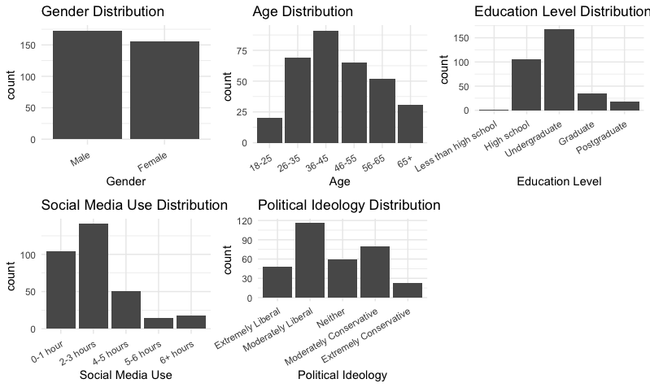
Figure 1: Sample Distribution in the study.
3.1 Material
In this study, two distinct sets of news claims were utilised for the experimental analysis:
Politifact Dataset: This dataset comprised 24 news claims, evenly divided into 12 fake and 12 real claims. Each claim was accompanied by a label, and the full supporting evidence was provided by PolitiFact (https://www.politifact.com/). Based on a pilot study in [29], these claims were selected to ensure an equitable distribution of partisanship intensity, familiarity, and perceived accuracy across claims favouring both democratic and republican perspectives.
MIST Dataset [40]: This second dataset consisted of 20 news claims, balanced with 10 fake and 10 real claims, generated using the GPT-2 model. This dataset is a psychometrically validated dataset that is used as a screening and intervention evaluation system.
3.2 Procedure
This study was conducted online using the Qualtrics (https://www.qualtrics.com) platform, employing a between-subjects design. Upon securing consent and collecting demographic data, participants (N = 328) were randomly assigned to one of three experimental conditions:
Control Condition: Participants (N = 112) evaluated 44 randomly ordered news claims, comprising 24 from the PolitiFact dataset and 20 from the MIST dataset. They rated each item's perceived accuracy on a 5-point Likert scale, ranging from 1 ("not accurate at all") to 5 ("very accurate") [59]: How accurate do you think the claim is? Additionally, participants assessed their confidence in their accuracy judgment from 1 ("Not confident at all") to 5 ("Extremely confident") and intent to share the news claim from 1 ("not likely at all") to 5 (very likely) on similar 5-point Likert scales.
Nudge Condition: This condition (N = 107) followed the same procedure as the control group for evaluating the 44 news items. However, at the start and midway through the experiment, participants were exposed to social norm nudges [3] designed to encourage critical evaluation of information. The initial message stated, "NOTICE: A lot of information online can be categorised as "fake news". It is often good practice to take a moment to reflect on the accuracy of the claim.". A similar message - "NOTICE: There is a lot of misleading and false information online. Most responsible people think twice before sharing content with their friends and followers." was presented again halfway through the session to reinforce cautious information-sharing behaviours [3].
Context Condition: Participants in this condition (N = 109) also evaluated the 44 randomly ordered news items. However, for the 12 false claims from the PolitiFact dataset, a "Prebunked message" was provided while viewing the stimuli. This prebunked message was provided under an "Added context" tag. Research has found that counterfactual reasoning resembles human reasoning when individuals seek to understand the causal structure of events [14, 43]. Recent research on misinformation detection has also indicated that large language models (LLMs) can effectively detect misinformation [63]. LLMs have also shown proficiency in generating counterfactual explanations for why a claim is true or false. Therefore, we employ GPT-4 (turbo) [48] to produce a short implicit explanation using the state-of-the-art counterfactual prompt [17]. The prompt format was: "Claim [Input] Evidence: [Input] This is a false claim. Please generate a short sentence of a counterfactual explanation for the claim," with the sentence structure being, "If we were to say . . . instead of . . ., the claim would be correct". The evidence text was directly copied from the PolitiFact page and inserted into the prompt without any corrections. The prompt for the MIST dataset was: "This is a news claim [Input]. Write a short sentence to add context to this news claim." Unlike the first dataset, both true and false news claims were supplemented with additional context. This approach was adopted to minimise potential bias associated with the "Added context" tag. These AI-generated contexts were then manually verified by researchers to ensure accuracy and relevance. These were also checked independently by a researcher from the school of communication, providing the added context conveyed the intended message with a neutral tone.
After the survey, the participants were thanked for their time and given fact-checked links for the stimuli. The cleaned dataset, stimuli used in this experiment and the generated context can be found at: https://osf.io/3796w/?view_only=6d4187b963534dd58da2cd896fc9512c. The Experimental design is given in Figure 2.
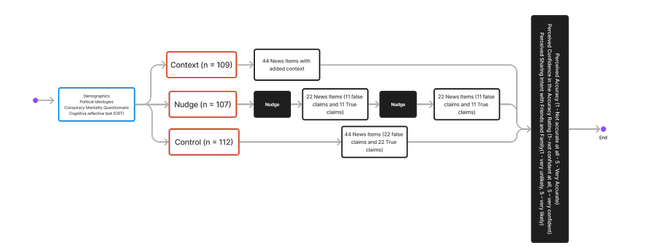
Figure 2: Experiment Design
Users were asked for additional measures - political labels they associate with, a 7-question cognitive reflection test (CRT) that measures the tendency to stop and think versus going with your gut [23, 62] and a conspiracy mentality questionnaire (CMQ) that measures the general propensity to subscribe to theories blaming a conspiracy of ill-intending individuals or groups [12] before assigning them into each condition. These measures were chosen because prior work has indicated that they moderate susceptibility to misinformation online [9, 51]; therefore, we investigate if they impact the effectiveness of the interventions. A 5-second delay was added to each news stimulus to ensure participants spent at least 5 seconds reading the claim, and two additional check questions were inserted while viewing the stimuli.
For our main analysis, we fit a generalised linear model (GLM) predicting the perceived accuracy of false news items—as a function of conditions with context as a baseline, social media use, political label, conspiracy mentality score (CMQ score), and cognitive reflection test (CRT) scores. Our model was designed to understand how these factors individually and collectively influence the ability to discern false information.
4 Analysis and Result
To ensure equitable distribution of participants across the three conditions—Control, Nudge, and Context—we employed the Chi-square test to analyse demographic variables. The Chi-square test revealed no significant differences in demographic variables among the conditions, confirming that the participant distribution was balanced across the conditions. This uniform distribution supports the validity of our comparative analysis among the Control, Nudge, and Context conditions. We analysed the sharing intent in each condition and found no statistical differences between the control and the intervention conditions. Moreover, we found that most participants in all conditions chose "very unlikely" to share these claims with their friends and family. This trend may be attributed to increased caution by individuals as sharing may hurt their reputation online [1]. Hence, we did not delve deeper into the impact of intervention in sharing intent across conditions.
4.1 Impact of Interventions
4.1.1 False News Claims
Accuracy. In our main analysis of the perceived accuracy of false news claims (RQ1), we employed a multifaceted approach to assess the effectiveness of various interventions. Using the Context condition as the baseline, we observed notable variances in intervention effectiveness. Compared to this baseline, the Control condition exhibited an increase in perceived accuracy scores by 0.20422 units (t-value = 3.430, p < 0.001), suggesting a reduction in discernment effectiveness. Similarly, the Nudge group reported a higher perceived accuracy score than the Prebunking condition, with an increase of 0.19718 units (t-value = 3.278, p < 0.001159), albeit less pronounced than the Control condition. This pattern suggests a subtle yet statistically significant difference in effectiveness between the Nudge and Control conditions, with both trailing behind the Context condition to enhance critical assessment of false information.
Building on these findings, further analysis using the Kruskal-Wallis and pairwise Dunn's tests across three conditions (Control, Nudge, Context) substantiated the initial observations. We use Cliff's $delta$ for effect size and median, as our dataset was not normally distributed. Specifically, for the PolitiFact dataset, we identified significant differences in accuracy assessments between the Context and both the Control ($M_{context} = 2.75$, $SD = 0.61$, $M_{control} = 3$, $SD = 0.46$, p < 0.0062, $delta = 0.22$) and Nudge ($M_{nudge} = 2.92$, $SD = 0.46$, p < 0.0095, $delta = 0.21$) conditions, underscoring the Context intervention's superior impact on participants' perceptions of news accuracy. The MIST dataset analysis echoed these results, particularly highlighting a significant difference between the Context and Nudge conditions ($M_{context} = 1.7$, $SD = 0.78$, $M_{nudge} = 2.1$, $SD = 0.71$, p < 0.0236, $delta = 0.194$). A combined analysis of both datasets reinforced the Context condition's efficacy in diminishing the perceived accuracy of false claims, with participants in the Context condition ($M_{context} = 2.34$, $SD = 0.60$) consistently rating false news as less accurate than those in the Nudge ($M_{nudge} = 2.52$, $SD = 0.48$, p < 0.02, $delta = 0.22$) and Control ($M_{control} = 2.42$, $SD = 0.48$, p < 0.02, $delta = 0.19$) conditions.
Interestingly, participants in the Nudge condition rated false news slightly more accurately than those in the Control condition, without a significant disparity between them. This convergence of results from our GLM and non-parametric tests elucidates a clear hierarchy of intervention effectiveness. The Context intervention emerges as the most potent strategy in reducing participants' likelihood of inaccurately identifying false news claims as accurate, followed by the Nudge and Control conditions. These insights provide an argument for the nuanced application of prebunking messages and context's critical role in effectively combating misinformation.
Confidence. These insights into the impact of interventions on the perceived accuracy of false news claims are further enriched by examining participants' confidence (RQ2) in their accuracy assessments across the three conditions (Control, Nudge, Context). Confidence in one's judgment is pivotal, as it not only influences the trust in the system's predictions but also significantly impacts the decision-making process [52], serving as an integral component in discerning and responding to misinformation [58]. Our analysis through the Kruskal-Wallis test, followed by pairwise Dunn's tests, unveils significant differences in confidence scores across both the datasets, indicating a substantial variance among the conditions (chi-squared = 22.047, df = 2, p = 1.631e-05). Notably, there were significant distinctions between the Context and both the Control (p < 0.0017, $delta = 0.265$) and Nudge (p < 0.0001, $delta = 0.347$) conditions, with medium effect sizes that underscore the Context intervention's effectiveness in bolstering confidence in correctly identifying false news claims. However, no significant differences were noted in the confidence scores between nudge and control conditions.
This pattern persisted across the datasets when compared individually. In the PolitiFact subset, significant differences highlighted the Context condition's significant advantage over the Control ($M_{context} = 3.9$, $SD = 0.79$, $M_{control} = 3.4$, $SD = 0.69$, p < 0.0053, $delta = 0.241$) and Nudge ($M_{nudge} = 3.4$, $SD = 0.79$, p < 0.0001, $delta = 0.329$) conditions in enhancing confidence levels. Similarly, the MIST dataset reinforced the substantial impact of contextual cues with the Context condition markedly improving confidence ratings compared to the Control ($M_{context} = 3.9$, $SD = 0.79$, $M_{control} = 3.4$, $SD = 0.75$, p < 0.0034, $delta = 0.239$) and Nudge ($M_{nudge} = 3.4$, $SD = 0.79$, p < 0.0001, $delta = 0.321$) conditions. Reflecting on the median values, participants in the Context condition exhibited the highest confidence in their evaluations of false news claims, with scores consistently higher than those in the Nudge and Control conditions. However, no differences were found between Nudge and Control conditions. Figure 3 illustrates each intervention's comparative impact on the accuracy of participants' judgments and their confidence levels in making these assessments of false news claims.
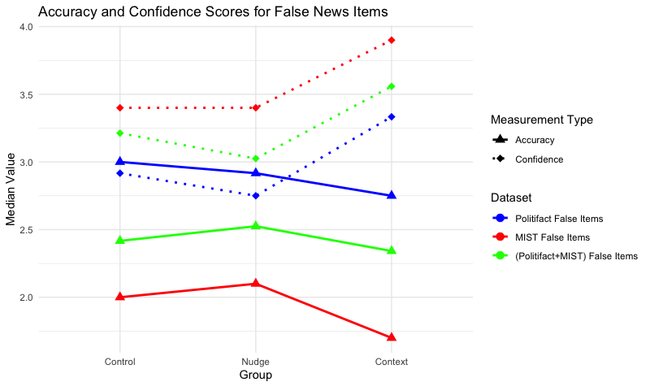
Figure 3: The median accuracy and confidence scores for false news claims in each dataset across the three conditions.
4.1.2 True News Claims
Accuracy. Examining perceived accuracy for true news claims across three conditions uncovers significant distinctions in participant evaluations. In the PolitiFact dataset for true news claims, no significant differences were found across conditions ($M_{context} = 3.00$, $SD = 0.45$, $M_{nudge} = 3.01$, $SD = 0.38$, $M_{control} = 2.98$, $SD = 0.46$, p = 0.9745), indicating uniformity in participant assessments regardless of the condition, with median scores consistent across all conditions. Conversely, the MIST dataset for true news claims revealed significant differences (chi-squared = 22.544, df = 2, p = 1.273e-05), with significant pairwise distinctions observed between the Context and Control conditions ($M_{context} = 4.$, $SD = 0.47$, $M_{control} = 3.8$, $SD = 0.48$, p < 0.0001, $delta = 0.310$), and the Context and Nudge conditions ($M_{nudge} = 3.7$, $SD = 0.52$, p < 0.00001, $delta = 0.330$), both showcasing medium effect sizes. This variance can be attributed to the unique context application solely to true news claims within the MIST dataset—a strategy to mitigate any bias introduced by the "added context" label. Participants' evaluations in this dataset demonstrated that the provision of context significantly enhanced the perceived accuracy of true news, emphasising the critical role of context in distinguishing between true and false claims.
Confidence. Exploring the confidence in participants' assessment of true news claims, we find no significant difference between the three conditions for the PolitiFact dataset ($M_{context} = 2.71$, $SD = 0.84$, $M_{control} = 3.56$, $SD = 0.74$, $M_{nudge} = 2.48$, $SD = 0.77$, p = 0.9745). However, significant differences were noted when comparing the confidence ratings in participants' assessment of true news claims for the MIST dataset between the Context condition and the other two conditions ($M_{context} = 3.53$, $SD = 0.69$, $M_{control} = 3.10$, $SD = 0.63$, $M_{nudge} = 3.12$, $SD = 0.73$, p < 1.273e-05). This elevation in confidence noted explicitly in the MIST dataset for the context, underscores the profound effect that context has on enhancing the accuracy of participants' judgments and bolstering their confidence in these evaluations. Such findings highlight that when participants are provided with additional context, they are better equipped to discern the veracity of true news claims and feel more assured in their ability to make these discernments. Figure 4 illustrates each intervention's comparative impact on the accuracy of participants' judgments and their confidence levels in making these assessments of true news claims.
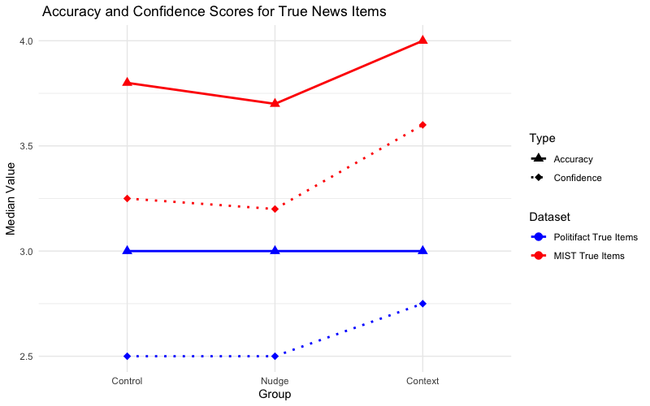
Figure 4: The median accuracy and confidence scores for true news claims in each dataset across the three conditions.
4.2 Impact of Interventions on User Characteristics
4.2.1 Exploring User Characteristics and Misinformation Discernment
In examining user characteristics and their susceptibility to misinformation, our analytical model underscores the complex interplay between individual differences and the discernment (the difference in accuracy scores of true and false news claims) of misinformation. Employing a GLM, we analysed variables such as Gender, Education Levels, Age, Social Media Use, Political Label, the propensity to subscribe to conspiracy theories as measured by Conspiracy Mentality Questionnaire (CMQ) and the propensity to go with one's gut, as measured by the Cognitive Reflection Test (CRT) influencing news claim discernment. The political label is coded as increasing, which means more conservative or right-leaning. Gender is coded as 1 (male) and 2 (female). The GLM coefficients are given in Table 1.
Table 1: Generalised linear model predicting the Misinformation Discernment
| Variable | Estimate | Std. Error | t value | Pr(>\|t\|) |
|---|---|---|---|---|
| (Intercept) | 2.16282 | 0.14139 | 8.323 | 2.50e-15 *** |
| Gender | 0.015470 | 0.04907 | -1.809 | 0.071373 . |
| Age | 0.028691 | 0.021735 | 1.320 | 0.188 |
| Education | 0.015223 | 0.035796 | 0.425 | 0.671 |
| Social Media Use | 0.002277 | 0.029375 | 0.078 | 0.938 |
| Political Label | -0.131352 | 0.025259 | -5.200 | 3.56e-07 *** |
| CMQ | -0.233073 | 0.031191 | -7.472 | 7.58e-13 *** |
| CRT | 0.068866 | 0.014348 | 4.800 | 2.44e-06 *** |
Signif. codes: 0 '***' 0.001 '**' 0.01 '*' 0.05 '.' 0.1 ' ' 1
A significant negative association with discernment was observed for Political Label (-0.131352, p < 0.000), indicating that individuals with more conservative or right-leaning ideologies exhibited lower capabilities in distinguishing false news claims from true news claims. Higher CMQ scores were linked to reduced discernment (-0.233073, p < 0.00001), suggesting that a stronger propensity to believe in conspiracy theories correlates with difficulties in identifying misinformation. CRT scores showed positive causation with discernment (0.068866, p < 0.0001), highlighting the importance of analytical thinking over intuitive judgments in evaluating news claims accurately. Gender, Age, education levels and social media use did not predict discernment.
4.2.2 Intervention-Specific Analysis
In response to RQ3, we analysed the perceived accuracy of false and true news claims across the control and two intervention conditions (Nudge, Context) against the same set of predictors. Since we had context attached to only MIST true news claims, we only compared the difference between the accuracy scores of true news claims for the PolitiFact dataset for our comparative analysis.
Control Condition: Political Label and CMQ scores emerged as significant predictors. A positive relationship was found for Political Label ($beta = 0.11511$, p < 0.01) and CMQ scores ($beta = 0.35714$, p < 0.001) with the perceived accuracy of false news claims, indicating a higher likelihood among conservatives and those with a high conspiracy mentality to perceive false claims as accurate. Interestingly, for true news claims, we found that CMQ ($beta = 0.11511$, p < 0.03) and CRT showed a positive effect ($beta = 0.057$, p < 0.01) in predicting true news claims accuracy.
Nudge Condition: The CMQ score showed a significant positive effect ($beta = 0.29907$, p < 0.001) on the perceived accuracy of false news claims, albeit with a smaller effect size than in the Control group. Interestingly, CRT scores were negatively associated with perceived accuracy ($beta = -0.04511$, p < 0.05), suggesting that higher cognitive reflection reduced false news accuracy perceptions. For true news claims, a positive effect of CMQ ($beta = 0.11713$, p < 0.004) and a negative effect of CRT ($beta = -0.03787$, p < 0.04) were observed, indicating heightened scepticism among higher cognitive individuals towards all news claims. However, no relationship was found with Political labels.
Context Condition: Along with CMQ's positive effect ($beta = 0.19861$, p < 0.001), Political Label ($beta = 0.09333$, p < 0.05) and CRT scores ($beta = -0.06342$, p < 0.05) significantly influenced perceptions of false news accuracy. The Political Label's positive coefficient was smaller than the Control condition. This suggests a nuanced response to contextual information among conservative ideologies and highlights the protective role of analytical thinking. For true news claims, we found that only social media use predicted the true news accuracy scores for the PolitiFact dataset ($beta = 0.074709$, p < 0.05).
Across all models, Gender, Age, and Education showed no consistent significant effect, highlighting that individual demographic characteristics and social media consumption habits might play a less direct role in influencing misinformation discernment across different interventions. The coefficient estimates and their confidence intervals for variables that influence the accuracy scores of false news items are given in Figure 5.
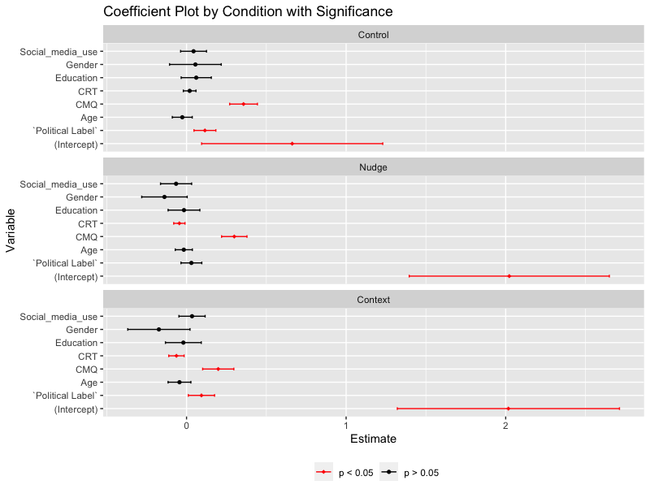
Figure 5: Coefficient estimates and confidence interval for variables across conditions for accuracy scores of false news items.
5 Conclusion
This paper investigates the impact of two proactive interventions – Nudge and Prebunking – on participants' ability to accurately assess the veracity of news claims, their confidence in these assessments and their sharing intent. Our findings underscore the role of prebunked messages in enhancing both the accuracy and confidence with which individuals discern false news from true news. Notably, the prebunked condition (Context) emerged as the most effective intervention, consistently outperforming the Nudge and control conditions in reducing the perceived accuracy of false news claims and bolstering participants' confidence levels. At the same time, no statistical differences were identified between control and nudge conditions. However, no statistical differences were found between the sharing intent across the conditions, with "very unlikely" being the average choice.
Moreover, the analysis of user characteristics revealed nuanced insights into factors that influence misinformation discernment. Participants who were right-leaning and exhibited a propensity for conspiracy theories were identified as significant predictors of lower discernment abilities. In contrast, participants who preferred analytical thinking over intuitions could discern false and true news claims.
Our analysis of intervention conditions revealed nuanced effects on the perceived accuracy of news claims influenced by individual differences in political orientation, CMQ, and CRT. Specifically, right-leaning participants were more likely to perceive false news claims as accurate in both the control and context (prebunked) conditions, suggesting that direct challenges to their pre-existing beliefs [60], as seen in prebunking intervention, may not effectively reduce misperceptions among this demographic. In contrast, no relationship was found between political orientation and perceived false news accuracy in the nudge condition. This indicates that subtler interventions might circumvent the cognitive resistance encountered by more confrontational approaches. Furthermore, while the CMQ scores predicted the perceived accuracy of false news across conditions, the interventions mitigated this effect, most notably in the context condition, suggesting that both nudging and prebunking can reduce the likelihood of conspiracy-minded individuals accepting false claims as accurate. Interestingly, higher CRT scores were associated with a reduced perception of false news accuracy in the nudge condition, highlighting a heightened scepticism towards false news claims among analytically inclined individuals, which also extended to true news claims. This suggests that while behavioural interventions can enhance discernment in individuals prone to conspiracy theories or lacking analytical scepticism, they also risk increasing scepticism among those already inclined to evaluate information critically.
The insights derived from our study emphasise the necessity of personalising interventions to counteract misinformation effectively. The differential impact of Nudge and Prebunking interventions on various demographic groups, particularly those with right-leaning political orientations, conspiracy theory inclinations, and cognitive reflection, underscores a nuanced landscape of information processing and belief systems. This diversity in response suggests that a one-size-fits-all approach to combating misinformation may not be universally effective. Instead, tailoring interventions to accommodate individual differences—leveraging subtlety for some while employing direct refutation for others—could enhance the overall efficacy of these strategies.
However, this study is not without limitations. Firstly, we used LLMs to generate prebunked messages, and LLMs can sometimes "hallucinate" [30], creating convincing but inaccurate or irrelevant content and thus requiring human verification. Secondly, our survey was self-reported, potentially introducing social desirability bias, wherein participants may respond in a way they perceive as socially acceptable rather than reflecting their true behaviour. Furthermore, self-reported data rely on the participant's subjective interpretation of questions, which could lead to variations in understanding and, subsequently, inconsistency in responses. Future research should focus on the long-term effects of these interventions [29] and explore whether initial improvements in discernment and confidence are sustained over time and translate into real-world information consumption behaviours. Furthermore, research should aim to expand the demographic and cultural diversity of participants to assess the generalisability of findings across different populations and contexts.
Acknowledgments
This work was conducted with the financial support of the Science Foundation Ireland Centre for Research Training in Digitally-Enhanced Reality (d-real) under Grant No. 18/CRT/6224 and at the ADAPT SFI Research Centre at Trinity College Dublin. ADAPT, the SFI Research Centre for AI-Driven Digital Content Technology is funded by Science Foundation Ireland through the SFI Research Centres Programme and is co-funded under the European Regional Development Fund (ERDF) through Grant Agreement No. 13/RC/2106. This work was also supported by the VIGILANT project, which has received funding from the European Union's Horizon Europe Programme under Grant Agreement No. 101073921.
References
Sacha Altay, Anne-Sophie Hacquin, and Hugo Mercier. 2022. Why do so few people share fake news? It hurts their reputation. New Media & Society 24, 6 (June 2022), 1303–1324. https://doi.org/10.1177/1461444820969893
Evangelia Anagnostopoulou, Babis Magoutas, Efthimios Bothos, Johann Schrammel, Rita Orji, and Gregoris Mentzas. 2017. Exploring the Links Between Persuasion, Personality and Mobility Types in Personalized Mobility Applications. In Persuasive Technology: Development and Implementation of Personalized Technologies to Change Attitudes and Behaviors, Peter W. de Vries, Harri Oinas-Kukkonen, Liseth Siemons, Nienke Beerlage-de Jong and Lisette van Gemert-Pijnen (eds.). Springer International Publishing, Cham, 107–118. https://doi.org/10.1007/978-3-319-55134-0_9
Simge Andı and Jesper Akesson. 2021. Nudging Away False News: Evidence from a Social Norms Experiment. Digital Journalism 9, 1 (January 2021), 106–125. https://doi.org/10.1080/21670811.2020.1847674
Sumitra Badrinathan and Simon Chauchard. 2023. "I Don't Think That's True, Bro!" Social Corrections of Misinformation in India. The International Journal of Press/Politics (February 2023), 194016122311587. https://doi.org/10.1177/19401612231158770
Meital Balmas. 2014. When Fake News Becomes Real: Combined Exposure to Multiple News Sources and Political Attitudes of Inefficacy, Alienation, and Cynicism. Communication Research 41, 3 (April 2014), 430–454. https://doi.org/10.1177/0093650212453600
Dipto Barman and Owen Conlan. 2023. Does Explanation Matter? An Exploratory Study on the Effects of Covid–19 Misinformation Warning Flags on Social Media. In 2023 10th International Conference on Behavioural and Social Computing (BESC), October 30, 2023. IEEE, Larnaca, Cyprus, 1–7. https://doi.org/10.1109/BESC59560.2023.10386371
Melisa Basol, Jon Roozenbeek, Manon Berriche, Fatih Uenal, William P. McClanahan, and Sander van der Linden. 2021. Towards psychological herd immunity: Cross-cultural evidence for two prebunking interventions against COVID-19 misinformation. Big Data & Society 8, 1 (January 2021), 205395172110138. https://doi.org/10.1177/20539517211013868
Daniele Bellutta, Joshua Uyheng, and Kathleen M. Carley. 2022. The Missing Link Between User Engagement and Misinformation's Impact on Online Behavior. In Social, Cultural, and Behavioral Modeling, Robert Thomson, Christopher Dancy and Aryn Pyke (eds.). Springer International Publishing, Cham, 79–89. https://doi.org/10.1007/978-3-031-17114-7_8
Mauro Bertolotti and Patrizia Catellani. 2022. Counterfactual thinking as a prebunking strategy to contrast misinformation on COVID-19. Journal of Experimental Social Psychology (September 2022), 104404. https://doi.org/10.1016/j.jesp.2022.104404
A. Bessi. 2016. Personality traits and echo chambers on facebook. Comput. Hum. Behav. 65, (2016), 319–324. https://doi.org/10.1016/j.chb.2016.08.016
Mikey Biddlestone, Jon Roozenbeek, and Sander van der Linden. 2022. Once (but not twice) upon a time: Narrative inoculation against conjunction errors indirectly reduces conspiracy beliefs and improves truth discernment. Applied Cognitive Psychology (December 2022), acp.4025. https://doi.org/10.1002/acp.4025
Martin Bruder, Peter Haffke, Nick Neave, Nina Nouripanah, and Roland Imhoff. 2013. Measuring Individual Differences in Generic Beliefs in Conspiracy Theories Across Cultures: Conspiracy Mentality Questionnaire. Front. Psychol. 4, (2013). https://doi.org/10.3389/fpsyg.2013.00225
T. Buchanan and J. Kempley. 2021. Individual differences in sharing false political information on social media: Direct and indirect effects of cognitive-perceptual schizotypy and psychopathy. Pers. Individ. Differ. 182, (2021). https://doi.org/10.1016/j.paid.2021.111071
Ruth M. J. Byrne. 2019. Counterfactuals in Explainable Artificial Intelligence (XAI): Evidence from Human Reasoning. In Proceedings of the Twenty-Eighth International Joint Conference on Artificial Intelligence, August 2019. International Joint Conferences on Artificial Intelligence Organization, Macao, China, 6276–6282. https://doi.org/10.24963/ijcai.2019/876
Josh Compton. 2020. Prophylactic Versus Therapeutic Inoculation Treatments for Resistance to Influence. Communication Theory 30, 3 (August 2020), 330–343. https://doi.org/10.1093/ct/qtz004
John Cook, Stephan Lewandowsky, and Ullrich K. H. Ecker. 2017. Neutralizing misinformation through inoculation: Exposing misleading argumentation techniques reduces their influence. PLoS ONE 12, 5 (May 2017), e0175799. https://doi.org/10.1371/journal.pone.0175799
Shih-Chieh Dai, Yi-Li Hsu, Aiping Xiong, and Lun-Wei Ku. 2022. Ask to Know More: Generating Counterfactual Explanations for Fake Claims. In Proceedings of the 28th ACM SIGKDD Conference on Knowledge Discovery and Data Mining, August 14, 2022. ACM, Washington DC USA, 2800–2810. https://doi.org/10.1145/3534678.3539205
Ullrich K. H. Ecker, Ziggy O'Reilly, Jesse S. Reid, and Ee Pin Chang. 2020. The effectiveness of short-format refutational fact-checks. British Journal of Psychology 111, 1 (2020), 36–54. https://doi.org/10.1111/bjop.12383
Álex Escolà-Gascón, Neil Dagnall, Andrew Denovan, Kenneth Drinkwater, and Miriam Diez-Bosch. 2023. Who falls for fake news? Psychological and clinical profiling evidence of fake news consumers. Personality and Individual Differences 200, (January 2023), 111893. https://doi.org/10.1016/j.paid.2022.111893
Franz Faul, Edgar Erdfelder, Albert-Georg Lang, and Axel Buchner. 2007. G*Power 3: A flexible statistical power analysis program for the social, behavioral, and biomedical sciences. Behavior Research Methods 39, 2 (May 2007), 175–191. https://doi.org/10.3758/BF03193146
Lisa Fazio. 2020. Pausing to consider why a headline is true or false can help reduce the sharing of false news. HKS Misinfo Review (February 2020). https://doi.org/10.37016/mr-2020-009
Seth Flaxman, Sharad Goel, and Justin M. Rao. 2016. Filter Bubbles, Echo Chambers, and Online News Consumption. Public Opinion Quarterly 80, S1 (January 2016), 298–320. https://doi.org/10.1093/poq/nfw006
Shane Frederick. 2005. Cognitive Reflection and Decision Making. Journal of Economic Perspectives 19, 4 (November 2005), 25–42. https://doi.org/10.1257/089533005775196732
R. K. Garrett. 2019. Social media's contribution to political misperceptions in US Presidential elections. PloS ONE 14, 3 (March 2019). https://doi.org/10.1371/journal.pone.0213500
Andrew M. Guess, Michael Lerner, Benjamin Lyons, Jacob M. Montgomery, Brendan Nyhan, Jason Reifler, and Neelanjan Sircar. 2020. A digital media literacy intervention increases discernment between mainstream and false news in the United States and India. Proc. Natl. Acad. Sci. U.S.A. 117, 27 (July 2020), 15536–15545. https://doi.org/10.1073/pnas.1920498117
Sajanee Halko and Julie A. Kientz. 2010. Personality and Persuasive Technology: An Exploratory Study on Health-Promoting Mobile Applications. In Persuasive Technology, Thomas Ploug, Per Hasle and Harri Oinas-Kukkonen (eds.). Springer Berlin Heidelberg, Berlin, Heidelberg, 150–161. https://doi.org/10.1007/978-3-642-13226-1_16
Lynn Hasher, David Goldstein, and Thomas Toppino. 1977. Frequency and the conference of referential validity. Journal of Verbal Learning and Verbal Behavior 16, 1 (February 1977), 107–112. https://doi.org/10.1016/S0022-5371(77)80012-180012-1)
Aumyo Hassan and Sarah J. Barber. 2021. The effects of repetition frequency on the illusory truth effect. Cognitive Research: Principles and Implications 6, 1 (May 2021), 38. https://doi.org/10.1186/s41235-021-00301-5
Yi-Li Hsu, Shih-Chieh Dai, Aiping Xiong, and Lun-Wei Ku. 2023. Is Explanation the Cure? Misinformation Mitigation in the Short Term and Long Term. Retrieved November 20, 2023 from http://arxiv.org/abs/2310.17711
Ziwei Ji, Nayeon Lee, Rita Frieske, Tiezheng Yu, Dan Su, Yan Xu, Etsuko Ishii, Ye Jin Bang, Andrea Madotto, and Pascale Fung. 2023. Survey of Hallucination in Natural Language Generation. ACM Comput. Surv. 55, 12 (December 2023), 1–38. https://doi.org/10.1145/3571730
Kiemute Oyibo, Rita Orji, Jaap Ham, Joshua Nwokeji, and Ana Ciocarlan. 2021. Personalizing Persuasive Technologies: Personalization for Wellbeing. (2021). https://doi.org/10.13140/RG.2.2.26605.00485
Loukas Konstantinou, Dionysis Panos, and Evangelos Karapanos. 2024. Exploring the Design of Technology-Mediated Nudges for Online Misinformation. International Journal of Human–Computer Interaction (January 2024), 1–28. https://doi.org/10.1080/10447318.2023.2301265
Mehrdad Koohikamali and Anna Sidorova. 2017. Information Re-Sharing on Social Network Sites in the Age of Fake News. InformingSciJ 20, (2017), 215–235. https://doi.org/10.28945/3871
Anastasia Kozyreva, Philipp Lorenz-Spreen, Stefan Michael Herzog, Ullrich K. H. Ecker, Stephan Lewandowsky, and Ralph Hertwig. 2022. Toolbox of Interventions Against Online Misinformation and Manipulation. PsyArXiv. https://doi.org/10.31234/osf.io/x8ejt
Candice Lanius, Ryan Weber, and William I. MacKenzie. 2021. Use of bot and content flags to limit the spread of misinformation among social networks: a behavior and attitude survey. Soc. Netw. Anal. Min. 11, 1 (December 2021), 32. https://doi.org/10.1007/s13278-021-00739-x
David M J Lazer, Matthew A Baum, Yochai Benkler, Adam J Berinsky, Kelly M Greenhill, Filippo Menczer, Miriam J Metzger, Brendan Nyhan, Gordon Pennycook, David Rothschild, Michael Schudson, Steven A Sloman, Cass R Sunstein, Emily A Thorson, Duncan J Watts, and Jonathan L Zittrain. 2018. The science of fake news. Science 359, 6380 (March 2018), 1094. https://doi.org/10.1126/science.aao2998
Stephan Lewandowsky, John Cook, and Doug Lombardi. 2020. Debunking Handbook 2020. https://doi.org/10.17910/B7.1182
Stephan Lewandowsky and Sander van der Linden. 2021. Countering Misinformation and Fake News Through Inoculation and Prebunking. European Review of Social Psychology (February 2021), 1–38. https://doi.org/10.1080/10463283.2021.1876983
Han Li. 2022. Disinformation Targeting Chinese Americans Sparks Concerns. The San Francisco Standard. Retrieved October 24, 2023 from https://sfstandard.com/2022/10/07/disinformation-chinese-americans-social-media-elections/
Rakoen Maertens, Friedrich M. Götz, Hudson F. Golino, Jon Roozenbeek, Claudia R. Schneider, Yara Kyrychenko, John R. Kerr, Stefan Stieger, William P. McClanahan, Karly Drabot, James He, and Sander Van Der Linden. 2023. The Misinformation Susceptibility Test (MIST): A psychometrically validated measure of news veracity discernment. Behav Res (June 2023). https://doi.org/10.3758/s13428-023-02124-2
C. Martel, G. Pennycook, and D. G. Rand. 2020. Reliance on emotion promotes belief in fake news. Cogn. Res: Prin. Implic. 5, 1 (2020). https://doi.org/10.1186/s41235-020-00252-3
W. J. McGuire and D. Papageorgis. 1961. The relative efficacy of various types of prior belief-defense in producing immunity against persuasion. The Journal of Abnormal and Social Psychology 62, 2 (March 1961), 327–337. https://doi.org/10.1037/h0042026
Tim Miller. 2019. Explanation in artificial intelligence: Insights from the social sciences. Artificial Intelligence 267, (February 2019), 1–38. https://doi.org/10.1016/j.artint.2018.07.007
Gillian Murphy, Elizabeth F. Loftus, Rebecca Hofstein Grady, Linda J. Levine, and Ciara M. Greene. 2019. False Memories for Fake News During Ireland's Abortion Referendum. Psychol Sci 30, 10 (October 2019), 1449–1459. https://doi.org/10.1177/0956797619864887
Jessica Murray, Aina J. Khan, and Rajeev Syal. 2022. 'It feels like people want to fight': how communal unrest flared in Leicester. The Guardian. Retrieved October 24, 2023 from https://www.theguardian.com/uk-news/2022/sep/23/how-communal-unrest-flared-leicester-muslim-hindu-tensions
Brendan Nyhan and Jason Reifler. 2010. When Corrections Fail: The Persistence of Political Misperceptions. Polit Behav 32, 2 (June 2010), 303–330. https://doi.org/10.1007/s11109-010-9112-2
Katherine Ognyanova, David Lazer, Ronald E. Robertson, and Christo Wilson. 2020. Misinformation in action: Fake news exposure is linked to lower trust in media, higher trust in government when your side is in power. HKS Misinfo Review (June 2020). https://doi.org/10.37016/mr-2020-024
OpenAI et. al. 2023. GPT-4 Technical Report. (2023). https://doi.org/10.48550/ARXIV.2303.08774
Gordon Pennycook, Jabin Binnendyk, Christie Newton, and David G. Rand. 2021. A Practical Guide to Doing Behavioral Research on Fake News and Misinformation. Collabra: Psychology 7, 1 (July 2021), 25293. https://doi.org/10.1525/collabra.25293
Gordon Pennycook, Jonathon McPhetres, Yunhao Zhang, Jackson G Lu, and David G Rand. Fighting COVID-19 Misinformation on Social Media: Experimental Evidence for a Scalable Accuracy-Nudge Intervention. 11.
Gordon Pennycook and David G. Rand. 2020. Who falls for fake news? The roles of bullshit receptivity, overclaiming, familiarity, and analytic thinking. J Pers 88, 2 (April 2020), 185–200. https://doi.org/10.1111/jopy.12476
Megan A.K. Peters. 2022. Confidence in Decision-Making. In Oxford Research Encyclopedia of Neuroscience. Oxford University Press. https://doi.org/10.1093/acrefore/9780190264086.013.371
20 Oct 2023 Associated Press. 2023. Misinformation About the Israel-Hamas War Is Flooding Social Media. Here Are the Facts. Military.com. Retrieved October 23, 2023 from https://www.military.com/daily-news/2023/10/20/misinformation-about-israel-hamas-war-flooding-social-media-here-are-facts.html
Jon Roozenbeek, Alexandra L. J. Freeman, and Sander van der Linden. 2021. How Accurate Are Accuracy-Nudge Interventions? A Preregistered Direct Replication of Pennycook et al. (2020). Psychol Sci 32, 7 (July 2021), 1169–1178. https://doi.org/10.1177/09567976211024535
Jon Roozenbeek and Sander van der Linden. 2019. Fake news game confers psychological resistance against online misinformation. Palgrave Commun 5, 1 (December 2019), 65. https://doi.org/10.1057/s41599-019-0279-9
Jon Roozenbeek, Jane Suiter, and Eileen Culloty. 2022. Countering Misinformation: Evidence, Knowledge Gaps, and Implications of Current Interventions. PsyArXiv. https://doi.org/10.31234/osf.io/b52um
M. Sallam, D. Dababseh, A. Yaseen, A. Al-Haidar, D. Taim, H. Eid, N. A. Ababneh, F. G. Bakri, and A. Mahafzah. 2020. COVID-19 misinformation: Mere harmless delusions or much more? A knowledge and attitude cross-sectional study among the general public residing in Jordan. PLoS ONE 15, 12 December (2020). https://doi.org/10.1371/journal.pone.0243264
Nikita A. Salovich, Amalia M. Donovan, Scott R. Hinze, and David N. Rapp. 2021. Can confidence help account for and redress the effects of reading inaccurate information? Mem Cogn 49, 2 (February 2021), 293–310. https://doi.org/10.3758/s13421-020-01096-4
Cornelia Sindermann, Helena Sophia Schmitt, Dmitri Rozgonjuk, Jon D. Elhai, and Christian Montag. 2021. The evaluation of fake and true news: on the role of intelligence, personality, interpersonal trust, ideological attitudes, and news consumption. Heliyon 7, 3 (March 2021), e06503. https://doi.org/10.1016/j.heliyon.2021.e06503
Christina Steindl, Eva Jonas, Sandra Sittenthaler, Eva Traut-Mattausch, and Jeff Greenberg. 2015. Understanding Psychological Reactance: New Developments and Findings. Zeitschrift für Psychologie 223, 4 (October 2015), 205–214. https://doi.org/10.1027/2151-2604/a000222
Edson C Tandoc, Richard Ling, Oscar Westlund, Andrew Duffy, Debbie Goh, and Lim Zheng Wei. 2018. Audiences' acts of authentication in the age of fake news: A conceptual framework. New Media & Society 20, 8 (August 2018), 2745–2763. https://doi.org/10.1177/1461444817731756
Keela S Thomson and Daniel M Oppenheimer. 2016. Investigating an alternate form of the cognitive reflection test. Judgment and Decision Making 11, 1 (2016), 15.
Tyler Vergho, Jean-Francois Godbout, Reihaneh Rabbany, and Kellin Pelrine. 2024. Comparing GPT-4 and Open-Source Language Models in Misinformation Mitigation. Retrieved January 22, 2024 from http://arxiv.org/abs/2401.06920
Nathan Walter and Riva Tukachinsky. 2020. A Meta-Analytic Examination of the Continued Influence of Misinformation in the Face of Correction: How Powerful Is It, Why Does It Happen, and How to Stop It? Communication Research 47, 2 (March 2020), 155–177. https://doi.org/10.1177/0093650219854600
Sam Wineburg, Joel Breakstone, Sarah McGrew, Mark D. Smith, and Teresa Ortega. 2022. Lateral reading on the open Internet: A district-wide field study in high school government classes. Journal of Educational Psychology 114, 5 (July 2022), 893–909. https://doi.org/10.1037/edu0000740
Thomas Zerback, Florian Töpfl, and Maria Knöpfle. 2021. The disconcerting potential of online disinformation: Persuasive effects of astroturfing comments and three strategies for inoculation against them. New Media & Society 23, 5 (May 2021), 1080–1098. https://doi.org/10.1177/1461444820908530
Do you like what you are reading? Subscribe to receive updates.
Unsubscribe anytime