
The boundary between reality and fiction in hyperfictions for smartphone
Serge Bouchardon (Costech Lab, Université de technologie de Compiègne, Compiègne, France)
Published in HT '23: 34th ACM Conference on Hypertext and Social Media, Rome, Italy, September 4-8, 2023 · DOI: 10.1145/3603163.3609081 · License: © Copyright held by the owner/author(s).
Authors: Serge Bouchardon
Abstract
Hyperfictions for telephones, described as smartfictions, are based on our ordinary practices with a smartphone, in particular instant messaging and notifications. Using the example of Bury Me, My Love, we analyse the play on the boundary between reality and fiction, but also what these narratives reveal about our own use of the smartphone and the ethical issues they raise.
1 Introduction
If we think of all the digital works that are inserted into the social media, whether it be twiterature or novels on Instagram, to mention only these examples1, it is the frontier between reality and fiction that is constantly being re-interrogated. These narratives provoke an intrusion of fiction into spaces that are not originally intended for it. To what extent does the digital reconfigure the boundary between reality and fiction, and to what extent are digital hyperfictions a good indicator of this?
1 One might also think of the whole online tradition of ARGs, Alternate Reality Games, or the "fictional profiles" on which Alexandra Saemmer and Bertrand Gervais are working (author's note). 2 http://enterremoimonamour.arte.tv/. In Arabic, "Bury me, my love" means "take care of yourself", "don't you dare die before me". 3 It is under this category that this creation is marketed.
On smartphone application platforms (Google Play and App
Store), there are more and more interactive narratives for smartphones, "smartfictions" [1]. These fictions are based on ordinary, everyday practices with a smartphone, such as instant chat, but also notifications (such as Lifeline or Somewhere). These fictions introduce the reader's real time into the fictional setting. The time of the smartphone and the time that passes are data that are fictionalised.
Using the example of Bury Me, My Love 2 , the aim is to
understand what is at stake in this blurring of the boundary between reality and fiction, but also what these stories tell us about our own use of the smartphone and the ethical issues they raise.
2 Bury me, my love: crossing borders The "narrative game"3 Bury me, my love (Enterre-moi, mon amour for the original French version), published in 2017, is the result of a collaboration between the studio The Pixel Hunt and the television channel Arte France. The starting point for this creation was a testimonial story published by the newspaper Le Monde in 2016 and entitled “Le Journal d'une migrante” 4. This diary consists of the Whatsapp feed of a young Syrian woman migrating to Germany. This testimonial story was later transformed into an fictional story, Bury Me, My Love5 (see figure 1).
4 https://www.lemonde.fr/international/visuel/2015/12/18/dans-le-
telephone-d-une-migrante-syrienne48348343210.html. 5 The interactive prologue is playable here:
http://enterremoimonamour.arte.tv/prologue.
HT ‘23, September, 2023, Rome, Italy S. Bouchardon
Figure 1. Intro
screen of "Bury me, my love".
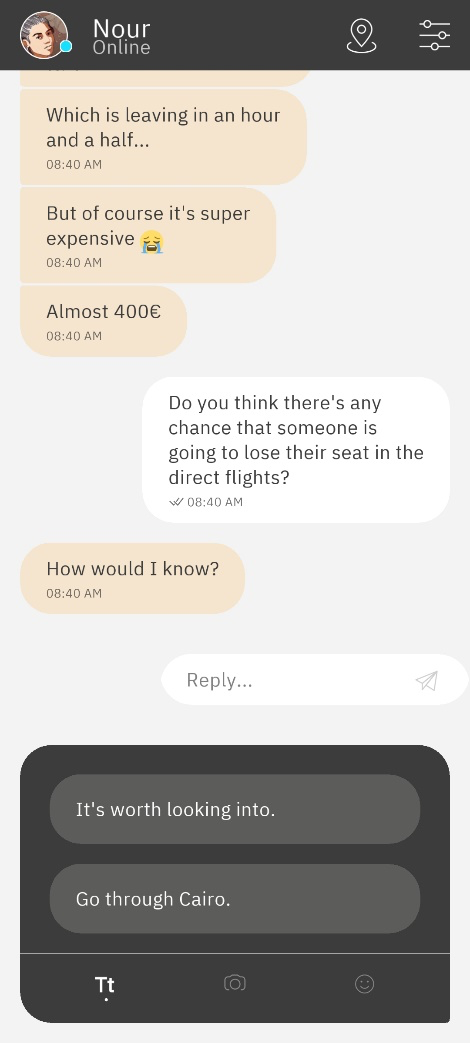
In this hyperfiction, we play the character of Majd, the
husband of Nour, a young Syrian woman trying to reach Europe. We exchange with Nour via instant messaging. We try to advise her and to support her morally via choices in hyperlinks (see figure 2). The journey between Syria and Europe has no set duration. The journey can last several days.
The play on chronology and temporality is combined with a
play on cartography and spatiality. The reader can access the progress of Nour's journey via a geolocation tag, located at the top right of the instant discussion space (see figure 2). The reader can thus visualise the character's progress in real time on a map. This temporality is also an indication of the reader's progress in the story. The closer Nour gets to one of the European countries, the closer the reader gets to the end of the reading experience. It is therefore both a spatial and temporal marker of the character's progress as well as that of the reader in his/her reading journey.
6 http://enterremoimonamour.arte.tv/.
Figure 2. Map (right) showing the character's route.
Along each route (there are 19 different endings in this
hypertext), a counter indicates the days that pass. The border may be temporarily closed, Nour may have an appointment with an acquaintance who does not arrive... In this case, should we wait or reconsider our plans?
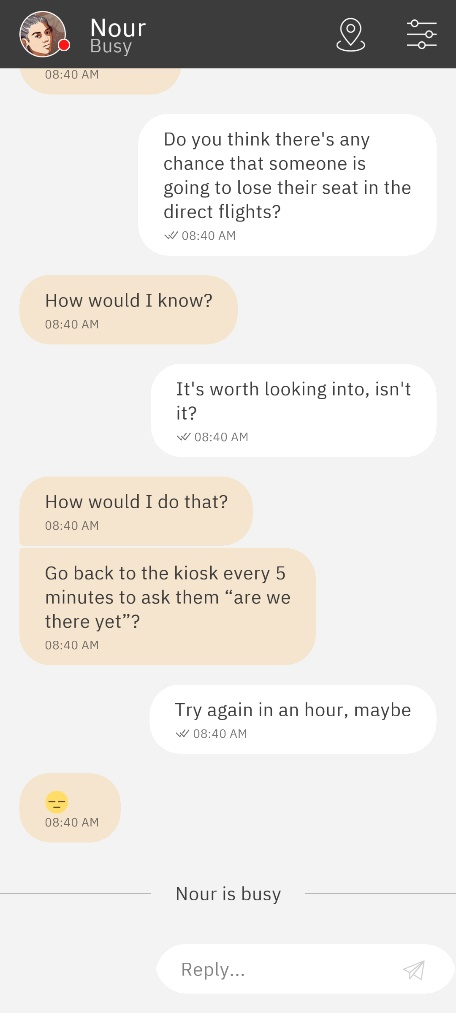
“Your communications will be in pseudo-real time: if Nour has
to do something that is supposed to take her a few hours, you will not be able to reach her during that time. When she returns, you will be notified that she is available again - and that she may need you.” 6
The boundary between reality and fiction in smartfictions HT ‘23, September, 2023, Rome, Italy
Figure 3. The character Nour is no longer available.
The reader must wait for a notification from her.
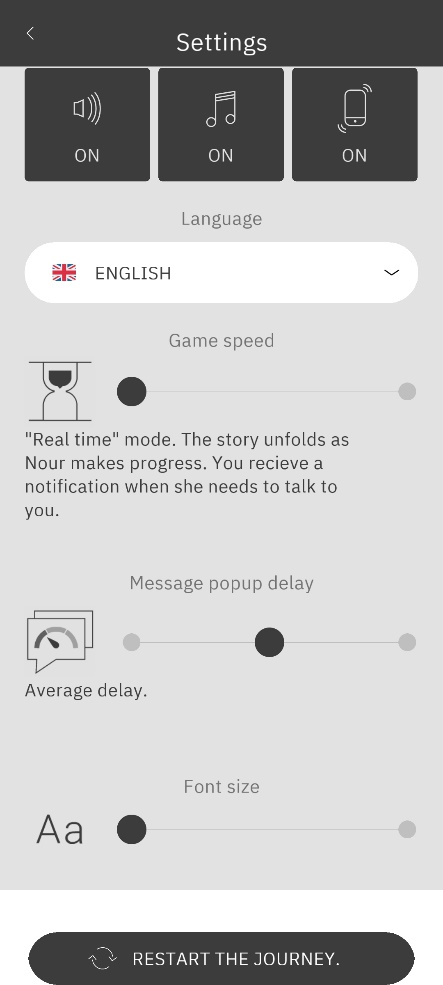
3 The reader's real time It is this "real time" mode that interests us here (see figure 4). It should be noted that the reader can deactivate the "real time" notifications if he or she wishes, as this mode is activated by default.
7 These include Lifeline (2015) and Somewhere (2017).
Figure 4. Real-time mode settings.
There is a play on temporality with the intrusion of the
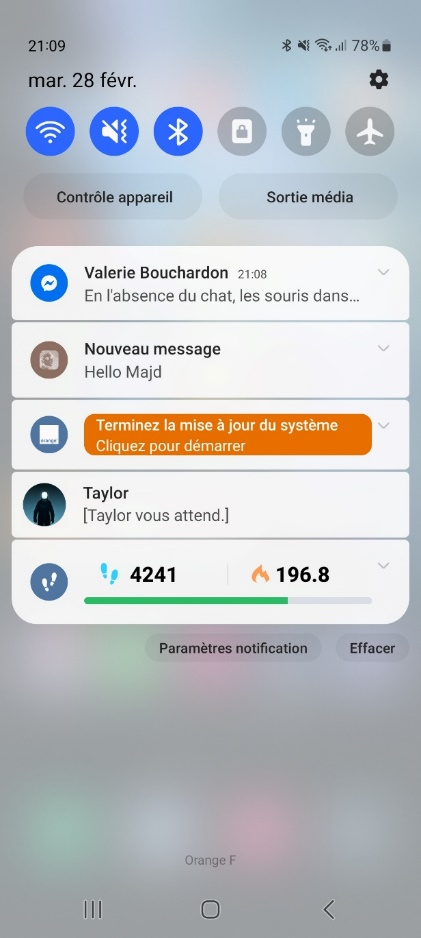
reader's (and the fictional character's) "real time". The relationship to reading time is thus different with the intrusion of notifications: when he or she receives a notification from Nour, among other notifications (see figure 5), the user is encouraged to dive back into the fiction to dialogue with the character. From a phenomenological point of view, there is an interruption with the injunction of the notification. Notification-based fictions7 thus go quite far in disrupting the user's time, but at the same time reintroduce the user's "real time" into the fictional setting. Manon Picard has referred to these fictional notifications as "notifictions"[1].
HT ‘23, September, 2023, Rome, Italy S. Bouchardon
insofar as it draws the features of temporal experience" [2]. Narrative is, according to this perspective, our main tool for situating ourselves in time - and for situating time in us. Furthermore, the digital can be characterised as a "tool for the phenomenal deconstruction of temporality" [3]. Indeed, it translates into two trends: real-time calculation, giving the impression of immediacy; universality of access 9 , giving the impression of availability. The digital, in its availability and immediacy, would thus lead to a permanent present, without any temporal flow [3].
Figure 5. Fictional notifications (Bury me, my love and
Lifeline) among other notifications.
Just as locative narratives 8 play on the boundary between
fictional space and the reader's real space, encouraging the reader to physically move to a given place to advance the narrative, notification-based narratives play on the boundary between fictional time and the reader's real time.
What do these smartfictions that involve notifications bring?
They give us the impression of co-presence. As readers/actors of smartfiction, when we make a choice, we somehow make the fictional character present through our actions. But this notion of presence is further reinforced when we respond to the character's call via a notification. We make the time of the other (as well as that of the fiction) happen. The temporality of the character (and of the events) coincides, via the notifications, with the temporality of the reader, who then fully appropriates the duration of the story. Note that for some readers, having to leave the story to wait for a notification can be a disengagement factor from the story (in this case, it is always possible to deactivate the notifications).
For Paul Ricoeur, "time becomes human time insofar as it is
articulated in a narrative manner; in turn, narrative is significant
8 For example The Cartographer's Confession (2017), by James Attlee, set in London. 9 While it can indeed be said that the smartphone has reached near global ubiquity, it is not universal nor are smartfictions iuniversally accessible.
The smartfictions that play with notifications could allow a
retemporalisation 10 of human time de-temporised by
computation.
4 An indicator of smartphone use
The play on notifications is based in particular on the fact that the smartphone device is our device for everyday communication and writing practices. The blurring between reality and fiction is all the more effective because it is the same device that we use to communicate in everyday life and to read/act in fiction. This blurring can be found in all the Lost Phone type smartfictions (A Normal Lost Phone, Another Lost Phone, Ana the Game...): the user is supposed to have found a phone in which he or she can rummage (email, photos, diary...) to understand the character's story.
If this gives the fiction an effect of reality, we also perceive,
through the fictional notifications that blur the real, that the smartphone is in a way itself a medium of derealisation: it builds a layer of fiction outside the real world. Thanks to these fictions, we thus understand that the smartphone device is already a medium of fiction (and narration) introducing a new relationship to temporality (and probably also reminding us that the fiction/reality distinction must be overcome in this case).
Smartfiction thus has a reflexive dimension. It invites us to
reflect on the daily use of the medium and device that is the smartphone. There are few devices that are used daily and that serve as narrative devices. The aesthetic diversion, which is carried out in an artistic gesture, shifts the focus and thus reveals the relationship that we have with the smartphone on a daily basis. Our everyday uses are always filled with fiction and narrative. Smartfiction, which exploits the possibilities of the device, thus reveals a power at work in all the uses of the smartphone: isn't any use of the smartphone in some way a smartfiction, thus tainted by absence and fiction? It is our own relationship to the blurring of the boundary between fiction and reality that interactive smartphone narratives bring to the fore, and about which they encourage us to question ourselves.
Many smartfictions emphasise the fact that they are based on
real data (for example, the Whatsapp feed of the Syrian migrant, Dana, published by the Le Monde website, and the real testimonies of migrants that fed into Bury Me, My Love). Florent Maurin, co-
10 Of course, smartfictions employ computation to interact with the reader, but the waiting times - and the consecutive narrative tension - lead to retemporalisation.
The boundary between reality and fiction in smartfictions HT ‘23, September, 2023, Rome, Italy
writer and game designer of Bury Me, My Love, also speaks of a "game of reality". In his speeches and interviews, he addresses the question of reality/fiction, insisting on the fact that Bury Me, My Love is a fiction and that this creation must be taken as such... but at the same time he insists on the fact that "everything we tell is based on reality, on concrete testimonies, and first and foremost Dana's. We didn't want to tell something that couldn't have happened"11 . In Bury Me, My Love, we thus have a hybrid between fact and fiction. Françoise Lavocat has argued that "what is factual is referential, and what is fictional is not" [4]. This is undoubtedly reductive, as fiction seems most of the time - if not always - to have a referential value (political, social, historical...), even though Thomas Pavel [5] underlines that what matters about fiction is its relation to the human capacity of invention and the complex requirements of imagination.
boundaries between reality and fiction, particularly in smartfictions that use the smartphone as a medium for fictionalisation.
5 Fictions and ethical issues
In Fait et fiction. Pour une frontière [4], Françoise Lavocat sets out to deconstruct the blurring of the boundaries between reality and fiction, seeking to "show the existence and the cognitive, conceptual and political necessity of the boundaries of fiction" in all the arts of fiction. There is thus a tension between the need to establish the boundaries between reality and fiction12 and the perpetual blurring practiced by the creators of digital fictions, in particular smartphone hyperfictions such as Bury Me, My Love. This blurring of the boundaries between reality and fiction is often a commercial argument: "The application chooses one alternative over another depending on your location, the time of day and even the weather around you. The story should thus come as close as possible to your context to enhance immersion."13
The ultra-personalisation of certain digital fictions for
smartphones (for example, if it is raining when I am reading the story, it is raining in the story I am reading...) has a consequence: the reader is not invited to de-centre himself or herself in order to immerse him or herself in an imaginary experience; on the contrary, it is the story that is moulded into the sphere of his or her identity.
More broadly, there is a current trend in storytelling, embodied
in particular by the fashion for autofiction. The narrative is not seen as an opening to the other, but as an extension of oneself, for the author as well as for the reader. Often, one no longer tells a story, that is, what happened to others than me, or to me as another, but extends one's present identity into fiction. In a way, in many contemporary fictions, the other is now only approached as a mirror of the self. Digital technology is part of this trend, but not the source of it. Digital technology introduces a presentism (content is consulted as if it were simultaneous with my consultation, there is no longer any marker of past time), and proposes a role as actor/player and not only as reader. In addition to presentism and interactivity, another feature of the digital world accentuates this trend, namely the blurring of the
11 Bury me, my love: a split/screen documentary: https://youtu.be/JGF1z8sSv9s. 12 One can think of the proliferation of fake news on the internet as part of a form of grand conspiracy narrative.
If, in Bury Me, My Love, Nour's story is an extension of myself,
what allows me to pretend to live what she lives? One can understand the ethical resistance of some readers. The question of ethical issues arises when the role of a migrant (or the role of a parent of a migrant) is played by a reader comfortably seated in front of his or her computer or smartphone, especially when the experience is presented as a "narrative game". It is thus conceivable that some users may be reluctant to "fictionalise" [6] such a story.
However, in Bury Me, My Love, the feeling of helplessness
experienced by the readers/players when they have only one possible answer, or when they have two and none of them suit them, reminds them that it is not their stories, but that of Majd (who is jealous, somewhat racist towards Iraqis in particular...). Majd's character is strongly characterised, in a somewhat counterintuitive way compared to many video games in which the character we play is intentionally neutral, without any marked personality, so that the player can more easily embody him or her (think for example of the character of Gordon Freeman in HalfLife). The aesthetics of Bury Me, My Love, in stylized drawing, also introduces distance and goes against the idea of a "game of reality". There is therefore a whole play on distance, in relation to the character and in relation to the story.
The "impeded desire to help the character", which according to
Françoise Lavocat [4] characterises empathy in fiction, works well in Bury Me, My Love, all the more so because the main character (Nour) is not the one we embody. Moreover, the fact that the fate of the character ends up partly eluding the reader, despite the promises of the interactive device, can also be seen as a way of reestablishing a certain otherness of the not-me. In smartfiction, there is a sense that the interactive device can increase the possibility of empathy tenfold, as well the Humanity within.
Jean-Marie Schaeffer [6] tells us that "fictional universes, far
from being illusory appearances or deceptive constructions, are one of the major aspects of our relationship with reality". And no doubt the digital – and hypertext in particular - opens up possibilities in this play on the boundary between reality and fiction, and on the promise of an empathetic fictional device.
6 Opening: does AI cancel out reality?
Ultimately, it is perhaps the whole relationship between data and reality that needs to be rethought with digital technology. According to Bruno Bachimont, “we might even wonder to what extent the digital does not cancel out reality: it seems to replace it as opposition and reference. The opposable real is not the reality,
13 "Chronique(s) d’Abîme, a novel that adapts to your context": https://www.igen.fr/app-store/2016/06/chroniques-dabime-un-romanqui-sadapte-votre-contexte-96253 (2016).
HT ‘23, September, 2023, Rome, Italy S. Bouchardon
but the data”14 [7]. In the opposable real, we find the idea of a reference that we put forward to affirm or confirm our statements. In digital twins, for example, the real thing (the real part or machine) is maintained thanks to the digital double, which provides the true version to which the real thing must be made to adhere.
(play store) https://play.google.com/store/apps/details?id=com.plugindigital.anathegame
In artificial intelligence in particular, it is considered that the
opposable real, that which enables justification, corresponds to the collected data on which the calculation and the proposed decision are based. In this way, the human beings in the situation must confront their reality, the reality of the situation, with the reality sedimented in the data. But, according the Bachimont, how can they justify relying on their assessment of any situation, when computational rationality would have them consider the opinion of the algorithm, which is based on the synthesis of situations already encountered and sedimented in the data?
Bruno Bachimont argues that AI data become fiction because
they are no longer anchored in reality, but replace it. They do have an origin in reality, but we no longer make them play and interact with reality: the real origin is not an anchor because this reality is dismissed, while making people believe that AI speaks for reality. As a result, we are not questioning the reality and truth of the data, but only the relevance of the algorithms confronted with these data.
In this sense - and this is perhaps the current trend - digital
technology cancels out reality in favour of fictional data (which have become fictional, even if they have sedimented reality). First and foremost with AI, since it is particular to the notion of datasets that they constitute a substitute reality. It is not so much the boundary between reality and fiction that tends to blur, but reality itself that is replaced. Digital fictions, particularly those involving AI, could be a good indicator of this. What could be the future creative and political implications of AI-driven smartphones and AI-driven smartfictions? This could be the next question.
7 References
[1] Manon Picard, 2022. La smartfiction: une fiction interactive à lire, un rôle à incarner ou une partie à jouer sur son smartphone? PhD Dissertation. Université de technologie de Compiègne, Compiègne.
[2] Paul Ricœur, 1985. Time and narrative, vol 1. University of Chicago Press, Chicago.
[3] Bruno Bachimont, 2010. Le sens de la technique : le numérique et le calcul. Editions Les Belles Lettres, Paris.
[4] Françoise Lavocat, 2016. Fait et fiction. Pour une frontière. Seuil, Paris.
[5] Thomas Pavel, 1986. Fictional Worlds. Cambridge: Harvard University Press.
[6] Jean-Marie Schaeffer, 1999. Pourquoi la fiction ? Seuil, Paris.
[7] Bruno Bachimont, 2023. “L’IA, une machine à inventer”, Conference Intelligence artificielle : une invention à émotion, Université de Montpellier, January 27 2023.
8 Examples of smartfictions
Ana Ana The Game - (app store) https://apps.apple.com/fr/app/ana-the-game/id1202981332
14 "On pourrait même « se demander dans quelle mesure le numérique n’annule pas le réel : il semble se substituer à lui comme opposition et référence. Le réel opposable, ce n'est pas le réel, mais la donnée" (Author’s translation).
Another Lost Phone: Laura’s story - (app store) https://apps.apple.com/fr/app/another-lost-phone/id1267197755 (play store) https://play.google.com/store/apps/details?id=com.accidentalqueens.anotherlostpho ne
Enterre-moi, mon amour / Bury Me, My Love - (app store) https://apps.apple.com/fr/app/enterre-moi-mon-amour/id1281473147 - (play store) https://play.google.com/store/apps/details?id=com.plugindigital.emma
Lifeline - (app store) https://apps.apple.com/fr/app/lifeline/id982354972#?platform=iphone - (play store) https://play.google.com/store/apps/details?id=com.threeminutegames.lifeline.googl e
Memento M - (app store) https://apps.apple.com/us/app/memento-m/id1533799527 - (play store) https://play.google.com/store/apps/details?id=com.glaznev.detective5
Seven – Endgame - (app store) https://apps.apple.com/fr/app/seven-endgame/id1476673731 - (play store) https://play.google.com/store/apps/details?id=air.de.sponsorads.endgame
Simulacra - (app store) https://apps.apple.com/fr/app/simulacra/id1252035454 - (play store) https://play.google.com/store/apps/details?id=com.kaigan.simulacra Somewhere: The Vault Papers - (app store) https://apps.apple.com/fr/app/somewhere-the-vaultpapers/id1340903844 - (play store) https://play.google.com/store/apps/details?id=com.tanuki.somewhere



Do you like what you are reading? Subscribe to receive updates.
Unsubscribe anytime