
Ghost Booking as a New Philanthropy Channel: A Case Study on Ukraine-Russia Conflict
Published in HT '23: 34th ACM Conference on Hypertext and Social Media · DOI: 10.1145/3603163.3609028 · License: © Copyright held by the owner/author(s). Publication rights licensed to ACM.
Authors: Fachrina Dewi Puspitasari, Gareth Tyson, Ehsan-Ul Haq, Pan Hui, Lik-Hang Lee
Fachrina Dewi Puspitasari The Hong Kong Polytechnic University & KAIST Hong Kong SAR & Republic of Korea fachrina.puspitasari@kaist.ac.kr
Gareth Tyson The Hong Kong University of Science and Technology (Guangzhou) China gtyson@ust.hk
Ehsan-Ul Haq Hong Kong University of Science and Technology Hong Kong SAR euhaq@connect.ust.hk
Lik-Hang Lee∗
Pan Hui The Hong Kong University of Science and Technology (Guangzhou) China panhui@ust.hk
The Hong Kong Polytechnic University Hong Kong SAR lik-hang.lee@polyu.edu.hk
Abstract
The term ghost booking has recently emerged as a new way to conduct humanitarian acts during the conflict between Russia and Ukraine in 2022. The phenomenon describes the events where netizens donate to Ukrainian citizens through no-show bookings on the Airbnb platform. Impressively, the social fundraising act that used to be organized on donation-based crowdfunding platforms is shifted into a sharing economy platform market and thus gained more visibility. Although the donation purpose is clear, the motivation of donors in selecting a property to book remains concealed. Thus, our study explores peer-to-peer donation behavior on Airbnb, which was originally intended for economic exchanges, and further identifies which platform attributes effectively drive donation behaviors. We collect over 200K guest reviews from 16K Airbnb property listings in Ukraine by employing two collection methods (screen scraping and HTML parsing). Then, we distinguish ghost bookings among guest reviews. Our analysis uncovers the relationship between ghost booking behavior and the platform attributes. We also pinpoint several attributes that influence ghost booking. Our findings highlight that donors incline to credible properties explicitly featured with humanitarian needs, i.e., the hosts in penury.
Ccs Concepts
• Networks →Online social networks; • Human-centered computing →User models.
∗Lik-Hang Lee is the corresponding author: lik-hang.lee@polyu.edu.hk. Fachrina Dewi Puspitasari was a research student in Lik-Hang Lee’s lab during the work period of the research.
Keywords
Airbnb, Sharing economy, Donation, Humanitarian acts, Social computing
ACM Reference Format: Fachrina Dewi Puspitasari, Gareth Tyson, Ehsan-Ul Haq, Pan Hui, and Lik- Hang Lee. 2023. Ghost Booking as a New Philanthropy Channel: A Case Study on Ukraine-Russia Conflict. In 34th ACM Conference on Hypertext and Social Media (HT ’24), September 4–8, 2023, Rome, Italy. ACM, New York, NY, USA, 11 pages. https://doi.org/10.1145/3603163.3609028
1 Introduction
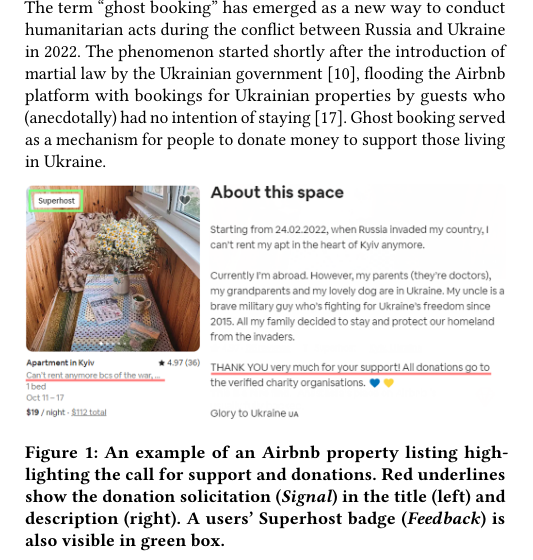
The term “ghost booking” has emerged as a new way to conduct humanitarian acts during the conflict between Russia and Ukraine in 2022. The phenomenon started shortly after the introduction of martial law by the Ukrainian government [10], flooding the Airbnb platform with bookings for Ukrainian properties by guests who (anecdotally) had no intention of staying [17]. Ghost booking served as a mechanism for people to donate money to support those living in Ukraine.
In the past, Airbnb has participated in humanitarian aid efforts, using top-down approaches organized by their leadership. For example, it provided emergency shelters for the evacuees of the Colorado
flooding in 2013 and Hurricane Sandy in 2012 through coordination with hosts near the disaster area [24]. In contrast, ghost booking takes a bottom-up approach, driven by individual users. During this ghost booking drive, Airbnb hosts use their property listings to solicit donations (Figure 1). This represents a relatively new form of humanitarian support, via a commercial platform market, which hitherto has remained unstudied. More specifically, it is obscure whether donation behavior in such platforms is driven more by the commercial tradeoff or the humanitarian tradeoff. This paper aims to explore which factors impact the likelihood of receiving a ghost booking donation on Airbnb. To do so, we borrow from the principle of signaling theory. This social theory tries to explain communication behavior between a signaler and receiver who experience information asymmetry [27]. Accordingly, the information is classified as either signals (host-generated information such as booking fee, property type, host tenure–how long a host has been renting, and listing title and description) or feedback (guest-generated information such as booking reviews, host qualification, and ratings). We dissect the relationship between these attributes and the likelihood of receiving a ghost booking (that we estimate using the number of ghost booking reviews). Our analysis discovers several influential factors that correlate with the probability of receiving a ghost booking. These include the host qualification (e.g., Superhost), the inclusion of solicitation for donations in the title or description, property type, count of normal booking reviews, Superhost tenure, and the booking fee. Our study contributes to the understanding of platform donations, in the context of Airbnb characterized by a bottom-up approach. After depicting the background and related work (Section 2), the paper begins with the methodologies of collecting data regarding Airbnb listing in Ukraine and labeling ghost booking with Latent Dirichlet Allocation (LDA) (Section 3). Section 4 presents the analysis by understanding the characteristics of ghost booking reviews given the platform attributes and further provides statistical and semantic analysis. Accordingly, Section 5 highlights the key findings. Last, Section 6 summarizes our findings and the potential drawbacks of utilizing ghost booking as a philanthropy channel.
2 Background & Related Work
We first review the definition of ghost booking and the characteristics of booking transactions on Airbnb. We also outline the platform attributes from the theoretical perspective.
The Understanding of Ghost Booking. The utilization of Airbnb as a medium for social fundraising is a relatively new concept. Ghost booking is the term used to describe a person who books an accommodation from an online platform but does not physically use it. The movement was first initiated by a Twitter user named Quentin Quarantino1 at the beginning of March 2022. Shortly after, the tweet went viral, and netizens began to donate to Ukrainian Airbnb hosts via ghost bookings.
The Nature of Transactions in Airbnb. Normally, Airbnb is utilized for the purpose of booking accommodation for a short stay. Former studies have explored the characteristics of Airbnb. For example, the booking fee and former guest reviews are found to be
1https://twitter.com/quentquarantino/status/1499441114738212871?cxt= HHwWjoCy2fvvis8pAAAA
important factors for Airbnb users obtaining a booking [31]. Moreover, other studies discovered that the number of guest reviews is considered more meaningful for the guest than the property rating [20]. The same study also confirmed that newer hosts have more popularity [20]. However, other researchers found that guest reviews may contain bias due to manipulation (system selection to eliminate scams) or natural selection (rule of big number or the already-low guest expectation) [9]. In regards to listing characteristics, a former study found a negative relationship between the booking fee and the booking attraction. This study also discovered that guests often prefer private accommodation (i.e., entire property) rather than a shared space because it enables them to have more freedom [35]. The same characteristics were also found in another study, which found that guests are more attracted to properties that provide detailed information [33].
Signaling Information on Airbnb. One of the widely used theories in explaining the communication patterns between two parties is the signaling theory. Although it was first developed in the field of economics by Michael Spence in 1973 [27], the main idea still revolves around the need to minimize information asymmetry [6]. The main construct of this theory consists of two actors (the signaler and receiver) and two pieces of information (the signal and feedback). Here, one cycle of communication is divided into four periods [6]. In the first period, signalers prepare the information that they want to convey. Next, signalers send it to the receiver, contained in a signal. During the third period, receivers accept the signals, interpret them, and prepare the response. Finally, receivers deliver them back to the signaler, bundled as feedback. Similar principles have been applied in the study of Airbnb [33]. Thus, our work aligns with the signaling theory to characterize the attributes of the Airbnb platform with regard to the ghost booking phenomenon. We aggregate the attributes into signals if contents originated from the hosts themselves. Examples of such attributes are the listing description, pictures, booking fee, list of amenities, host identity, and types of rental accommodation. Conversely, we group the Airbnb features into feedback, which covers information from anyone but the hosts themselves. These attributes may be in the form of former guest reviews, ratings, and host qualifications. Although, in practice, these features are still shared by the hosts to Airbnb users, theoretically, they are part of the feedback. Host qualification feature (superhost vs. regular host) is released by the Airbnb system, but we still consider them in the feedback group as the system refers mainly to the data of former guests’ reviews and evaluations when assessing the host performance. Note that the Superhost badge (Figure 1) can be achieved within a year of having an average rating of at least 4.8/5, at least ten bookings, a cancellation rate below 1%, and a response rate within 24 hours for at least 90% of new inquiries [1].
Prior studies on Airbnb. Since Airbnb is the most representative and successful example of the sharing economy, significant research efforts have been made in the past decade regarding the economic incentives and two-sided market designs [2, 32]. In addition, peer-to-peer interaction among hosts and guests is a vital source of user-generated data. The data analytics of such data can act as novel socioeconomic indices, such as the cues of understanding longstanding residential communities featured with cultural
diversity and authenticity [28], the beneficiary of Airbnb in a local community [25], as well as a real-time indicator of tracking neighborhood changes, i.e., a socioeconomic index [15]. Other researchers focus on the relationship between people and sharing economy services. Giovanni et al. conducted a 10-year analysis to explore the guests’ reviews from six cities located in the United States, the United Kingdom, and Australia. The analysis highlights social interactions in Airbnb. The social interaction between the hosts and guests can deteriorate due to uncertainty, as the two parties can only interact with each other through selfdisclosure profile pages and guest reviews. Such self-disclosure signals become the primary conveyor of trust [22]. It is also worthwhile mentioning that potential guests can spend hours and days examining the description of the listing [30]. Similarly, Lampinen and Cheshire [19] conducted a qualitative study to examine the potential of introducing a third party to reduce uncertainty between Airbnb hosts and guests, and hence their financial assurance in the emerging social interaction. In addition, Nata et al. proposed an experimental interface that enables users to invest in trust-driven tokens, and hence constructs a behavioral framework for building trustworthy information in sharing economy platforms [3]. Our work studies the features of Airbnb’s Ukrainian listings as confounding factors for the number of ghost booking reviews. In addition to confirming the findings from previously studied features such as host qualification, our work highlights other features, such as donation solicitation. In summary, our analysis offers a unique and the first case study on humanitarian support through Airbnb (sharing economies) based on the Russia-Ukraine crisis, as compared to the well-known yet organized crowd-sourced donation through diversified platforms [11]. The traditional platforms include DonorsChoose2 and CrowdFunder,3 while the emerging platforms primarily refer to live streaming interaction like Twitch [34], Facebook, and YouTube [21]. The most relevant works refer to the design of mechanisms, information conveyors, and interfaces, which drive the willingness or persuasiveness of donation on these platforms [5, 8, 18, 23, 29].
3 DATA COLLECTION METHODOLOGY
2https://www.donorschoose.org 3https://www.crowdfunder.co.uk
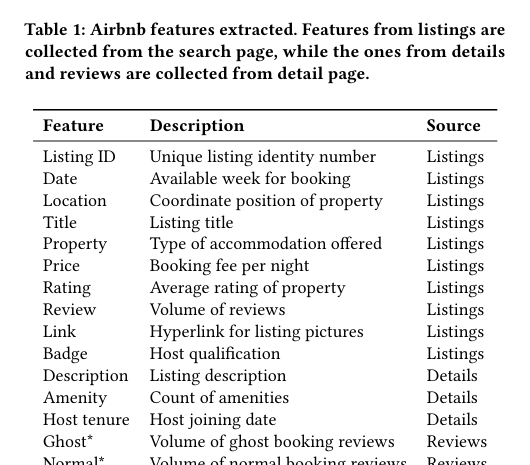
Feature Description Source
Listing ID Unique listing identity number Listings Date Available week for booking Listings Location Coordinate position of property Listings Title Listing title Listings Property Type of accommodation offered Listings Price Booking fee per night Listings Rating Average rating of property Listings Review Volume of reviews Listings Link Hyperlink for listing pictures Listings Badge Host qualification Listings Description Listing description Details Amenity Count of amenities Details Host tenure Host joining date Details Ghost Volume of ghost booking reviews Reviews Normal Volume of normal booking reviews Reviews
Features added after LDA classification.
3.1 Airbnb Dataset
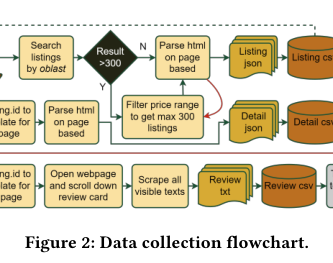
To examine the ghost booking behavior, we collect publicly available data from the Airbnb website. Figure 2 describes the procedures of data collection, while Table 1 contains a summary of the data collected.
Accommodation Listings. First, we gather the list of available accommodations from the search page. Our search term is the name of 24 Ukrainian oblasts4 as destinations. To maximize our search result, we set the dates to “flexible” for a one-week stay (a week period is the most reasonable choice for a short stay compared to only weekends and a month). Since Airbnb limits the search to fifteen pages (twenty listings per page), there is a maximum of 300 listings displayed per search. Accordingly, to retrieve all accommodation data, we filter the search by selecting the oblast and manipulating the price range to handle such a limitation. This dataset covers general information about the property, such as the listing ID, available date, location, listing title, property type, booking fee, average rating, review count, picture hyperlink, and host qualification.
Accommodation Details. Using the listing ID from the above search page dataset, we then visit the accommodation page to extract all public information. This covers the property description, reviews, list of amenities, and host profile.
Guest Reviews. We gather all property reviews by scrolling through the review card on each accommodation page. Each review contains the guest’s name, posting date, review comments, and host responses. We collect all reviews, regardless of their posting date. Later, we use the count of reviews as a proxy for the number of bookings.
4This is an administrative division in Ukraine, https://en.wikipedia.org/wiki/ Oblast
The final dataset consists of 16,330 unique Ukrainian properties with a total of 209,466 guest reviews, ranging from October 2011 to September 2022.
3.2 Labeling Ghost Reviews
We next label each review as a ghost vs. non-ghost booking indicator. The former refers to a guest review, which is likely from a guest who intentionally did not stay on the property; while the latter signifies otherwise. While non-ghost booking reviews may be present at any time period, we posit that ghost booking reviews only started following the Ukraine-Russia conflict. For simplicity, we refer to non-ghost booking as “normal booking”. We next describe how we categorize reviews into these two groups.
Topic Extraction. Prior to the analysis, we pre-process Airbnb guest reviews by removing account handles (Response from [host name]) and boilerplate text. Other unrelated sentence elements, such as tabs, new lines, punctuations, symbols, and emojis, are also removed. Last, reviews with empty content are excluded from the dataset. We then perform the Latent Dirichlet Analysis (LDA) using the textmineR and LDAvis libraries. First, we tokenize and stem the preprocessed reviews. Subsequently, we create a document term matrix using the combination of unigrams or bigrams of the stems. The topic model is constructed by selecting the number of topics (17) using the optimum coherence score. After the appropriate model has been constructed, the topics are assigned to each review. We provide examples of five topics in Table 2. There are topics (topic number 3, 15, and 16) related to the ongoing crisis with keywords such as support and love. Topic numbers 8 and 11 show a more generic Airbnb-specific discourse highlighting the comfort and location of the listed properties.
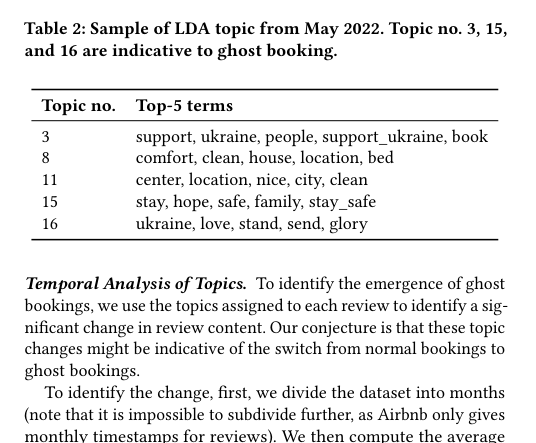
Topic no. Top-5 terms
3 support, ukraine, people, supportukraine, book 8 comfort, clean, house, location, bed 11 center, location, nice, city, clean 15 stay, hope, safe, family, staysafe 16 ukraine, love, stand, send, glory
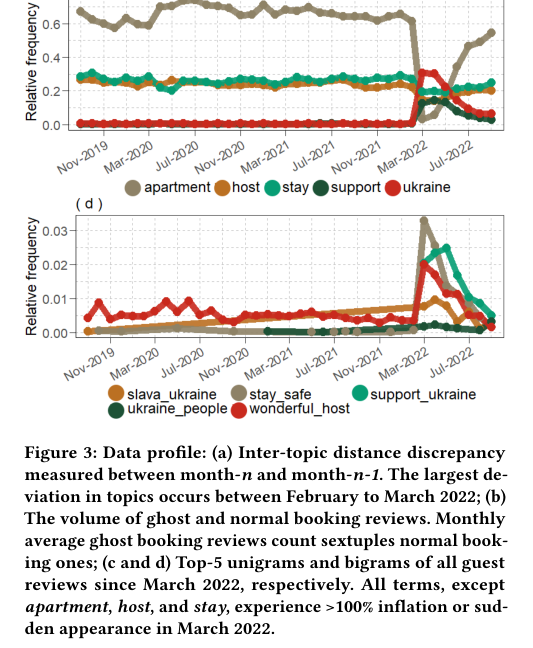
Temporal Analysis of Topics. To identify the emergence of ghost bookings, we use the topics assigned to each review to identify a significant change in review content. Our conjecture is that these topic changes might be indicative of the switch from normal bookings to ghost bookings. To identify the change, first, we divide the dataset into months (note that it is impossible to subdivide further, as Airbnb only gives monthly timestamps for reviews). We then compute the average inter-topic distances between each contiguous time segment. Figure 3(a) shows the result plotted on a time series graph. As distance measures the degree of difference among topics, the y-axis in this graph represents the change between the distance of month n and month n-1. As can be seen, there is a clear spike between February
and March 2022. We observe a remarkable 650% increase in the average Euclidean distance of reviews in March compared to those in February. This shows that the topics discussed within these periods changed dramatically.
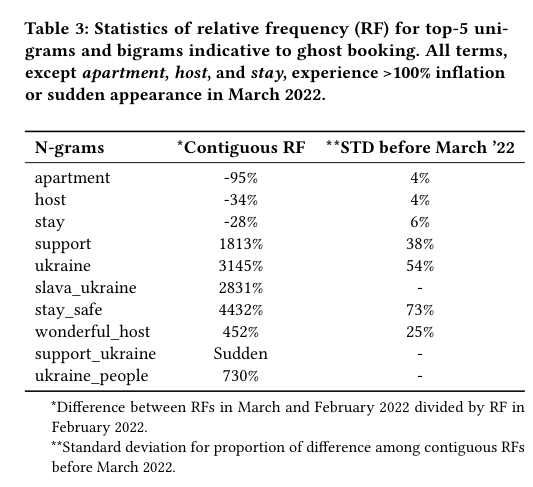
N-grams Contiguous RF STD before March ’22
apartment -95% 4% host -34% 4% stay -28% 6% support 1813% 38% ukraine 3145% 54% slavaukraine 2831% - staysafe 4432% 73% wonderfulhost 452% 25% supportukraine Sudden - ukrainepeople 730% -
Difference between RFs in March and February 2022 divided by RF in February 2022. Standard deviation for proportion of difference among contiguous RFs before March 2022.
Ghost Review Classification. Inspired by the above, we argue that the text topics can serve as a mechanism to identify ghost reviews. To classify a topic as indicative of a ghost booking, we extract the terms that experience an abrupt spike since the start of the conflict. We first extract the top-5 frequent unigrams and bigrams from all guest reviews starting from March 2022. Subsequently, we analyze their temporal relative frequency over time. Our technique is to compute their frequency of occurrence in each time segment and divide it by the total number of reviews in the respective segment. Figures 3(c) and 3(d) depict the relative usage frequency of the top-5 unigrams and bigrams, respectively. We only show the data from November 2019 to September 2022 for better readability. Starting from March 2022, the terms indicative of ghost reviews are those that suddenly appear or increase >100% in relative usage compared to the previous time segment. Specifically, these terms are support, ukraine, supportukraine, staysafe, wonderfulhost, ukrainepeople, and slavaukraine. Table 3 presents the statistics for this selection. Accordingly, we refer to these terms to categorize the LDA topics from March 2022 into ghost booking indicative by manually scrutinizing the top-20 terms of each topic. Referring to these ghost booking indicative topics, we label each review as ghost vs. normal. We further verify the accuracy by randomly checking the content of ten reviews in each time segment starting from March 2022. Finally, we obtain a total of 31,816 ghost-booking reviews and 114,629 normal booking reviews (Figure 3(b)). The total ghost booking reviews accumulated in seven months (from March to September 2022) is almost equivalent to 30% of the total normal booking reviews accumulated in twelve years (from October 2011 to September 2022). This figure illustrates the substantial interest in the grass-root movement for ghost booking.
4 Regression Method
We use the property features as described in Section 2 to quantify their effect in relevance to the number of ghost booking reviews (as a proxy of the number of bookings). To this end, we train a regression model with the number of ghost-booking reviews as the dependent variable. The choice of regression analysis is based on
its interpretability of the effect for independent variables. We use negative-binomial regression due to the non-normal distribution of the data [4, 12, 13].
Model Building. We follow an incremental approach and build 5 regression models in total. We first start with three models: Model 1 involves variables categorized as feedback, i.e., count of normal booking reviews and host qualification (Table 4); Model 2 includes variables grouped as signals, i.e., booking fee, property type, hosting tenure, listing title, and listing description (Table 4); Model 3 incorporates all independent variables to test the influence of both signals and feedback on ghost booking likelihood. We then pick the best-fitting model from these three models and add two additional variables (host qualification and listing title) interaction terms to create Models 4 and 5, respectively. Our grouping is based on the signaling theory discussed in Section 2. Our goal is to investigate whether donors are more influenced by the information published by a host on the Airbnb platform (signals), or by the facts affirmed by the previous guests (feedback). Table 5 lists the variables included in our models.
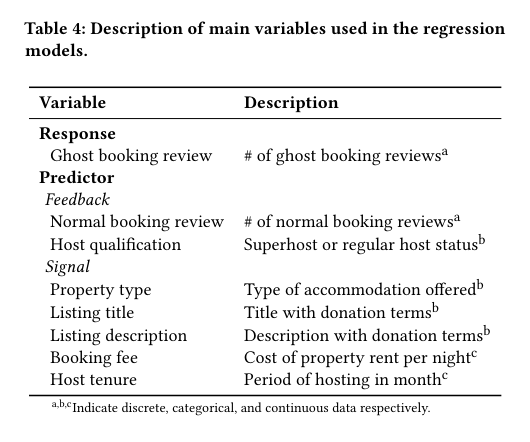
Variable Description
Response Ghost booking review # of ghost booking reviewsa
Predictor Feedback Normal booking review # of normal booking reviewsa
Host qualification Superhost or regular host statusb
Signal Property type Type of accommodation offeredb
Listing title Title with donation termsb
Listing description Description with donation termsb
Booking fee Cost of property rent per nightc
Host tenure Period of hosting in monthc
a,b,cIndicate discrete, categorical, and continuous data respectively.
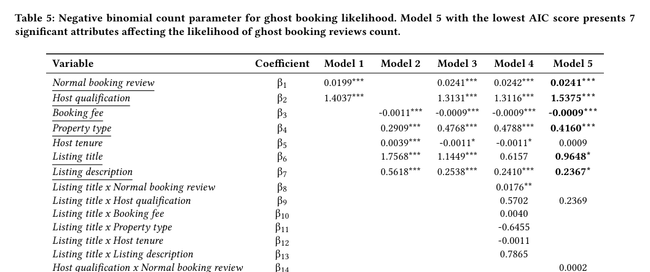
Selection of Most-Fitting Model. We use the Akaike information criterion (AIC) metric to select the best-fitting model from the first iteration with three models. Note that AIC measures the relative quality of three models. This lowest metric marks the most-fitted model, as it indicates that the model has the least information loss relative to the true model. Model 3 has the lowest AIC metric (47,782.23) and is therefore chosen as the best model. Additionally, this model also has the highest goodness-of-fit value (log-likelihood ratio test value of 3,191.29), indicating that it greatly deviates from the null model. Table 5 shows the result for all three models; the significant variables are those with α below 0.05. We observe from Model 3 that all main independent variables, except host tenure, fall in the 95% confidence band, indicating their significance to the volatility of ghost booking review count. Additionally, we also notice that among others, the regression coefficients for host qualification and listing title are the two highest, indicating that both cause the greatest change in the number of
Variable Coefficient Model 1 Model 2 Model 3 Model 4 Model 5
Normal booking review β1 0.0199 0.0241 0.0242 0.0241 Host qualification β2 1.4037 1.3131 1.3116 1.5375 Booking fee β3 -0.0011 -0.0009 -0.0009 -0.0009 Property type β4 0.2909 0.4768 0.4788 0.4160 Host tenure β5 0.0039 -0.0011 -0.0011 0.0009 Listing title β6 1.7568 1.1449 0.6157 0.9648 Listing description β7 0.5618 0.2538 0.2410 0.2367 Listing title x Normal booking review β8 0.0176 Listing title x Host qualification β9 0.5702 0.2369 Listing title x Booking fee β10 0.0040 Listing title x Property type β11 -0.6455 Listing title x Host tenure β12 -0.0011 Listing title x Listing description β13 0.7865 Host qualification x Normal booking review β14 0.0002 Host qualification x Booking fee β15 -0.0006 Host qualification x Property type β16 0.1775 Host qualification x Host tenure β17 -0.0036 Host qualification x Listing description β18 0.0119
AIC 47,694.23 50,694.23 47,496.00 47,509.61 47,468.02 Log likelihood -23,843.11 -25,312.35 -23,739.00 -23,739.79 -23719.00 Log likelihood ratio 3,269.29 330.81 3,477.52 3,475.93 3,517.52 p-value‡ 2 × 10⁻¹⁶ 2 × 10⁻¹⁶ 2 × 10⁻¹⁶ 2 × 10⁻¹⁶ 2 × 10⁻¹⁶
† p-value < 0.05, p-value < 0.01, p-value < 0.001 ††Model 5 has the lowest AIC value (most fit among all models) and highest log likelihood ratio test value (most fit compared to null model). † † †Underlined variables have significant relationship with response variable with reference p-value of 0.05. ‡ p-value from Chi-square statistics of log likelihood ratio test.
ghost booking reviews. Hence, due to their large coefficient value (host qualification β2 = 1.390 and listing title β6 = 1.132), we suspect that there exists a multicollinearity between them and other independent variables, which may influence the effect of the main variables in predicting ghost booking. According to the above observation, Model 3 may have limitations. One of these is that it only considers the change in the number of ghost booking reviews caused by each platform attribute, given everything else is constant. Such an assumption may weaken the external validity of the model because guests conduct a trade-off assessment when choosing which accommodation to book. Thus, relying only on the main variables may overlook the effect of colinearity between these variables. To overcome this, we extend Model 3. We put the interaction effects of property advert title and host qualification with the main variables into Models 4 and 5, respectively. The use of two separate models will better highlight the interaction effect between property advert title and host qualification on the number of ghost-booking reviews likelihood. A generalized formula for the final model can be written as:
𝐿𝑛(𝐺𝐻) = 𝛼+ 𝛽𝑘𝑣𝑘+ 𝛽𝑛𝑣𝑘∗𝑖𝑗+ 𝜖
where 𝑣𝑘∈𝑉and 𝑉is the set of all independent variables. 𝑖𝑗∈𝐼 is a set of interaction variables. 𝛽𝑘and 𝛽𝑛are the coefficients for each term with 𝐾= number of all variables and 𝑁=number of all possible interaction combinations.
5 UNDERSTANDING GHOST BOOKING FROM PLATFORM ATTRIBUTE
We next explore which features are most determinant in predicting the number of ghost-booking reviews a property receives. To achieve this, recall that we we rely on Model 5, based on the lowest AIC measure (47,468.02), to explain our findings. In the context of Airbnb, we define the seven attributes as either signal and feedback. The Title of Donation Solicitation, Property Type, Description of Donation Solicitation, Superhost Tenure, and Booking Fee all refer to Signal, as the Airbnb hosts offer these descriptive yet one-way attributes to pitch to potential donors. On the other hand, Host Qualification and the Number of Normal Booking Reviews are regarded as feedback because this information is based on usergenerated data resulting from the interaction between Airbnb hosts and guests.
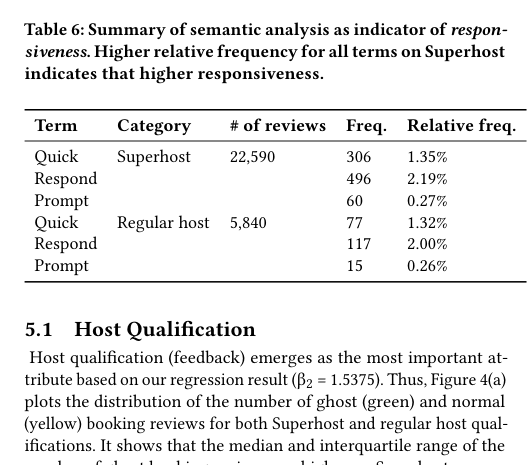
Term Category # of reviews Freq. Relative freq.
Quick Superhost 22,590 306 1.35% Respond 496 2.19% Prompt 60 0.27% Quick Regular host 5,840 77 1.32% Respond 117 2.00% Prompt 15 0.26%
5.1 Host Qualification
Host qualification (feedback) emerges as the most important attribute based on our regression result (β2 = 1.5375). Thus, Figure 4(a) plots the distribution of the number of ghost (green) and normal (yellow) booking reviews for both Superhost and regular host qualifications. It shows that the median and interquartile range of the number of ghost booking reviews are higher on Superhost properties than on regular host ones. We also observe a similar pattern for the distribution of the number of normal booking reviews. However, since both the median and interquartile range of the number of normal booking reviews are higher than those of ghost ones, we suspect that the number of ghost and normal booking reviews have different distributions. We next conduct the Chi-square goodness of fit test and find that both the number of ghost vs. normal booking reviews on Superhost and regular host properties similarly produce small p-value (<0.05 with χ2 of 40,854 vs. 39,399). This demonstrates that both types of booking reviews are different yet are likely to occur more on Superhost properties. This also reinforces our regression results, i.e., we see that Superhosts get 6.35x more ghost booking reviews than regular hosts. This pattern may indicate that donors are most concerned about donating only to trustworthy individuals. As it is unlikely that the host and the donor know each other, the Superhost status is one of the few mechanisms to establish trust. Further, responsiveness (as required for the Superhosts status) can serve as a key criterion for trustworthiness [16]. To support this, we compare the relative occurrence of the terms that are indicative of host responsiveness written on Superhost vs. regular host properties. A former study on the exploration of Airbnb guest reviews content lists question, quick, respond, answer, and prompt as terms indicative of the host’s responses [36]. Referring to this study, we find that the relative frequency for the top-3 terms (quick, respond, and prompt) are all higher on Superhost properties than on the normal host ones (1.35% vs. 1.32%, 2.19% vs. 2.00%, and 0.27% vs. 0.26%, respectively). Further details are listed in Table 6.
5.2 Donation Solicitation in Title
Each property has an associated title (signal), e.g., “Spacious One Bedroom Flat”. We conjecture that some titles may actively solicit contributions, e.g., “donations welcome”. Indeed, titles that contain donation solicitation with words like donate, support, help, and charity are the second most important features in attracting ghost booking reviews (β6 = 0.9648). Figure 4(b) shows the distribution of
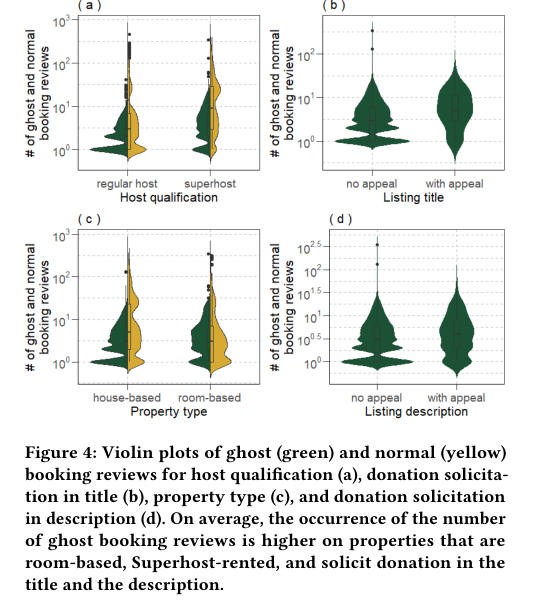
the number of ghost booking reviews (green) for listing titles with and without solicitation. Here, the median for the former is higher than that of the latter. The distribution of the number of ghost booking reviews for the title with solicitation is concentrated around the median (4) and the third quartile (8.5), whereas the distribution for the title without solicitation converges around the lower quartiles (median = 0 and third quartile = 2). This demonstrates that ghost booking is likely to occur in property listings that request donations in their titles. Overall, we see that properties that solicit donations in their title receive 2.82x more ghost booking reviews compared to others. The above suggests that the title may help donors to select receivers as they can easily filter hosts seeking financial assistance during the Ukraine-Russia conflict. This observation is in line with former studies on online feedback systems, where the provision of descriptive information helps the buyer’s purchase decision [26]. By explicitly requesting donations in the title, a host may signal to the donors that the property accepts aid (also known as “needs signaling” [6]).
5.3 Property Type
Property type (signal), i.e., room vs. entire house, is the third most important feature in our regression analysis (β4 = 0.4160). This shows that room-based properties may receive about 1 more ghostbooking reviews than house-based ones. Figure 4(c) presents the distribution of the number of ghost (green) and normal (yellow) booking reviews for room-based vs. house-based properties. We notice that the distributions are rather different. More specifically,
the first quartile of the number of ghost booking reviews on housebased properties tends to be lower (high concentration of 1 review) than on room-based ones. The average number of ghost booking reviews for house-based properties is 1.67, which can be compared to 2.22 for room-based properties. On the other hand, the interquartile range for the number of normal booking reviews is higher in house-based properties than in the room-based ones. We validate this observation using the Chi-square goodness of fit test for both the number of ghost vs. normal booking reviews on room-based and house-based properties. As a result, a small p-value (<0.05 with χ2room-based = 15,392 vs. χ2house-based = 82,811) indicates that the difference does exist. The contrasting pattern of the number of ghost booking reviews on room-based vs. house-based properties can be caused by the former offering lower booking fees than the latter. Our data show that the average booking fee for room-based ($50.63 USD) is lower than for house-based ($80.57 USD). Naturally, a lower fee may attract more users to book the property than the counterpart with expensive booking fees. Besides, since the room-based listings refer to a shared accommodation (e.g., a private room with a shared toilet), donors possibly are not concerned over the privacy issue [35] as they do not plan to stay there.
5.4 Donation Solicitation in Description
Donation solicitation in the description of the property listing (signal) is the next most powerful confounding factor on the number of ghost-booking reviews (β7 = 0.2367). This solicitation attracts 0.46x more ghost booking compared to other listings that do not solicit. Figure 4(d) illustrates the distribution of the number of ghost booking reviews (green) on property descriptions with and without solicitation. The plot shows a similar pattern as observed in Section
5.2
. On average, the number of ghost booking reviews is higher for those with solicitation than those without. However, since the medians of the number of ghost booking reviews over listing descriptions with vs. without donation solicitations are not greatly different (1 vs. 0), the influence of donation solicitation in listing descriptions towards ghost booking is potentially weak.
5.5 Number of Normal Booking Reviews
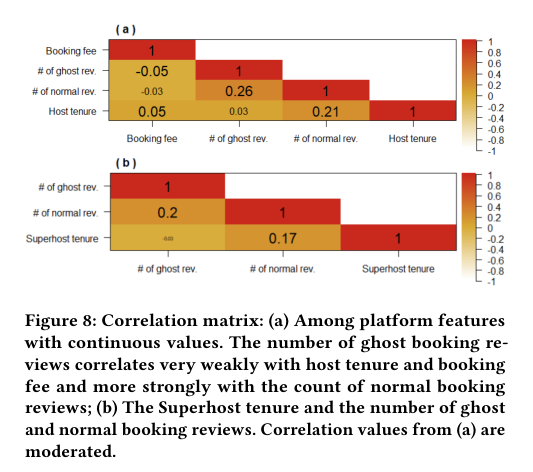
Contrary to the normal booking behavior in Airbnb [31], the count of normal booking reviews (feedback) has little predictive power for the number of ghost bookings (β1 = 0.0241). Figure 5(a) further illustrates the density of distributions for the number of ghost (green) and normal (yellow) booking reviews, in which both distributions exhibit a different number of peaks; the ghost booking reviews have sharper peeks than the normal booking review. The small p-value (<0.05, U = 72,405,036) from the Mann-Whitney test further supports this discrepancy. Furthermore, Figure 5(b) presents the relationship between the number of ghost (green) and normal booking reviews. From this scatter plot, we notice a slightly increasing trend in the number of ghost booking reviews following the increase in the number of normal booking reviews. We further evaluate the correlation of both types of the number of booking reviews in Figure 8(a). Here, we observe that the number of ghost booking reviews positively correlates (0.26), although slightly weakly, with the number of normal booking reviews. This also supports
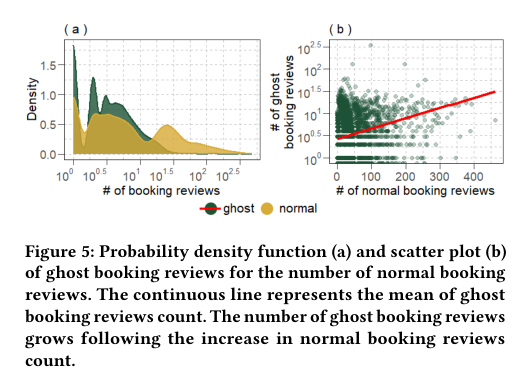
our regression result where we observe that the mean count of the number of ghost booking reviews only increases by 2.44% subjected to 1 increase in the number of normal booking reviews. We infer the weak correlation pattern between both numbers of booking reviews as potentially caused by the difficulty to derive further information solely from the numerical measures of normal booking reviews. A prior study in Airbnb also found that while having more reviews may indicate the popularity of a listing, the count of reviews is less influential in increasing the booking odds than the actual content of the reviews [33].
5.6 Superhost Tenure
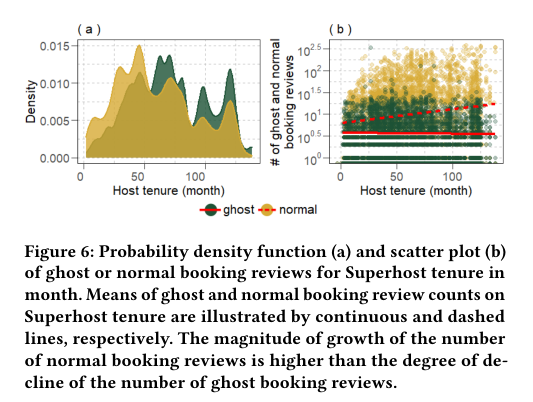
Our regression shows that the tenure of a Superhost (signal) may impact the number of ghost reviews (β17 = -0.0036). This is slightly different from the normal booking pattern where guests tend to book hosts (regardless of qualification) with shorter tenure [20]. To further investigate this, Figure 6(a) shows the distribution of the Superhost tenure, for the number of ghost (green) and normal (yellow) booking reviews. We observe that both distributions are different; this is confirmed through a Mann-Whitney U test, which results in a small p-value (<0.05, U = 1,107,668,184). We see that the average Superhost tenure of the ghost review properties is 60.66 months vs. 59.25 months of the normal reviews properties. Figure 6(b) shows the relationship between both types of booking reviews count and the Superhost tenure. We observe that the number of ghost booking reviews decreases slightly after the increase in host tenure. We further observe the correlation between Superhost tenure and the number of ghost booking reviews in Figure 8(b), which shows that they are very weakly correlated to each other (-0.03).
5.7 Booking Fee
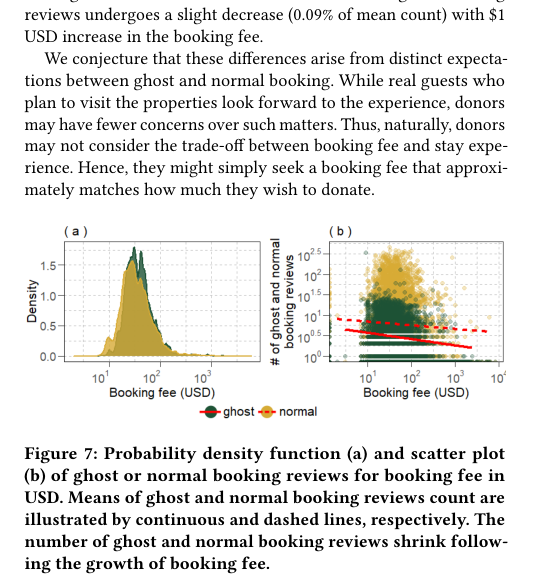
Surprisingly, the booking fee (signal) has a very weak influence on the likelihood of receiving ghost booking reviews (β3 = -0.0009). To further investigate this, Figure 7(a) shows the distribution of the booking fee for the number of ghost (green) and normal (yellow) booking reviews. We notice that both distributions are different, as confirmed by the small p-value (<0.05, U = 2,164,319,869) of a
Mann-Whitney U test. Additionally, Figure 7(b) shows the relationship between the number of ghost (green) and normal (yellow) booking reviews with the booking fee in USD. Although both types of booking reviews decrease following the increase in the booking fee, the magnitude of the decline in the number of ghost booking reviews is larger than that of the normal booking reviews. Figure 8(a) reinforces this relationship, showing that the correlation score (although very weak) of the booking fee with the number of ghost booking reviews (-0.05) is slightly higher than that of the normal booking reviews (-0.03). This reduction is also supported in our regression result that observes the number of ghost booking reviews undergoes a slight decrease (0.09% of mean count) with $1 USD increase in the booking fee. We conjecture that these differences arise from distinct expectations between ghost and normal booking. While real guests who plan to visit the properties look forward to the experience, donors may have fewer concerns over such matters. Thus, naturally, donors may not consider the trade-off between booking fee and stay experience. Hence, they might simply seek a booking fee that approximately matches how much they wish to donate.
6 CONCLUSION AND DISCUSSION
This paper has explored the phenomenon of ghost booking as a mechanism to donate to people in Ukraine. We have examined factors impacting the likelihood of receiving ghost booking reviews (as a proxy for the number of bookings).
Findings. As the platform attributes are classified into feedback (information originated from guests as receiver) and signal (details generated by hosts as signaler), our study discovers that host qualification (feedback), either regular or Superhost, emerges as the most vital platform feature that donors consider when booking. It is important to note that Superhost receives 6.35x more reviews from ghost booking donors than regular hosts. Additionally, the property advert title (signal) also appears to be substantial in influencing donors’ decisions to book. We found that hosts who solicit donation in their listing titles receive 2.82x more ghost booking reviews than hosts who do not. Our observations on Airbnb data imply that both feedback and signal are equally important in affecting the decision to donate, conforming to the previous studies on their effect on donation [14]. Host qualification is an algorithmically aggregated term that provides a holistic performance review of the host on the Airbnb platform. However, this measure is indicated together with other signals, i.e., property features. For instance, the super host badge appears on the top corner of the property photo (Figure 1). Naturally, more information leads to a more minor degree of information asymmetry, and thus reinforcing the quality of the host’s signals [7]. Nevertheless, feedback, albeit only two feedback types are studied in this paper, is potentially more potent than signal, as seen from the different numbers of ghost booking reviews that each can attract.
Potential Pitfalls of Ghost Booking. Trustworthiness is always a critical issue of donation between the donors and the receivers, and thus it impacts the robustness of the donation mechanism. Remarkably, the issue is well recognized by recent studies [3, 16, 18,
22]. We acknowledge that both the signals and feedback act as the basis for informing the potential donors and hence establishing the donors’ perception of trustworthiness in a particular host. Although our work attempted to parse the signals and feedback, such cues may manipulate the donors’ perception of the trustworthiness of a particular host. Donors who donate through ghost booking may still need to be aware of whether their donation is right-on-target for the following reasons. First, when taking the Superhost badge for granted, donors may be misled only by trustworthiness without knowing the host’s financial ability. Our result in Section 5 shows that there are several Superhosts who have been hosting the property for a long time. For such hosts, donors may become slightly hesitant to donate (decrease 0.36% from the mean count) because they may consider them financially sufficient. Furthermore, the host might rent multiple properties in Ukraine or anywhere else in the world. Second, the distribution of aid may become uneven since naturally, not all Ukrainian households rent on the Airbnb platform. Referring to our statistics (Section 3), given that there are only 16,330 Ukrainian listings, assuming no hosts renting multiple properties, and taking the size of each household for 2.465, ghost booking may only be able to help at maximum (all properties receive ghost booking) 40,172 citizens out of 41,723,9985 or less than 1% of total populations.
Limitations and Future Work. We highlight the limitations of our work and present the future line of research. We do not include guest-specific features in our analysis; as such, it is limited by our data collection approach. Future work with guest information may provide a holistic approach from both donors and receivers. Accordingly, we are keen to perform a longitudinal study on both guests and hosts during the ghost booking campaign and its effects on bookings. For future work, we will further elicit relevant user-perceived attributes prevalent on traditional (top-down) and crowdsourced fundraising platforms, to further generalize our findings. Accordingly, we will leverage such attributes to consider the potential mechanism of a fundraiser certification system for donation activities during other new crises. In other words, certified hosts can facilitate humanitarian acts during warfare or natural disasters, especially when the purposes of such sharing economy platforms are initially not designated for humanitarian responses. On the other hand, the attributes of signals and feedback can be further considered as the socioeconomic indices for humanitarian response, e.g., hosts’ trustworthiness and donors’ willingness to donation.
References
[1] Airbnb. 2022. Airbnb superhost program details. https://www.airbnb.com/d/ superhost [2] Siddhartha Banerjee, Sreenivas Gollapudi, Kostas Kollias, and Kamesh Munagala. 2017. Segmenting Two-Sided Markets. In Proceedings of the 26th International Conference on World Wide Web (Perth, Australia) (WWW ’17). International World Wide Web Conferences Steering Committee, Republic and Canton of Geneva, CHE, 63–72. https://doi.org/10.1145/3038912.3052578 [3] Natã M. Barbosa, Emily Sun, Judd Antin, and Paolo Parigi. 2020. Designing for Trust: A Behavioral Framework for Sharing Economy Platforms. In Proceedings of The Web Conference 2020 (Taipei, Taiwan) (WWW ’20). Association for Computing Machinery, New York, NY, USA, 2133–2143. https://doi.org/10.1145/3366423. 3380279
5https://en.wikipedia.org/wiki/Listofcountriesbynumberofhouseholds
[4] Anabel Blasco-Moreno, Marta Pérez-Casany, Pedro Puig, Maria Morante, and Eva Castells. 2019. What does a zero mean? understanding false, random and structural zeros in ecology. Methods in Ecology and Evolution 10, 7 (2019), 949–959. https://doi.org/10.1111/2041-210x.13185 [5] Abhijnan Chakraborty, Nuno Mota, Asia J. Biega, Krishna P. Gummadi, and Hoda Heidari. 2019. On the Impact of Choice Architectures on Inequality in Online Donation Platforms. In The World Wide Web Conference (San Francisco, CA, USA) (WWW ’19). Association for Computing Machinery, New York, NY, USA, 2623–2629. https://doi.org/10.1145/3308558.3313663 [6] Brian L Connelly, S Trevis Certo, R Duane Ireland, and Christopher R Reutzel. 2011. Signaling theory: A review and assessment. Journal of management 37, 1 (2011), 39–67. [7] Christopher Courtney, Supradeep Dutta, and Yong Li. 2017. Resolving Information Asymmetry: Signaling, Endorsement, and Crowdfunding Success. Entrepreneurship Theory and Practice 41, 2 (2017), 265–290. https://doi.org/10.1111/ etap.12267 [8] Henry K. Dambanemuya and Emőke-Ágnes Horvát. 2021. A Multi-Platform Study of Crowd Signals Associated with Successful Online Fundraising. Proc. ACM Hum.-Comput. Interact. 5, CSCW1, Article 115 (apr 2021), 19 pages. https: //doi.org/10.1145/3449189 [9] Andrey Fradkin, Elena Grewal, Dave Holtz, and Matthew Pearson. 2015. Bias and Reciprocity in Online Reviews: Evidence From Field Experiments on Airbnb. In Proceedings of the Sixteenth ACM Conference on Economics and Computation. 641–641. [10] Iana Fremer. 2022. Ukraine: Martial law introduced in response to Russian invasion. https://www.loc.gov/item/global-legal-monitor/2022-03-03/ukrainemartial-law-introduced-in-response-to-russian-invasion/ [11] Jeremy Goecks, Amy Voida, Stephen Voida, and Elizabeth D. Mynatt. 2008. Charitable Technologies: Opportunities for Collaborative Computing in Nonprofit Fundraising. In Proceedings of the 2008 ACM Conference on Computer Supported Cooperative Work (San Diego, CA, USA) (CSCW ’08). Association for Computing Machinery, New York, NY, USA, 689–698. https://doi.org/10.1145/1460563.1460669 [12] Ehsan-Ul Haq, Tristan Braud, Lik Hang Lee, Reza Hadi Mogavi, He Zhang, and Pan Hui. 2022. Tips, Tidings, and Tech: Governmental Communication on Facebook During the COVID-19 Pandemic. In DG.O 2022: The 23rd Annual International Conference on Digital Government Research (Virtual Event, Republic of Korea) (dg.o 2022). Association for Computing Machinery, New York, NY, USA, 105–117. https://doi.org/10.1145/3543434.3543642 [13] Ehsan-Ul Haq, Lik-Hang Lee, Gareth Tyson, Reza Hadi Mogavi, Tristan Braud, and Pan Hui. 2022. Exploring Mental Health Communications among Instagram Coaches. arXiv preprint arXiv:2211.06013 (2022). [14] Han-Chiang Ho, Candy Lim Chiu, Somkiat Mansumitrchai, Zhengqing Yuan, Nan Zhao, and Jiajie Zou. 2021. The Influence of Signals on Donation Crowdfunding Campaign Success during COVID-19 Crisis. International Journal of Environmental Research and Public Health 18, 14 (2021). https://doi.org/10.3390/ ijerph18147715 [15] Shomik Jain, Davide Proserpio, Giovanni Quattrone, and Daniele Quercia. 2021. Nowcasting Gentrification Using Airbnb Data. Proc. ACM Hum.-Comput. Interact. 5, CSCW1, Article 38 (apr 2021), 21 pages. https://doi.org/10.1145/3449112 [16] Karen Jones. 2012. Trustworthiness. Ethics 123, 1 (2012), 61–85. https://doi.org/ 10.1086/667838 [17] Suzanne Rowan Kelleher. 2022. Why people are booking Airbnbs in Ukraine when they have no plans to go. https://www.forbes.com/sites/suzannerowankelleher/ 2022/03/05/booking-airbnbs-in-ukraine-donations/?sh=521c3f6a257f [18] Louisa Küchler, Guido Hertel, and Meinald T. Thielsch. 2020. Are You Willing to Donate? Relationship between Perceived Website Design, Trust and Donation Decisions Online. In Proceedings of Mensch Und Computer 2020 (Magdeburg, Germany) (MuC ’20). Association for Computing Machinery, New York, NY, USA, 223–227. https://doi.org/10.1145/3404983.3409993 [19] Airi Lampinen and Coye Cheshire. 2016. Hosting via Airbnb: Motivations and Financial Assurances in Monetized Network Hospitality. In Proceedings of the 2016 CHI Conference on Human Factors in Computing Systems (San Jose, California, USA) (CHI ’16). Association for Computing Machinery, New York, NY, USA, 1669–1680. https://doi.org/10.1145/2858036.2858092 [20] Donghun Lee, Woochang Hyun, Jeongwoo Ryu, Woo Jung Lee, Wonjong Rhee, and Bongwon Suh. 2015. An Analysis of Social Features Associated with Room Sales of Airbnb. In Proceedings of the 18th ACM Conference Companion on Computer Supported Cooperative Work & Social Computing (Vancouver, BC, Canada) (CSCW’15 Companion). Association for Computing Machinery, New York, NY, USA, 219–222. https://doi.org/10.1145/2685553.2699011 [21] Adele Lu Jia, Yuanxing Rao, Hongru Li, Ran Tian, and Siqi Shen. 2020. Revealing Donation Dynamics in Social Live Video Streaming. In Companion Proceedings of the Web Conference 2020 (Taipei, Taiwan) (WWW ’20). Association for Computing Machinery, New York, NY, USA, 30–31. https://doi.org/10.1145/3366424.3382682 [22] Xiao Ma, Jeffrey T. Hancock, Kenneth Lim Mingjie, and Mor Naaman. 2017. Self- Disclosure and Perceived Trustworthiness of Airbnb Host Profiles. In Proceedings of the 2017 ACM Conference on Computer Supported Cooperative Work and Social
Computing (Portland, Oregon, USA) (CSCW ’17). Association for Computing Machinery, New York, NY, USA, 2397–2409. https://doi.org/10.1145/2998181. 2998269 [23] Nuno Mota, Abhijnan Chakraborty, Asia J. Biega, Krishna P. Gummadi, and Hoda Heidari. 2020. On the Desiderata for Online Altruism: Nudging for Equitable Donations. Proc. ACM Hum.-Comput. Interact. 4, CSCW2, Article 126 (oct 2020), 21 pages. https://doi.org/10.1145/3415197 [24] Julianne Pipetone. 2012. Airbnb offers free housing for sandy victims in New York. https://money.cnn.com/2012/11/07/technology/innovation/airbnb-freehousing-sandy/index.html [25] Giovanni Quattrone, Davide Proserpio, Daniele Quercia, Licia Capra, and Mirco Musolesi. 2016. Who Benefits from the "Sharing" Economy of Airbnb?. In Proceedings of the 25th International Conference on World Wide Web (Montréal, Québec, Canada) (WWW ’16). International World Wide Web Conferences Steering Committee, Republic and Canton of Geneva, CHE, 1385–1394. https://doi.org/10.1145/2872427.2874815 [26] Michael Siering, Jan Muntermann, and Balaji Rajagopalan. 2018. Explaining and predicting online review helpfulness: The role of content and reviewer-related signals. Decision Support Systems 108 (2018), 1–12. https://doi.org/10.1016/j.dss. 2018.01.004 [27] Michael Spence. 1973. Job Market Signaling. The Quarterly Journal of Economics 87, 3 (08 1973), 355–374. https://doi.org/10.2307/1882010 [28] Remy Stewart. 2022. Authenticity for Rent? Airbnb Hosts and the Commodification of Urban Displacement. Proc. ACM Hum.-Comput. Interact. 6, CSCW2, Article 493 (nov 2022), 28 pages. https://doi.org/10.1145/3555594 [29] Nhat Tran, Malihe Alikhani, and Diane Litman. 2022. How to Ask for Donations? Learning User-Specific Persuasive Dialogue Policies through Online Interactions. In Proceedings of the 30th ACM Conference on User Modeling, Adaptation and Personalization (Barcelona, Spain) (UMAP ’22). Association for Computing Machinery, New York, NY, USA, 12–22. https://doi.org/10.1145/3503252.3531313 [30] Bradley C. Turnbull. 2019. Learning Intent to Book Metrics for Airbnb Search. In The World Wide Web Conference (San Francisco, CA, USA) (WWW ’19). Association for Computing Machinery, New York, NY, USA, 3265–3271. https: //doi.org/10.1145/3308558.3313648 [31] Arup Varma, Nenad Jukic, Almir Pestek, Clifford J. Shultz, and Svetlozar Nestorov. 2016. Airbnb: Exciting innovation or passing fad? Tourism Management Perspectives 20 (2016), 228–237. https://doi.org/10.1016/j.tmp.2016.09.002 [32] Shuai Wang, Tian He, Desheng Zhang, Yunhuai Liu, and Sang H. Son. 2019. Towards Efficient Sharing: A Usage Balancing Mechanism for Bike Sharing Systems. In The World Wide Web Conference (San Francisco, CA, USA) (WWW ’19). Association for Computing Machinery, New York, NY, USA, 2011–2021. https://doi.org/10.1145/3308558.3313441 [33] Bin Yao, Richard TR Qiu, Daisy XF Fan, Anyu Liu, and Dimitrios Buhalis. 2019. Standing out from the crowd–an exploration of signal attributes of Airbnb listings. International Journal of Contemporary Hospitality Management (2019). https: //doi.org/10.1108/IJCHM-02-2019-0106 [34] Jiajun Yu and Adele Lu Jia. 2022. User Donations in Online Social Game Streaming: The Case of Paid Subscription in Twitch.Tv. In Companion Proceedings of the Web Conference 2022 (Virtual Event, Lyon, France) (WWW ’22). Association for Computing Machinery, New York, NY, USA, 215–218. https://doi.org/10.1145/ 3487553.3524260 [35] Jurui Zhang. 2019. Listening to the consumer: Exploring review topics on Airbnb and their impact on listing performance. Journal of Marketing Theory and Practice 27, 4 (2019), 371–389. https://doi.org/10.1080/10696679.2019.1644953 [36] Jurui Zhang. 2019. What’s yours is mine: exploring customer voice on Airbnb using text-mining approaches. Journal of Consumer Marketing (2019). https: //doi.org/10.1108/JCM-02-2018-2581
Do you like what you are reading? Subscribe to receive updates.
Unsubscribe anytime